


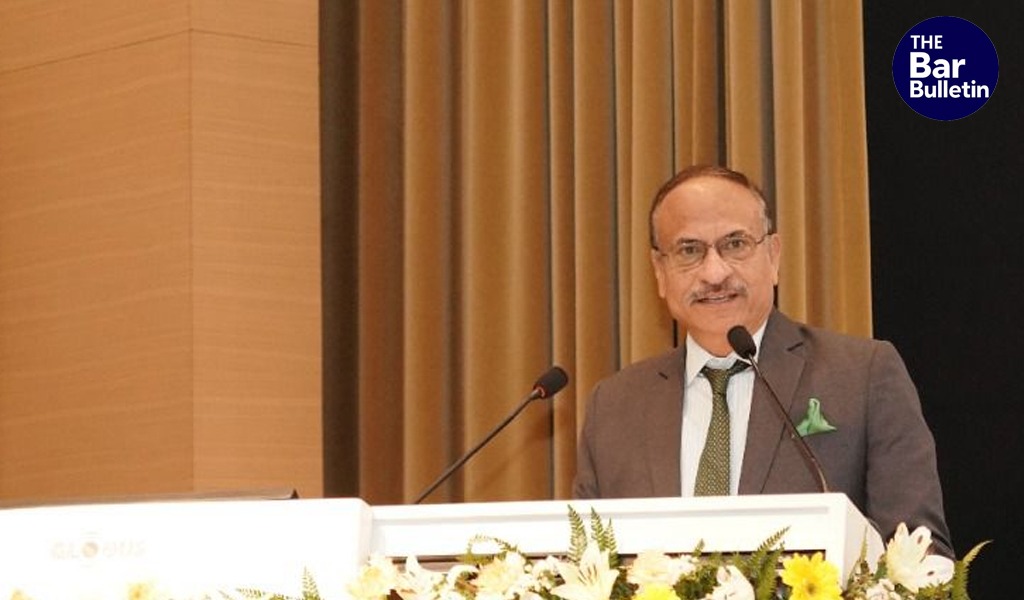

Delivering a keynote address at the India International Disputes Week 2026, Mr Chawla, Secretary General of the Indian Council of Arbitration, underscored the critical role of credible dispute resolution systems and strong arbitration institutions in strengthening investor confidence and supporting India’s growing economy.
Opening his remarks, Mr Chawla congratulated the organisers of IIDW, particularly CJI Surya Kant, whose vision and leadership, he said, had brought together the judiciary, arbitration institutions, practitioners and industry leaders on a common platform to deliberate on the future of dispute resolution in India. He also acknowledged the support and encouragement of Justice Sheel Nagu, noting that judicial engagement plays a vital role in strengthening institutional dispute resolution mechanisms.
Mr Chawla emphasised that IIDW represents more than a series of discussions on arbitration; rather, it reflects India’s growing commitment to strengthening the institutional architecture that underpins commercial activity, investor confidence and the rule of law. He observed that the development of a robust arbitration ecosystem requires close collaboration among courts, arbitral institutions, legal professionals and industry stakeholders.
To illustrate the importance of dispute resolution in investment decisions, Mr Chawla recounted an instance of an international infrastructure investor who chose to invest in one Asian country over another not because of tax incentives or market size, but because the investor believed that any dispute would be resolved fairly and efficiently in that jurisdiction. The anecdote, he noted, highlights a fundamental reality of modern economies investors value credible justice systems as much as economic opportunity.
Placing arbitration in the global context, Mr Chawla observed that international trade now exceeds USD 30 trillion, with cross-border investments and large infrastructure projects involving multiple jurisdictions and stakeholders. In such an interconnected economic environment, disputes are inevitable, making arbitration the preferred mechanism for resolving complex commercial disagreements. Referring to global arbitration surveys, he noted that more than 90 per cent of international commercial contracts today contain arbitration clauses, with businesses valuing neutrality, enforceability and procedural flexibility.
Turning to India’s economic trajectory, Mr Chawla noted that the country is currently among the world’s largest economies and is expected to become the third-largest global economy in the coming years. With foreign direct investment continuing to grow and India emerging as a major destination for global supply chains, the volume and complexity of commercial disputes are also likely to increase. The key question, he said, is whether India can build a dispute resolution ecosystem that inspires confidence among global investors.
Tracing the evolution of arbitration in India, Mr Chawla explained that arbitration practice in the country was earlier largely ad hoc in nature, with parties appointing arbitrators themselves and determining procedures. While this offered flexibility, it often lacked procedural structure. A major turning point came with the Arbitration and Conciliation Act, 1996, which aligned India with internationally recognised arbitration frameworks. Subsequent legislative reforms and a more arbitration-supportive judicial approach have further strengthened India’s arbitration landscape.
However, Mr Chawla stressed that legislation alone cannot transform arbitration systems. Successful arbitration jurisdictions such as Singapore, London and Paris have built their reputations on the strength of credible arbitral institutions that provide professional case administration, transparent procedures and predictable timelines.
Highlighting the role of the Indian Council of Arbitration, Mr Chawla noted that since its establishment in 1965, the institution has worked to promote institutional arbitration and build confidence among businesses, legal professionals and policymakers in structured arbitration frameworks.
Mr Chawla also addressed the continuing debate between ad hoc arbitration and institutional arbitration. While ad hoc arbitration provides flexibility, he noted that as disputes become more complex particularly in infrastructure and cross-border transactions institutional arbitration offers significant advantages, including structured procedures, administrative support, cost transparency and effective case management.
He further emphasised that the development of a robust dispute resolution ecosystem requires highly skilled arbitrators, specialised legal professionals, effective judicial support and strong engagement with international arbitration practices. Expanding arbitration infrastructure beyond major metropolitan centres is equally important, he said, as commercial disputes arise wherever economic activity takes place.
In this context, Mr Chawla welcomed initiatives such as the Chandigarh International Arbitration Centre, describing it as a significant step in strengthening institutional arbitration in North India. Regional arbitration centres, he noted, complement national institutions and contribute to the development of a broader arbitration ecosystem across the country.
Looking ahead, Mr Chawla highlighted the growing influence of technology in dispute resolution, including the use of artificial intelligence in legal research, digital platforms for remote hearings and electronic management of evidence. While these innovations can significantly enhance efficiency and accessibility, he cautioned that they must be used responsibly with appropriate safeguards to ensure transparency, confidentiality and fairness.
Mr Chawla also stressed the need to build greater capacity within the arbitration ecosystem, including the training of arbitrators, arbitration lawyers, technical experts, forensic specialists, case administrators and other professionals. Universities, bar associations and arbitration institutions must work together, he said, to develop a strong pipeline of arbitration professionals.
Another important development, he noted, is the emergence of specialised arbitration bars in leading arbitration jurisdictions, where legal professionals focus primarily on arbitration practice. Encouraging similar specialisation in India could further strengthen professional standards and procedural efficiency.
Mr Chawla also referred to the work of the United Nations Commission on International Trade Law, which has played a foundational role in shaping global arbitration through instruments such as the UNCITRAL Model Law on International Commercial Arbitration, adopted in numerous jurisdictions including India. UNCITRAL’s initiatives on online dispute resolution further demonstrate how technology can help address the evolving needs of global commerce.
He observed that digital platforms for filing documents, conducting remote hearings and managing case records can significantly reduce costs and make arbitration more accessible particularly for micro, small and medium enterprises that may not have the resources to pursue lengthy litigation.
Concluding his address, Mr Chawla noted that India possesses several advantages as a potential global arbitration hub, including a respected judiciary, a sophisticated legal profession and a rapidly expanding economy. However, he emphasised that the next phase of India’s arbitration journey will depend on sustained focus on institutional development, professional training, international collaboration and technological innovation.
“Economic growth requires legal certainty, and legal certainty requires credible dispute resolution institutions,” Mr Chawla said. “Investment follows opportunity, but long-term investment follows trust and trust begins with a reliable dispute resolution system.”
He added that events such as India International Disputes Week play an important role in bringing together the judiciary, arbitration institutions and practitioners to collectively shape the future of dispute resolution in India.