


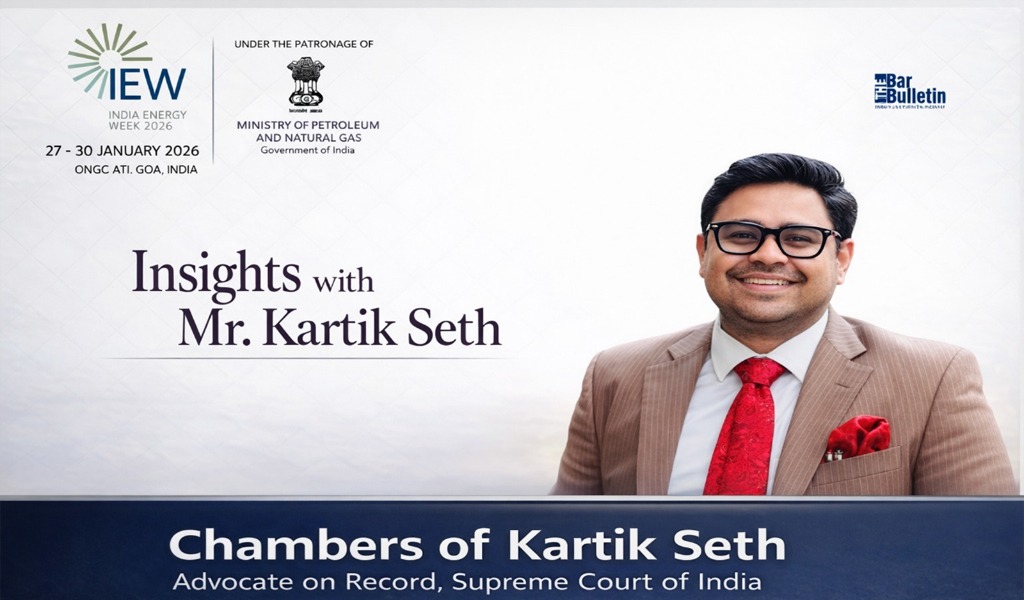

Mr. Kartik Seth offers a succinct summary of the structure of India’s energy sector, highlighting his involvement and insights gained from participating as a strategic speaker at the recent India Energy Week conference.
Q1: What is India Energy Week?
A: India Energy Week is a strategic platform that assembles policymakers, regulators, multinational energy majors, public sector undertakings, private developers, and global investors to discuss and shape India’s energy future. Held in Goa from 27-30 January 2026, it brings competing interests state and central governments, electricity producers and distributors, fossil fuel and renewable energy advocates under one framework designed for consensus-building on India’s energy policy.
Q2: How is IEW different from traditional energy conferences?
A: Traditional energy conferences emphasise technology, market analysis, and networking. In contrast, IEW serves as a policy-making forum, bringing together global energy leaders and regulators to create actionable frameworks for India’s energy transformation, moving beyond typical business practices.
Q3: How are you associated with India’s energy sector as a lawyer, and what was your experience as a strategic speaker at IEW 2026?
A: I am deeply grateful to Shri Hardeep Singh Puri, the Hon’ble Union Minister for Petroleum and Natural Gas, for providing me this opportunity to speak at India Energy Week 2026. It has been an honour to share my perspective on this prestigious platform. I represent public sector undertakings and private energy companies in arbitration proceedings, as well as before the Hon’ble Supreme Court, High Courts, APTEL, and state electricity regulatory commissions. I handle disputes between distribution companies, generation companies, and transmission operators, disputes involving power purchase agreements, electricity pricing, coal supply defaults, and grid management. Several of the companies I represent are speakers at IEW 2026. Over more than a decade of practice, I’ve witnessed India’s energy sector undergo dramatic transformation, which I was honoured to share with the energy community at IEW.
Q4: Why is legal expertise critical in energy transformation?
A: Policy announcements and capital allocation are starting points, not solutions. Energy projects require clear contracts, robust regulatory frameworks, and efficient dispute resolution mechanisms. Without legal architecture, energy transformation becomes aspirational rhetoric. With it, transformation becomes achievable and enforceable. Law is not a constraint, it’s the scaffolding upon which energy security is built.
Q5: What are the persistent disputes that slow energy sector growth?
A: Three main dispute types persist: tariff design disagreements, power purchase agreement (PPA) interpretation issues, and transmission versus distribution grid responsibilities. These cases are complex, often requiring arbitration for technical expertise over court proceedings.
Q6: How does arbitration function as the primary dispute resolution mechanism?
A: Arbitration is preferred in energy disputes due to the expertise of arbitrators and confidentiality, but it is costly, time-consuming, and does not establish binding precedents, leading to regulatory inconsistency. Enforcement against government entities is challenging, and high costs often exclude smaller developers.
Q7: How does legal certainty attract investment in energy projects?
A: Investors make capital allocation decisions based on risk-adjusted returns. Legal certainty reduces risk. When tariff methodologies are transparent, contractual terms are standardized, arbitration awards are enforced swiftly, and regulatory determinations are consistent, investors perceive lower political and regulatory risk. This translates directly to lower risk premiums, faster project commissioning, and higher financing availability. Conversely, regulatory unpredictability, delayed award enforcement, and inconsistent contract interpretation deter investment and slow execution. In the energy sector, where projects require long-term capital commitments, legal certainty determines whether capital flows to India or elsewhere.
Q8: What emerging energy domains require new legal expertise?
A: Several critical areas are emerging: legal frameworks for deepwater oil exploration, IP and technology transfer for green hydrogen, new tariffs for energy storage, safety and liability in nuclear energy, maritime law for offshore wind, and contractual issues arising from AI and blockchain in energy systems. The legal profession must quickly build expertise in these evolving fields.
Q9: How should lawyers engage with India’s energy sector transformation?
A: Lawyers should transition from transactional roles to strategic advisors by specialising in energy law, arbitration, and regulatory processes. They must engage with regulatory bodies, participate in industry forums, and prioritise dispute prevention through clear contracts and proactive risk management, focusing their expertise at both policy and contracting stages.
Q10: What does India’s energy security depend on from a legal perspective?
A: India’s energy security hinges on: (1) robust contracts and effective arbitration for supply security in emerging areas like deepwater, renewables, hydrogen, and nuclear; (2) equitable arbitration access for all market players; and (3) advanced international arbitration expertise for strategic security. Legal clarity and efficient dispute resolution will shape India’s energy leadership in the coming decade.