


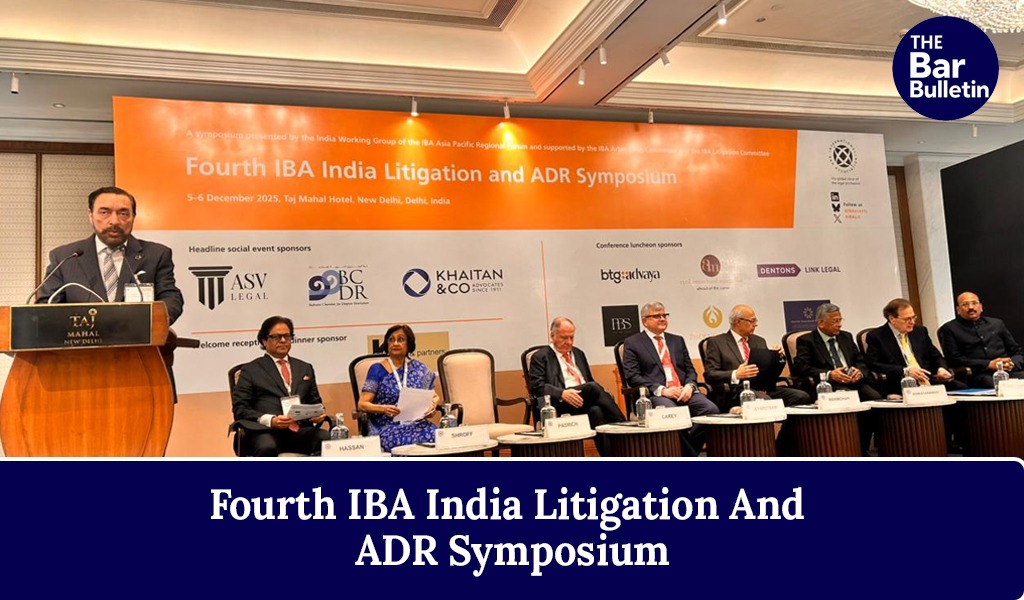

The International Bar Association’s (IBA) India Litigation and ADR Symposium opened in New Delhi with a powerful message i.e. India is no longer a participant in the global legal conversation, it is helping to shape it. The inaugural session brought together leading judges, international jurists, senior advocates, in-house counsel, academics and global legal policymakers to engage on the future of dispute resolution, arbitration, and the rule of law in an increasingly complex world.
Welcoming the gathering, Nusrat Hasan, Co-Chair of the IBA India Working Group, traced the history and growing influence of the International Bar Association. Established in 1947 in an era of post-war rebuilding, the IBA today connects more than 80,000 lawyers and 190 bar associations across 170 countries. Recalling his own 25-year association with the IBA, he credited the organisation for shaping the outlook of young practitioners and providing unparalleled access to global legal discourse.
Addressing the gathering next, Ms Pallavi Shroff, Co-Chair of the IBA India Working Group, provided a detailed overview of the Working Group’s structure, mandate and impact. Established in 2016, the Group functions as a strategic advisory and implementation body under the Asia Pacific Regional Forum of the IBA. With a membership of approximately 40 carefully selected professionals, the IWG plays a pivotal role in organising conferences, policy engagements, legal education initiatives and collaborative projects with governmental institutions, bar councils, chambers of commerce and international legal bodies.
Mr Amir Pasrich, Advocate and senior office-bearer within the IBA, formally welcomed Jaime Carey, President of the International Bar Association, as Guest of Honour. He also announced a landmark policy shift approved by the IBA Management Board i.e. a 40% membership discount for developing countries including India, Nepal and several African and Asian nations. This measure, he noted, is aimed at broadening participation and making the organisation more inclusive, enabling greater representation from emerging legal markets.
Delivering his special address, IBA President Jaime Carey expressed admiration for India’s transformation and its growing influence in the global legal and economic order. He reaffirmed the IBA’s commitment to strengthening its engagement with Asia and Africa and revealed ongoing discussions with Indian bar leaders to potentially host a major IBA conference in India in the coming years.
Carey also outlined one of his foremost priorities, the creation of an IBA AI Institute. Recognising IBA’s emerging global role in shaping ethical and regulatory frameworks around artificial intelligence, he announced plans to invest in high-level technical leadership to enable the association to lead international conversations on AI governance, legal standards and ethical deployment.
A highlight of the session was a powerful questionnaire round and Justice Manmohan, who responded to a question on Indian Supreme Court judgments that have shaped global legal thinking. He referenced the landmark 1973 judgment in Kesavananda Bharati v. State of Kerala, which propounded the “Basic Structure Doctrine”. He explained how the doctrine preserved the supremacy of the Constitution while limiting Parliament’s power to amend its foundational values including rule of law, separation of powers and judicial independence.
Justice Manmohan observed that the doctrine has since been adopted or debated in several jurisdictions including Pakistan, Bangladesh, Malaysia and Taiwan, and credited it for safeguarding Indian democracy for over 75 years. He further connected the doctrine to investor confidence, noting that the assurance of an independent judiciary and constitutional continuity is vital for commercial stability. He also referenced the Supreme Court’s recent Electoral Bonds judgment as another example of the rule of law in action, reinforcing the public’s right to transparency in political funding.
Adding a constitutional and philosophical dimension to the discussion, R. Venkataramani, Attorney General for India, noted that access to justice is integral to social, economic and political order. He argued that in an increasingly interconnected world, legal systems must evolve beyond rigid, inherited models and develop institutional mechanisms that genuinely serve every cross-section of society.
Calling for bold and innovative reforms, he advocated moving away from strictly adversarial frameworks and promoting a nationwide culture of mediation and arbitration beyond purely commercial disputes. He emphasised that access to justice is meaningful not merely through availability, but through the State’s ability to build accountable, efficient, and inclusive institutions. Recounting his own role in advancing the right to education through constitutional litigation, he reminded the audience that transformational change often begins with a single question: “What have I done today to strengthen access to justice and equality in my country?”
Providing an international historical perspective, Peter Goldsmith reflected on the evolution of the rule of law in common law systems. Tracing its roots to the Magna Carta and later constitutional developments, he noted that while the document itself emerged from a dispute between power and privilege, it eventually formed the foundation for modern human rights jurisprudence across jurisdictions.
Goldsmith emphasised that the most fundamental aspect of the rule of law is that even the most powerful authority is subject to the law. However, he offered a crucial distinction, the rule of law must not be confused with “rule by law”, where oppressive or authoritarian regimes legitimise injustice through legislation. He also warned that rule of law is not “rule by lawyers”, underscoring the balance that must exist between legal interpretation, democratic legitimacy and governance.
Further deepening the Indian constitutional narrative, Dr Rajiv Mani reflected on India’s civilisational roots in the concept of “Dharma”, righteous conduct which he described as the true philosophical bedrock of the rule of law in India. He explained that the Indian Constitution seamlessly integrates this moral tradition through its Preamble, Fundamental Rights and Directive Principles.
Highlighting over 106 constitutional amendments in 75 years, Dr Mani described the Constitution as both resilient and dynamic. He noted that doctrines such as the Basic Structure principle, judicial review and an independent judiciary have preserved democratic values while ensuring adaptability to changing times. Referring to the 106th Constitutional Amendment reserving one-third of seats for women, he identified inclusivity as a defining strength of India’s democracy. He added that consistent legal reforms, particularly over the past decade, demonstrate India’s readiness to meet the constitutional, economic and governance challenges of the future.
Adding an international comparative perspective, Philip Jeyaretnam, Senior judge of the Singapore International Commercial Court (SICC), explained that commercial disputes generally fall into three categories domestic disputes governed by a country’s own laws, investor–host country disputes involving foreign entities, and cross-border disputes between parties from different jurisdictions seeking a neutral forum. It is in this third category, he said, that the SICC plays a critical role. Designed as an international, neutral court for global business disputes with no direct connection to Singapore other than choice of forum, the SICC serves as a trusted platform for resolving transnational commercial conflicts with fairness and consistency.
He further highlighted that the SICC strengthens the global rule of law by acting as the supervisory court for Singapore-seated arbitrations, offering an effective judicial alternative to arbitration, and contributing to the development of transparent, published and reasoned jurisprudence in cross-border commercial matters. He also noted the growing convergence between civil law and common law systems, combining strong case management with robust fact-finding. Sharing personal observations from a recent visit, he expressed admiration for the scale and efficiency of the Delhi High Court and extended an invitation to the legal community to reconvene in Singapore in 2027 for the IBA conference.
The inaugural session set the tone for a two-day programme featuring expert panels on white collar crime, arbitration reforms, technology law, AI governance, data protection, intellectual property, and the future architecture of dispute resolution in India and beyond.