


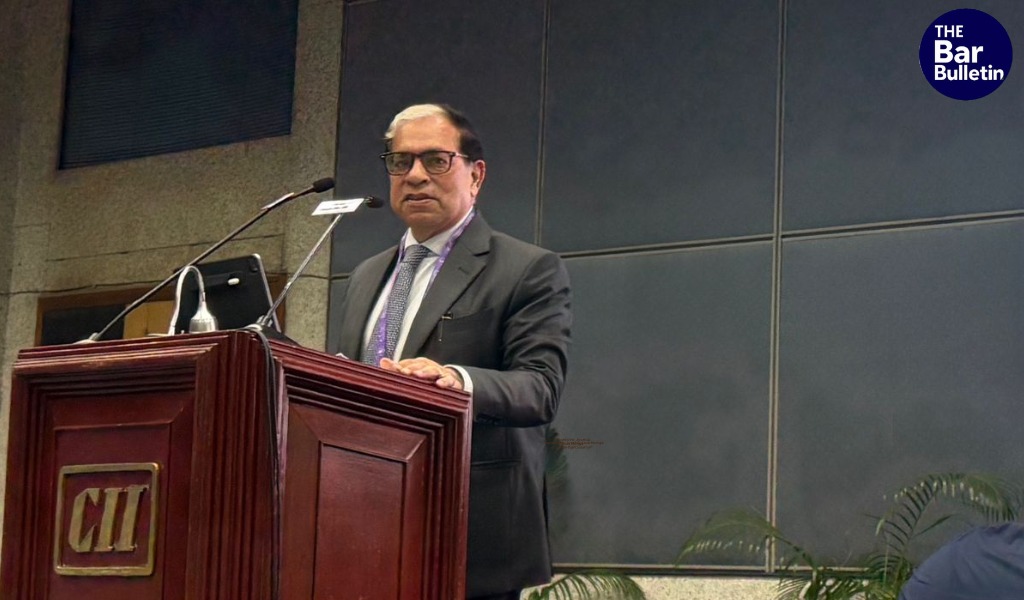

India must position itself as a trusted global “safe harbour” for resolving international commercial disputes in an increasingly uncertain geopolitical and economic environment, Justice Arjan Kumar Sikri said while delivering the keynote address on Day 4 of India International Disputes Week at the Confederation of Indian Industry (CII).
Justice Sikri, an International Judge at the Singapore International Commercial Court, addressed legal professionals, industry representatives, and students, emphasizing that the future of global commerce depends heavily on credible, neutral, and efficient dispute-resolution systems. He noted that as capital, technology, and businesses increasingly move across borders, disputes are inevitable, making robust international legal mechanisms essential for economic stability and investor confidence.
Highlighting India’s ambition to emerge as a major centre for international arbitration, Justice Sikri said the country possesses immense potential but must strengthen institutional frameworks, procedural efficiency, and professional discipline to attract global disputes. He observed that arbitration and mediation have traditionally served as preferred alternatives to courts in cross-border commercial matters due to party autonomy, confidentiality, flexibility, and the ability to appoint subject-matter experts. However, he candidly acknowledged that modern arbitration is facing growing criticism worldwide for rising costs, delays, voluminous documentation, and concerns regarding impartiality, causing parties to reconsider traditional dispute-resolution choices.
Justice Sikri explained that these developments have led to the rapid emergence of international commercial courts, which seek to combine the flexibility of arbitration with the authority and safeguards of judicial systems. Drawing from his experience at the Singapore International Commercial Court, he described how such forums offer international benches, allow foreign lawyers to appear, apply laws chosen by parties, and adopt arbitration-style case management while retaining appellate review and precedent-building functions. Unlike arbitral awards, he noted, judicial decisions contribute to the development of global commercial jurisprudence, thereby enhancing predictability in international business relations.
He further linked the rise of new dispute-resolution models to shifting geopolitical realities, global conflicts, and changing trade alignments, observing that businesses and wealthy families are increasingly relocating investments to jurisdictions offering strong rule of law and legal certainty. In this context, he stressed that countries able to provide reliable dispute-resolution ecosystems will attract investment and commercial confidence in the coming decades.
Justice Sikri also noted the need for greater professionalism in arbitration practice in India, urging stakeholders to adopt strict timelines and structured case management systems commonly followed in leading international forums, where procedural schedules are fixed at the outset and adjournments are rarely permitted. Such efficiency, he said, is critical if India seeks to compete with established global arbitration centres.