


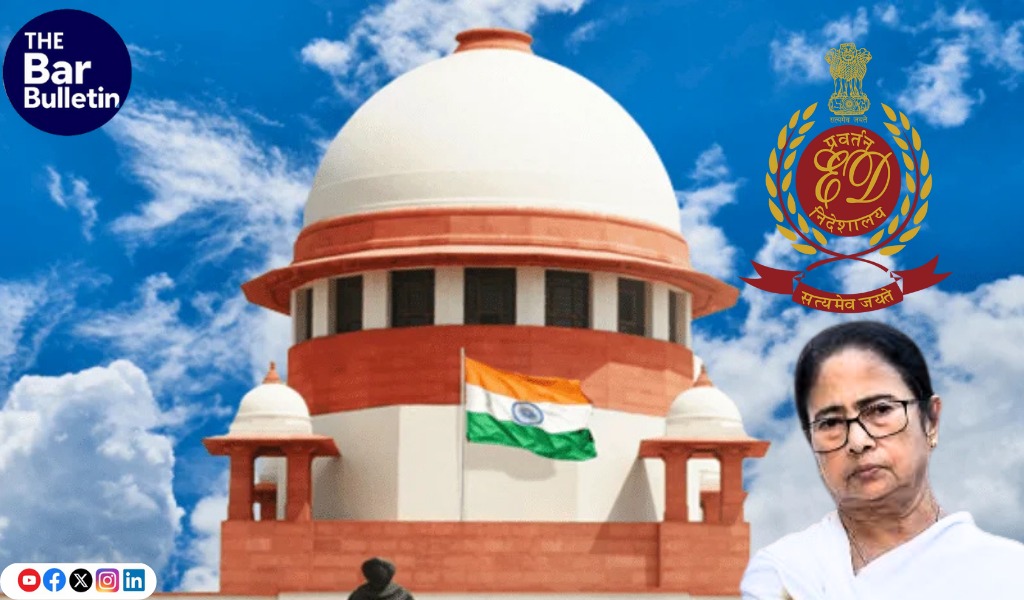

The Supreme Court today heard extensive submissions in a writ petition filed by the Enforcement Directorate under Article 32 of the Constitution, alleging obstruction during a search conducted at the Kolkata office of the Indian Political Action Committee (I-PAC).
Appearing for the Enforcement Directorate, Solicitor General Tushar Mehta submitted that ED officers exercising powers under Section 17 of the Prevention of Money Laundering Act (PMLA) were obstructed during the search. It was alleged that senior State police officials accompanied Chief Minister Mamata Banerjee to the premises, resulting in the removal of material collected during the operation. It was contended that the presence of uniformed police officers alongside political leaders amounted to abetment of offences and seriously compromised the independence of the agency.
The ED further alleged that documents and even mobile phones belonging to ED officials were taken away during the incident, and argued that such actions demoralised the central agency and undermined the statutory scheme of the PMLA. Relying on Section 54 of the PMLA, the Solicitor General submitted that police officers are statutorily bound to assist enforcement authorities and not impede them.
Maintainability of the Petition
The Enforcement Directorate argued that its writ petition under Article 32 was maintainable in the present facts, contending that the matter involved violations of the fundamental rights of ED officers and serious interference with the discharge of statutory functions under the Prevention of Money Laundering Act.
The ED submitted that the circumstances were extraordinary and exceptional, warranting direct intervention by the Supreme Court. It relied on earlier incidents of alleged obstruction of central agencies in the State to argue that effective relief could not be secured at the High Court level. The ED also pointed to the disruption of proceedings before the Calcutta High Court on an earlier date, where the High Court itself recorded that a large gathering inside the courtroom prevented the hearing of the matter. Reliance was placed on judicial orders recording disturbances in court proceedings, as well as WhatsApp messages allegedly calling party members and lawyers to assemble in court.
It was further argued that where allegations involve high constitutional functionaries and senior police officials, the Supreme Court can exercise jurisdiction directly under Article 32, particularly where there is an apprehension that an investigation by local authorities would not be independent or effective.
Opposing the plea, senior advocate Kapil Sibal, appearing for the State and the Chief Minister, submitted that the petition was not maintainable under Article 32, contending that the High Court was already seized of the matter under Article 226 and had jurisdiction to adjudicate the issues. It was argued that the hierarchy of courts must be respected and that there was no basis to assume that the High Court could not hear the matter.
Counsel further submitted that a hearing had taken place before the High Court peacefully on the previous day, and that the ED itself had sought an adjournment on the ground that proceedings were pending before the Supreme Court. It was also contended that the allegations regarding the removal of documents were incorrect and contradicted by the ED’s own panchnama, and that statutory safeguards under the Bharatiya Nagarik Suraksha Sanhita required audio-video recording of search proceedings.
Interim Directions by the Court
After hearing the parties at length, the Bench of Justice Prashant Kumar Mishra and Justice Vipul M. Pancholi observed that the petitions raised “serious issues” concerning interference with investigations conducted by central agencies and the functioning of State authorities, which required examination. The Court noted that larger questions relating to the rule of law and the independence of investigative agencies were involved.
The Supreme Court issued notice to the respondents and directed that replies be filed within two weeks. The matter has been listed for further hearing on 3 February 2026.
In the meantime, the Court directed that:
• CCTV cameras and storage devices containing footage of the premises searched on 8 January 2026, as well as footage of nearby areas, shall be preserved.
• Further proceedings and investigations pursuant to four FIRs against ED officers shall remain stayed until the next date of hearing.
The Court clarified that the stay was limited to the FIRs specifically referred to and was not a blanket order. No orders were passed at this stage on the ED’s prayer seeking suspension of police officers, with the Court indicating that the issue would be considered after replies are filed.
Appearances
For the Enforcement Directorate: SG Tushar Mehta, ASG R. Raju
For the State and others: Senior Advocates Kapil Sibal, Abhishek Singhvi, and Shyam Divan