


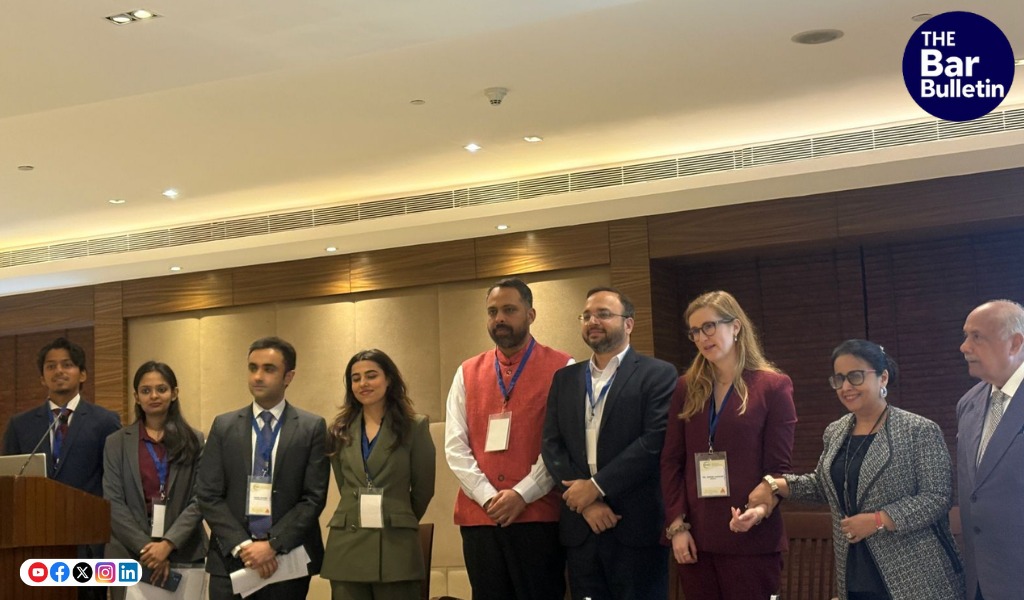

The Inter-Pacific Bar Association (IPBA) Young Lawyers’ Symposium & Open House was held at The Lalit Hotel, New Delhi, bringing together lawyers, students, and practitioners to reflect on the evolving opportunities and challenges in building cross-border legal practices. The symposium, themed “From Practitioner to Professional: Opportunities and Challenges for Young Lawyers in Developing a Cross-Border Practice,” created a platform for candid conversations on professional growth, international exposure, and the realities of practice-building beyond doctrinal expertise.
The event opened with welcome remarks by Ms. Aaliya Waziri, Advocate, Delhi High Court, followed by a keynote address by Dr. Lalit Bhasin, President of the Society of Indian Law Firms and former President of IPBA. In his address, Dr. Bhasin traced the evolution of the Indian legal profession and reaffirmed that law remains, at its core, a profession rooted in merit, competence, and service. Cautioning against viewing legal practice purely through a commercial lens, he urged young lawyers to remain committed to professional ethics, hard work, and public service, observing that recognition and opportunity inevitably follow sustained merit.
The first technical session focused on how young lawyers can engage meaningfully with international platforms and navigate global legal conferencing. Moderated by Ankit Khushu, Partner at Kachwaha & Partners, the session featured Arush Khanna, Partner at Numen Law Offices, Abhishek Saxena, and Philippe Harles, Partner at Arendt & Medernach, Luxembourg. Setting the context, Ankit Khushu described IPBA as having developed a distinctive culture marked by openness, accessibility, and a strong sense of community. He noted that unlike many large international conferences driven by overt marketing, IPBA fosters a family-like environment where professional relationships are built through sustained interaction. Drawing from experience, she observed that consistent participation over the years enables lawyers to develop trusted networks across jurisdictions, allowing seamless referrals, arbitrator recommendations, and cross-border collaboration.
Reflecting on how young lawyers can stand out within large international organisations, Arush Khanna cautioned against a “spray and pray” approach to conferencing. Recalling his own early experiences, he noted that attending conferences without preparation or clarity of purpose often yields limited long-term value. According to him, meaningful engagement begins with understanding an organisation’s structure, particularly its committee-driven framework. He advised young lawyers to identify committees aligned with their interests, proactively seek opportunities to contribute, and remain consistent over time. Leadership, he explained, is built gradually through visible commitment rather than isolated participation. Mr Khanna emphasised that international conferencing is a long-term investment that matures over years, urging patience even when early efforts appear unrewarding.
Addressing the practical realities of sustained international engagement, Abhishek Saxena spoke about the demanding nature of global conferences and the pressure of balancing travel with active legal practice. He stressed that clients do not view conference attendance as a justification for reduced responsiveness and that expectations remain unchanged regardless of location or time zone. Mr Saxena highlighted the importance of advance planning, delegation, and transparent communication with clients, noting that reliability and organisation are essential to maintaining credibility. Sharing an anecdote from an overseas transaction handled during a conference, he illustrated how coordinated teamwork across jurisdictions ensured uninterrupted service delivery. He also observed that accelerated professional growth is possible through focused effort, remarking that intensive learning and responsibility can compress years of experience into a shorter timeframe.
Philippe Harles offered a complementary perspective, emphasising the need for balance and selectivity. He noted that early conference experiences often lead young lawyers to attempt to attend every session and event, an approach he described as unsustainable. According to Mr Harles, professional maturity involves choosing engagements carefully and being fully present in each interaction. He cautioned that divided attention undermines authentic connection and advised young lawyers to alternate consciously between focused networking and dedicated work time. Summing up his approach, he remarked that in international conferencing, “less is more.”
Returning to the broader question of why young lawyers should consider IPBA as a starting point for international engagement, the speakers highlighted the organisation’s global yet non-practice-specific character. Arush Khanna noted that some of the most valuable referrals and relationships developed through IPBA were outside his primary practice area, reinforcing the importance of cross-practice engagement. Philippe Harles echoed this view, describing IPBA’s compact format and relationship-driven environment as particularly conducive to building lasting professional bonds. Abhishek Saxena reflected on IPBA as his first international conference experience, noting that its manageable scale and concentrated duration allow participants to balance learning, networking, and client responsibilities effectively.
The symposium also featured a special address by Itzik Amiel, growth strategies expert and author of The SWITCH, titled “Build It Before You Need It: The 3 Pillars Every Young Lawyer Must Master to Accelerate Growth, Opportunity, and Influence.” Addressing young lawyers and students, Mr Amiel highlighted a gap in legal education, observing that while competence and hard work are essential, they alone do not build a sustainable practice. He emphasised that relationships, trust, and visibility developed early and nurtured consistently play a decisive role in professional growth, particularly in cross-border contexts. Urging young lawyers not to wait for seniority or the “right time,” he stressed the importance of demonstrating value, following up on relationships, and grounding visibility in genuine competence.
Session II, titled “Building Your Book: How to Win Business and Influence People!” brought the conversation closer to the realities of practice development. Moderated by Ms. Aaliya Waziri, the panel featured Shashank Garg, Senior Advocate; Janine Haesler, Managing Associate at VISCHER, Zurich; Sujoy Bhatia, Managing Partner at Chandhiok & Mahajan; and Shilpa Bhasin Mehra, senior legal counsel and board-level legal leader based in Dubai. Setting the tone, Ms Waziri observed that while career trajectories are central to a lawyer’s professional life, the mechanics of building a practice are rarely addressed in formal training, often leaving young lawyers unprepared for questions of visibility and credibility.
Reflecting on his early years in independent practice, Shashank Garg shared that stepping out on his own made business development unavoidable. While confidence in legal ability was essential, he noted that trust takes time to build, particularly for young teams. He described early initiatives focused on creating forums for meaningful engagement, including conferences held in collaboration with academic institutions. However, he cautioned against expecting immediate results, observing that some relationships took several years to translate into instructions. According to him, patience, sincerity, and allowing relationships to evolve organically are indispensable.
Janine Haesler offered an international perspective, noting that while young lawyers in large firms can initially focus on technical work, they are eventually required to articulate what distinguishes them professionally. She emphasised that trust in cross-border work is built not only on competence but also on consistency, commitment, and reliability. She added that association with senior practitioners or institutions can help establish initial credibility, which must then be reinforced through sustained performance.
Sujoy Bhatia highlighted that sincerity and dependability often matter as much as expertise in cross-border instructions. He observed that repeat international work frequently emerges from associate-level interactions rather than formal networking, with trust developing through everyday professional conduct such as responsiveness, clarity, and reliability. Shilpa Bhasin Mehra cautioned against prioritising visibility over substance, stressing that credibility follows track record, not publicity. On social media, she identified LinkedIn as a useful platform for young lawyers when used to contribute ideas and add value rather than merely showcase achievements.
The symposium concluded with a vote of thanks by Mr Arush Khanna.