


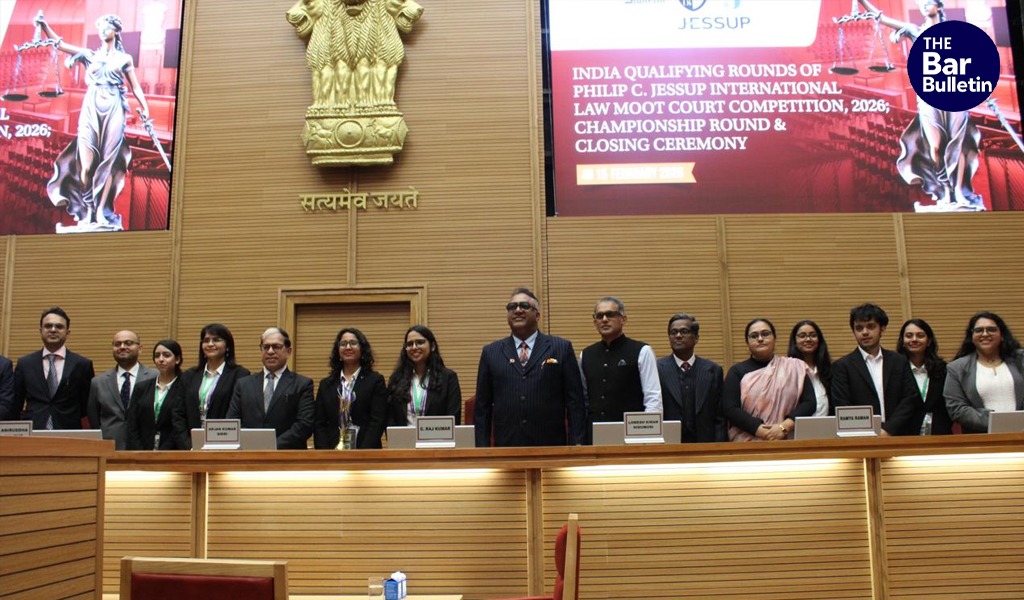
The Nyāyābhyāsa Maṇḍapam, IMAANDAAR, at OP Jindal Global University, with remnants of the applause from the opening ceremony, hosted the closing ceremony of the India Qualifying Rounds of the Philip C. Jessup International Law Moot Court Competition.
Over four days, 65 teams from across India and Bhutan tested a problem that traversed indigenous rights, resource extraction, sovereignty, and state responsibility. If the opening ceremony had framed Jessup as an act of faith in international law, the closing ceremony insisted that such faith must be earned through rigour, humility, and institutional discipline.
The Vice-Chancellor, C. Raj Kumar, reminded the audience of the institutional project behind the evening, i.e., JGU’s investment in advocacy infrastructure and the civic imagination that gave rise to the Nyayabhyasa Maṇḍapam and urged students to carry their Jessup training into careers that strengthen law and institutions.
Justice A.K. Sikri: On Constitutional Morality and the Discipline of Argument
Justice A.K. Sikri’s address at the closing ceremony carried the unmistakable cadence of a jurist who has spent decades at the intersection of constitutional principle and lived consequence. Speaking to a hall still charged from the final round, he drew a careful line between advocacy as performance and advocacy as responsibility. Mooting, he observed, is not about eloquence alone, but it is about disciplined thinking, fidelity to precedent, and intellectual honesty before the Bench.
He reminded participants that the rule of law is sustained not by abstract reverence but by daily acts of reasoning. Courts operate within institutional constraints, and judges do not pronounce personal morality but interpret constitutional morality. It is here, he suggested, that mooters must locate their craft, in the ability to distinguish between what the law is, what it ought to be, and how far a court can legitimately travel in bridging that distance.
Justice Sikri also emphasised balance. He noted that a good advocate must anticipate the court’s anxiety. International law disputes, particularly those concerning sovereignty, indigenous rights, and state responsibility, are rarely binary. They demand nuance. They demand respect for competing claims. And they demand, above all, civility. He urged students to remember that persuasion in a courtroom is built not through aggression but through clarity and restraint. He concluded that winning a moot is momentary; learning to think like a lawyer is enduring. The Jessup problem, he added, asks students to confront tensions that real judges wrestle with, i.e., development v/s dignity and power v/s principle. If mooters leave with sharper reasoning and a deeper respect for institutional limits, then the competition has succeeded.
Sreejith S. G.: On Community, Gratitude, and Continuity
Professor Sreejith’s words were the philosophically perfect end to the evening. Where the earlier speeches soared through doctrine and principle, his words returned to people, i.e., the students, the volunteers, the faculty, and the judges who animated the Nyayabhyasa Ma??apam over the past days.
He began by acknowledging the invisible labour behind the spectacle, which is the JGU Moot Court Society’s months of preparation, the administrative teams, the time given by judges who travelled across the country to sit through the rounds. Competitions of this scale, he observed, are sustained by collective commitment.
Turning to the participants, Professor Sreejith struck a tone of reassurance. Jessup, he said, is as much about intellectual fellowship as it is about ranking. The friendships built in corridors between rounds, the conversations after oral arguments, and the shared anxiety before results are announced, all of these are part of the pedagogy. They create a community of international lawyers who may one day face each other across real courtrooms.
He also echoed a recurring theme of the week, continuity. Each Jessup generation inherits a tradition and passes it forward. The teams that qualified for the international rounds now carry not only their institutional colours but the aspirations of a national round that has grown remarkably in depth and scale.
Mooting as civic pedagogy: the student voice
Professor Anjali Chawla, the Director of JGLS Moot Court Society and Jessup’s Indian National Administrator, spearheaded the entire competition. She urged the students to consider this experience through a civic lens by pointing to the fact that moots are a place where law must listen to history, and where competitors are asked to “remember” communities whose doctrine can be marginalised. Her remarks reframed advocacy as an act of moral imagination, not mere rhetoric. Her plea to all the teams was that they not only argue with clarity but also with “consciousness.”
Winners, honours and the path forward
Teams Qualifying for International Rounds:
1. Hidayatullah National Law University (TC 160)
2. National Law School of India University, Bengaluru (TC 193)
3. National Academy for Legal Studies and Research, Hyderabad (NALSAR) (TC 231)
4. Maharashtra National Law University, Mumbai (TC 269)
5. Jindal Global Law School (TC 374)
6. Christ University, Delhi NCR (TC 449)
7. Rajiv Gandhi National University of Law (TC 591)
8. National Law University, Delhi (TC 796)
9. Symbiosis Law School, Noida (TC 889)
• Champion of India Qualifying Rounds: Hidayatullah National Law University
• Runner Up of India Qualifying Rounds: National Academy for Legal Studies and Research, Hyderabad (NALSAR)
• Best Oralist (Championship Round): Aryan Kapoor, National Academy for Legal Studies and Research, Hyderabad (NALSAR)
• Best Memorial: Team Code: 433 (National University of Advanced Legal Studies, Kochi)
• Runner-up Best Memorial: Team Code 269 (Maharashtra National Law University, Mumbai)
• Best Oralist in Preliminary Rounds: Sriram Chockalingam Arunachalam (Team Code: 374- Jindal Global Law School)
• Runner-up Best Oralist in Preliminary Rounds: Kartik Kalra (Team Code: 193- National Law School of India University, Bengaluru)
Top 15 Oralists (based on Preliminary Rounds scores):
| # | Name | Team (#) | University |
| 1 | Sriram Chockalingam Arunachalam | 374 | Jindal Global Law School |
| 2 | Kartik Kalra | 193 | National Law School of India University, Bengaluru |
| 3 | Taniya Kedia | 411 | The West Bengal National University of Juridical Sciences |
| 4 | Aryan Kapoor | 231 | National Academy for Legal Studies and Research, Hyderabad (NALSAR) |
| 5 | Anasruta Roy | 433 | National University of Advanced Legal Studies |
| 6 | Anoushka Kothari | 193 | National Law School of India University, Bengaluru |
| 7 | Sarthak Sahoo | 591 | Rajiv Gandhi National University of Law |
| 8 | Anshu Varahagiri | 193 | National Law School of India University, Bengaluru |
| 9 | Ustat Kaur Sethi | 433 | National University of Advanced Legal Studies |
| 10 | Aayush Agarwal | 762 | CHRIST (Deemed to be University, Lavasa |
| 11 | Kusha Grover | 591 | Rajiv Gandhi National University of Law |
| 12 | Arun Raghuram Mahapatra | 591 | Rajiv Gandhi National University of Law |
| 13 | Saksham Gaikwad | 310 | National Law University, Jodhpur |
| 14 | Ayaan Ur Rehman | 367 | Christ University |
| 15 | Akshath Indusekhar | 374 | Jindal Global Law School |
Top 5 Memorials
| # | Team (#) | Institution |
| 1 | 433 | National University of Advanced Legal Studies, Kochi |
| 2 | 269 | Maharashtra National Law University, Mumbai |
| 3 | 231 | National Academy for Legal Studies and Research, Hyderabad (NALSAR) |
| 4 | 420 | Gujarat National Law University |
| 5 | 106 | Galgotias University |
The trophies will travel with teams to Washington and other international stages; the arguments will be rewritten and refined, but what the ceremony insisted upon was the work that follows the award: listening, learning, and returning to law as service. For the students who argued inside the world’s largest moot hall, that was the clearest prize of all.