


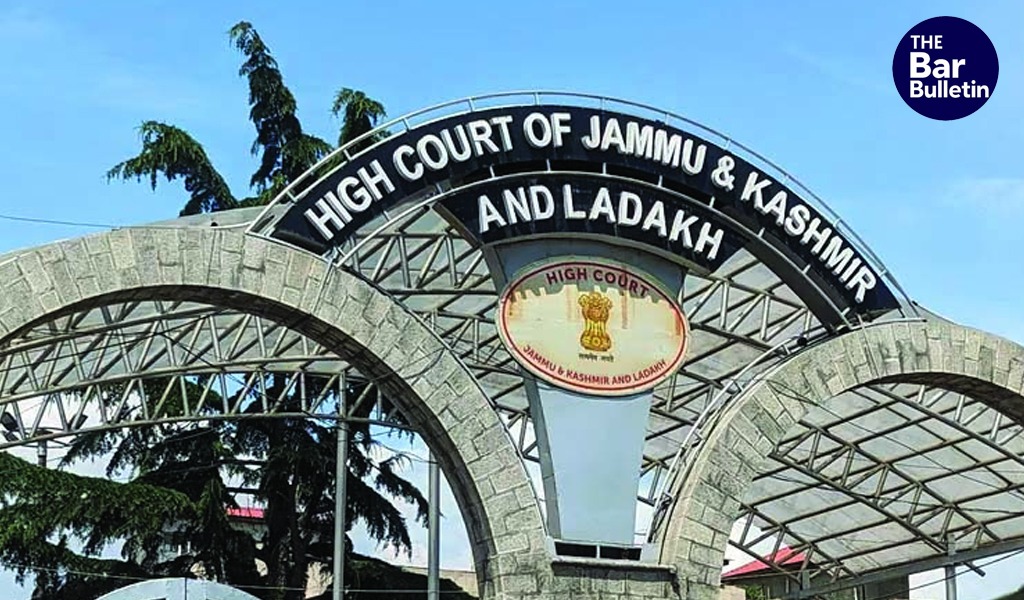
Jammu and Kashmir and Ladakh High Court dismissed the criminal appeal challenging the Special NIA Court’s order dated 27 September 2025 and refused to grant bail to the appellant on medical and humanitarian grounds.
The appellant, senior advocate Mian Abdul Qayoom, filed the appeal under Section 21 of the NIA Act against order of the Additional Sessions Judge, Jammu rejecting his medical bail application. He sought enlargement on bail solely on medical and humanitarian grounds despite being charged under Sections 16(1)(a), 18 and 38 of the Unlawful Activities (Prevention) Act, 1967 and related offences in the terrorist killing of advocate Babar Qadri. He was arrested on 25 June 2024.
The prosecution case is that the appellant, a prominent lawyer and former Bar leader, conspired with terrorists and handlers across the border to eliminate advocate Babar Qadri, whose rising popularity allegedly threatened him. The High Court had already transferred trial from Srinagar to Jammu because material witnesses and the victim’s family complained of threats, and no lawyer at Srinagar was willing to represent the complainant side, while the appellant himself was an influential advocate.
The appellant does not seek bail on merits but only on medical grounds, arguing that his age, cardiac surgery, urological and ophthalmic conditions, and frequent hospital visits (36 examinations) show a continuous need for intensive and palliative medical care (about 20 medicines daily) that cannot be met in the “restrictive and resource-constrained” jail environment, and that Article 21 requires his release on medical grounds.
The State opposed bail, asserting that he is an active conspirator and member/associate of a terrorist organisation, that his influence led to transfer of investigation to SIA and trial from Srinagar to Jammu, and that jail authorities have provided advanced treatment, including pacemaker implantation and regular specialist follow-up, with his latest report (20 October 2025) describing his condition as stable.
The Division Bench comprising Justice Sindhu Sharma and Justice Shahzad Azeem accepted that the appellant has multiple comorbidities but noted that these have been effectively managed in custody and that he failed to show any life-threatening condition that cannot be treated in jail hospitals.
In view of Section 43D(5) UAPA, the Court held that humanitarian or prolonged incarceration grounds cannot, by themselves, override the statutory embargo unless there are reasonable grounds to believe that accusations are not prima facie true or an exceptional medical case is made out. The Court concluded that palliative care is not an independent ground but a subset of medical care and that once it is found that adequate medical treatment is available and being provided in custody, neither medical nor palliative grounds justify bail.
The Court distinguished all precedents cited by the defence and noted that initial investigation and trial transfers were prompted by threats to witnesses and the victim’s family, and that releasing a historically influential Bar leader while many prosecution witnesses are yet to depose would prejudice the right to a free and fair trial.
After a balancing exercise, the Court found no reason to disturb the trial Court’s refusal of bail. The appeal was dismissed as devoid of merit, and the impugned order rejecting medical bail was affirmed.
Case referred to:
1. State of Karnataka vs Sri Darshan, 2025 SCC OnLine SC 1702
Appearances:
For the Appellant: M/s S Muralidhar & Z.A Qureshi, Sr. Advocates with Mr. Amandeep Singh, Mr. Mian Rauf Ahmed and Mr. Babar Bilal Malik, Advocates
For the Respondent-State: Mrs. Monika Kohli, Sr. AAG with Ms. Sagira Jaffar, Assisting counsel
