


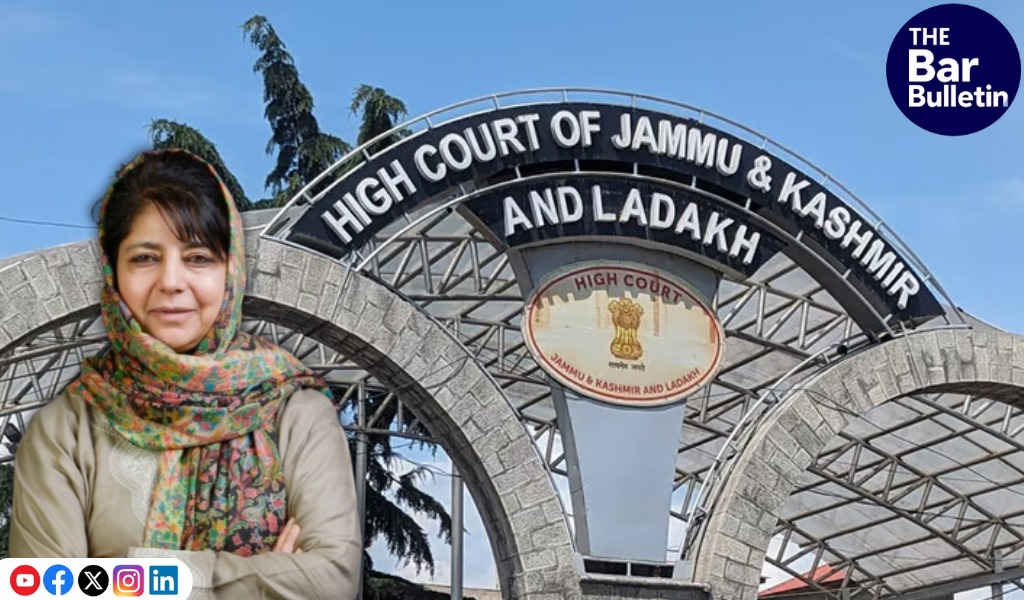

In a writ petition filed before the Jammu & Kashmir and Ladakh High Court by Mehbooba Mufti, the President of Jammu and Kashmir Peoples Democratic Party and former Chief Minister of the State, for directing the respondents to repatriate and transfer all undertrial prisoners belonging to J&K in various prisons outside the Union Territory, to jails within J&K, a Division Bench of the Chief Justice Arun Palli and Justice Rajnesh Oswal found the petition to be misconceived and dismissed the same.
Through this petition, Mehbooba Mufti also sought the framing and enforcement of an access protocol to ensure minimum weekly in-person family interviews, unrestricted privileged lawyer-client interviews, subject to reasonable regulations, and no denial on cost/escort pretexts. Directions were also sought for the Legal Service Authorities to monitor and file quarterly compliance reports. Apart from this, Mehbooba Mufti sought fixing of outer timelines for recording of evidence and preventing adjournments attributable to custody logistics, as well as the formation of a Two-member Oversight and Grievance Redressal Committee.
Mehbooba Mufti asserted that, post 05-08-2019, several residents of J&K who are facing investigation or trial are being lodged in prisons outside the Union Territory, thereby depriving them of their rights to access courts, family visits, and counsel conferences.
The Court stated that the extraordinary jurisdiction, as mentioned in People’s Union for Democratic Rights v. Union of India, AIR 1982 SC 1473, was developed by constitutional courts since they encountered situations where judicial intervention was necessary to protect the vulnerable sections of society. It was said that the tool of Public Interest Litigation (PIL) has been subject to misuse as well as abuse over time, and that litigants use it for their personal gain, vengeance, or political purposes, which are not aligned with the objectives of said extraordinary jurisdiction.
Reference was made to various decisions, and it was said that the Supreme Court had established necessary guardrails for Courts entertaining PILs, obligating them to do more than ensure that such litigations are not based on vague and general allegations. The Court stated that Mehbooba Mufti had made ‘general and vague averments’ and had miserably failed to specify the particulars of the families and undertrial prisoners whose cause was being projected by the present petition.
The Court stated that detention of undertrials in prisons outside J&K is not a universal practice, but is individual-specific. It was further said that the petition not only lacked material documents but was also ambiguous and sought to invoke writ jurisdiction based on incomplete and unsubstantiated facts, which unveiled political undercurrents in the petition.
The Court said that the petition appeared to have been initiated to gain political advantage and to position Mehbooba Mufti as a crusader of justice for a particular demographic. It was said that a PIL is not a mechanism to gain political leverage and that the Courts cannot serve as a forum for electoral campaigns.
Further, the Court observed that judicial avenues are available to such undertrials for redressal of any grievance regarding their detention, and that such an omission on their part was indicative of the fact that they are not genuinely aggrieved by their detention outside J&K. It was also said that under the framework existing under the Legal Services Authorities Act, any prisoner aggrieved by illegal State action can challenge the same and that since despite such a mechanism being in place, no one had approached the Court, Mehbooba Mufti lacked the standing to espouse her cause.
The Court held that Mehbooba Mufti’s request for omnibus directions was legally unsustainable, since no transfer orders were challenged or even brought on record for the court to consider. It was also held that Mufti was a third-party stranger to the cause, having no locus standi to invoke the Court’s jurisdiction.
The Court stated that a PIL is only maintainable for a prima facie public interest, and that where such interest is compromised, the Court must decline to interfere, since preventing the abuse of legal process is a matter of significant public interest itself. Thus, the petition was dismissed.
Appearances:
For Petitioner(s) – Mr. Aditya Gupta
For Respondent(s) – Mr. T. M. Shamsi, Mr. Faizan Majeed Ganaie, Ms. Maha Majeed, Mr. Mohsin S. Qadri, Mr. Faheem Nisar Shah
