


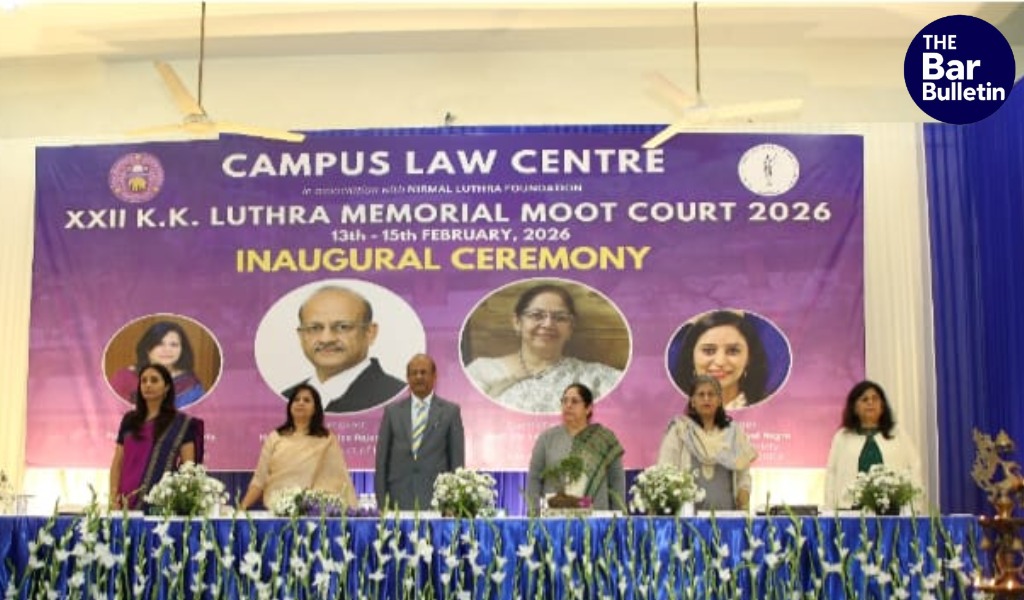

The Campus Law Centre at Delhi University in association with Nirmal Luthra Foundation proudly hosted the prestigious K.K. Luthra Memorial Moot Court Competition, commemorating its remarkable 22nd Anniversary. Established in 2005 in honour of the late Senior Advocate Mr K.K. Luthra, this distinguished event continues to inspire legal excellence.
This year, the Competition received participation from 138 institutions from India and abroad and only 72 teams were shortlisted. The 72 teams shortlisted for the Competition are from various institutions, including NLSIU, Bangalore and Symbiosis Law School, ILS Law College, Pune and National Law Institute University, Bhopal. The Competition will also have participation from international teams including, Northumbria University (United Kingdom), University of Mauritius (Mauritius), University of Zimbabwe (Zimbabwe), Tashkent State University of Law (Uzbekistan), Prithvi Narayan Campus (Tribhuvan University), Tulsipur Metro College, National Law College, Nepal Law Campus (Nepal), Bangladesh University of Business and Technology (BUBT), Independent University (Bangladesh), General Sir John Kotelawala Defence University (Sri Lanka) and University of Lagos (Nigeria)
This year’s Moot Problem invites teams to explore the criminal liability arising from interference with life supporting medical technology, and the evolving legal question surrounding AI-enabled medical devices and emergency decision-making.
The event was graced by the presence of Hon’ble Mr. Justice Rajesh Bindal, Judge, Supreme Court of India, as the Chief Guest . His participation added to the grandeur of the occasion and inspired the participants.
Hon’ble Mr. Justice Rajesh Bindal, in his speech, congratulated the Luthra family for successfully hosting the K.K. Luthra Memorial Moot Court Competition in honor of Shri K.K. Luthra for the past 22nd years. He spoke about the inspirational journey of Shri K.K. Luthra and encouraged students to learn from his legacy.
Reflecting on his time in law school, Justice Rajesh Bindal observed that moot court competitions did not exist during his student days and remarked on how fortunate present-day law students are to have access to such platforms. He emphasized that every profession requires a blend of theoretical knowledge and practical exposure, and in the legal profession, practical learning often comes much later. Moot court competitions, he noted, bridge this gap by equipping students with practical skills and preparing them for future professional challenges.
Speaking about this year’s moot problem, Justice Bindal highlighted the rapid evolution of technology, particularly in recent years with the advent of artificial intelligence, which has taken technological development in an entirely new direction. He pointed out that in comparison to other countries Indian courts have adapted to technological advancements more effectively.
Justice Bindal explained that Indian courts now routinely use live streaming, virtual courts, digital courts, e-library and e-filing systems, making the justice delivery system more accessible and convenient for both litigators and citizens. He remarked that through virtual courts, the judiciary has effectively reached the doorstep of the public, and e-courts have become the functional office of every lawyer. He also noted that digital research platforms such as e-SCR have become comprehensive repositories of Supreme Court and High Court judgments.
While acknowledging the advantages of technology, Justice Bindal also cautioned against its drawbacks. He expressed concern that excessive reliance on technology has led to reduced attention spans among law students and a tendency to depend blindly on readily available information without critical analysis. He stressed that technology should serve as a tool, not a substitute for independent thinking and thorough reading. In this context, he underlined the crucial role of teachers in providing proper guidance and fostering analytical skills.
Justice Bindal further addressed a growing concern faced by judges in day-to-day proceedings, particularly regarding the right to be forgotten. He noted that parties involved in litigation, especially in sensitive matters, often face difficulties due to their names remaining permanently associated with court records. To address this issue, he stated that courts are increasingly adopting measures to mask the identities of parties in matrimonial disputes and cases under the POCSO Act.
While concluding his speech, Justice Rajesh Bindal encouraged students to pursue litigation more than relying over the corporate jobs.
The concluding remarks and vote of thanks were delivered by Adv. Samarth Krishan Luthra, marking the successful conclusion of the event.