


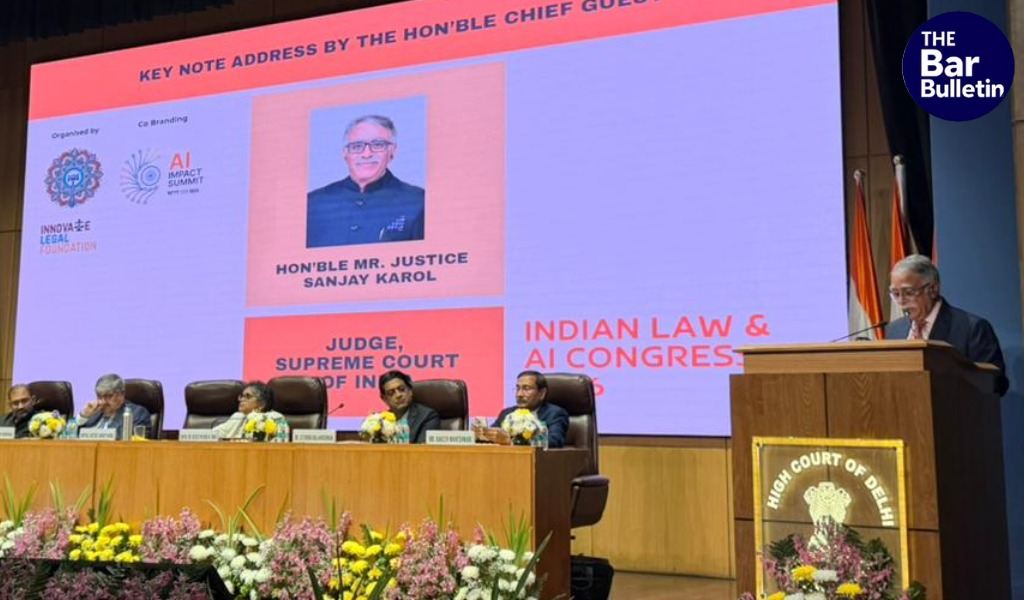

Justice Sanjay Karol, Judge of the Supreme Court of India, on Thursday called for a measured, constitutionally compliant, and human-centric approach to the adoption of artificial intelligence, particularly in the justice delivery system, while addressing at the Indian Law & AI Congress.
Justice Karol observed that artificial intelligence is no longer a futuristic concept and is already being deployed across critical sectors including healthcare, finance, governance, and public administration. He noted that AI systems are being used for tasks such as early cancer detection, fraud prevention, risk assessment, and large-scale data analysis, making it imperative for institutions to understand both the benefits and limitations of the technology.
Emphasising the constitutional framework, Justice Karol said that any technological adoption in India must align with the principles of fairness, transparency, accountability, and human dignity embedded in Articles 14 and 21 of the Constitution. He cautioned that technology should not be allowed to dilute procedural safeguards or undermine fundamental rights.
Referring to global developments, Justice Karol highlighted regulatory responses such as the European Union’s Artificial Intelligence Act, which adopts a risk-based approach to AI governance, particularly in sensitive sectors such as law enforcement and employment. He noted that while India may chart its own regulatory path, international developments underscore that AI regulation has emerged as a significant public policy concern.
On the use of AI in courts, Justice Karol said that while technology can assist in administrative functions such as case management, translation, transcription, and document analysis, the responsibility for judicial reasoning and decision-making must remain with human judges. He referred to comparative experiences from jurisdictions including China, Qatar, and the United States, where AI tools are being tested under regulated conditions, often accompanied by concerns relating to bias and accountability.
Justice Karol also warned against the uncritical use of generative AI, citing instances globally where misuse has resulted in fabricated legal citations and breaches of confidentiality. He stressed that AI systems embed design choices and data patterns that can influence outcomes and may disproportionately impact marginalised communities if not carefully designed and regulated.
Addressing students and young legal professionals, Justice Karol observed that while AI tools may assist with research and organisation, they must remain supplementary in legal education. He cautioned that outsourcing learning and analytical reasoning to machines risks weakening core legal skills.
He also highlighted the potential role of AI in addressing environmental challenges, including monitoring deforestation, detecting illegal mining, predicting climate events, and strengthening disaster early-warning systems. Referring to recent monsoon-related disasters in India, he underscored the importance of responsible deployment of technology in disaster management and environmental protection.
Concluding his address, Justice Karol called for the development of a robust legislative framework to govern artificial intelligence in India, covering data protection, accountability, transparency, and bias mitigation. He reiterated that technology must serve as an aid to human decision-making and not replace it.
The Indian Law & AI Congress brought together judges, lawyers, policymakers, technologists, academics, and students to deliberate on the evolving intersection of law, artificial intelligence, and public policy.
Vision of Innovate Legal Foundation is to build India’s premier legal-tech and legal-innovation platform, one that fosters dialogue, enables collaboration, supports responsible technology adoption, and strengthens access to justice through human-centric innovation. We envision Innovate Legal as a trusted bridge between law, policy, technology, and society.