


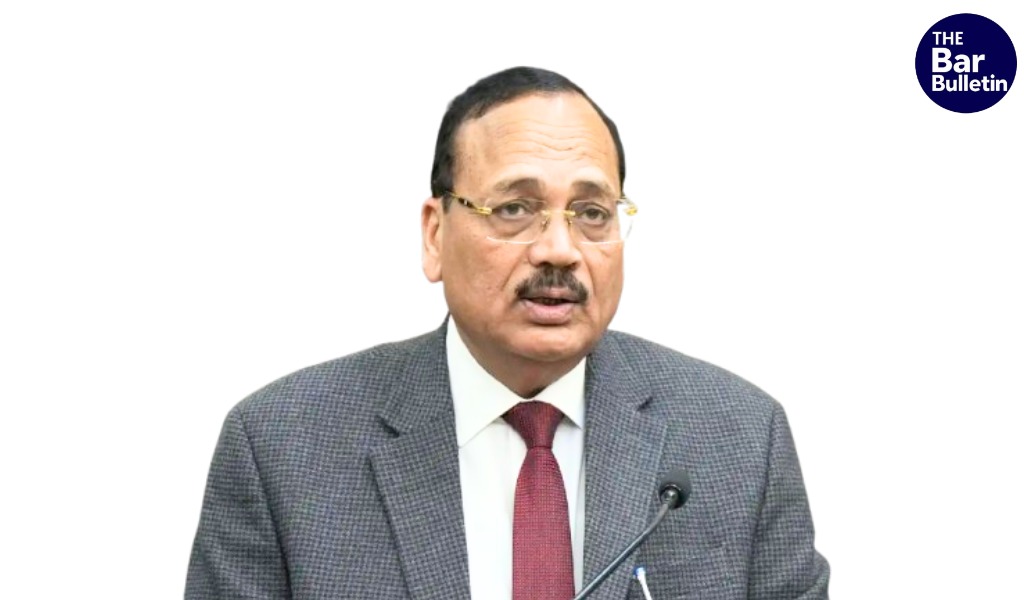

Delivering the convocation address at the 4th Convocation of the National Forensic Sciences University (NFSU), Gandhinagar, Justice Surya Kant noted the indispensable role of forensic science in strengthening the administration of justice, describing justice not as an isolated judicial function but as a “collective enterprise” shaped by judges, lawyers, investigators, and scientific experts working in harmony.
Addressing graduating students as the Chief Guest, Justice Surya Kant observed that convocations are not endpoints but moments of transition, where structured academic learning must now respond to real-world complexities. He noted that forensic professionals occupy a unique intersection between curiosity and responsibility, where the pursuit of truth carries direct consequences for individual liberty and institutional credibility.
Highlighting the evolution of modern justice systems, the Chief Justice emphasised the shift from reliance on assertions and subjective testimonies to authentication through scientifically verifiable facts. He remarked that while human memory and perception are fallible, forensic science provides courts with evidentiary clarity that enables confident and reliable adjudication. Drawing from judicial experience, he stated that forensic evidence often resolves uncertainty where competing narratives appear equally persuasive.
Justice Surya Kant described forensic science as integral not supplementary to justice delivery, noting that disciplines such as DNA analysis, digital forensics, forensic accounting, and advanced analytical techniques have transformed how courts evaluate evidence. According to him, the quality of justice depends fundamentally on the quality of evidence, and meticulous forensic processes reduce delays, narrow disputes, and enhance public confidence in outcomes.
Cautioning against uncritical reliance on technology, the Chief Justice stressed that science must always meet conscience. While forensic capabilities have expanded significantly, he warned that scientific analysis cannot operate in a moral vacuum and must remain anchored in constitutional values of fairness, proportionality, and human dignity. He observed that neutrality, transparency, and intellectual honesty are essential expectations courts place on forensic experts, whose conclusions increasingly shape legal outcomes.
In the context of the digital age, Justice Surya Kant characterised forensic science as a “Raksha Kawach”,a protective shield safeguarding the justice system against technological deception, cybercrime, and informational chaos. He noted that as crimes become more technologically sophisticated, forensic professionals play a stabilising role by bridging scientific complexity with legal standards, ensuring that technological advancement strengthens rather than undermines the rule of law.
Emphasising trust and integrity, the Chief Justice observed that public confidence in the justice system is closely tied to the credibility of forensic expertise. Every forensic report, he said, carries accountability not just to the profession but to the constitutional promise of fairness itself. In moments of pressure where speed may be prioritised over precision, he reminded graduates that credibility is the most enduring professional asset.
Concluding his address, Justice Surya Kant urged graduates to pursue truth with intellectual discipline and ethical clarity, noting that their work would directly influence how truth is established and justice is delivered. He congratulated the graduating class, their parents, and faculty, and expressed confidence that forensic science would continue to serve as a protective force for the integrity of justice in India.