




The book “Dawn of the Finance Revolution 5.0”, authored by senior advocate Aruneshwar Gupta, was formally launched at the India International Centre in New Delhi on January 24, 2026. The event was graced by Justice Uday U. Lalit, former Chief Justice of India, as the Chief Guest, with Justice Dinesh Maheshwari, former Judge of the Supreme Court of India and former Chairperson of the Law Commission of India, as Guest of Honour.
The book was published by Mohan Law House.
Addressing the gathering, author of the book, Senior Advocate Aruneshwar Gupta, said Dawn of the Finance Revolution 5.0 is not a conventional book on finance but “a statement of civilizational direction.” Drawing from his decades-long legal practice, he said the book examines the fault lines between the visible economy of money and what he described as the “invisible economy” of care, service and human effort. “How long can we sustain a financial order that remembers only money and forgets the services that make life deliverable?” he asked, adding that while GDP measures prosperity, it often fails to account for dignity, trust and responsibility.
Mr Gupta explained that the book proposes a “second ledger” to record and recognise non-monetised human contributions through Pro Bono Social Impact Credits. He noted that societies risk becoming “very rich in GDP yet very poor in meaning” if such contributions remain invisible. The book, he concluded, was written not to add another theory of money, but to “restore the dignity of the human being” by recognising value beyond markets and balance sheets.
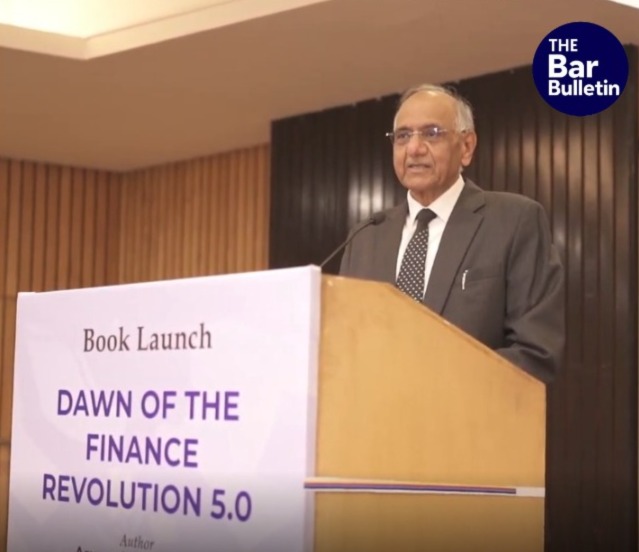
Speaking at the launch, Justice Dinesh Maheshwari, Chairperson of the Law Commission of India, who has written the afterword to the book, described Dawn of the Finance Revolution 5.0 as an invitation to rethink the very foundations of value and finance.
Participating in the launch as Guest of Honour, Justice Maheshwari said the book does not merely present a theory but invites readers to “wander into entirely different horizons of thought.” While contemporary debates increasingly focus on financial valuations through cryptocurrencies and digital assets, he observed that finance ultimately remains centred on money. What the book does, he said, is place at the forefront something that has always existed around us but has rarely received the recognition it deserves, i.e. human goodness and social contribution.
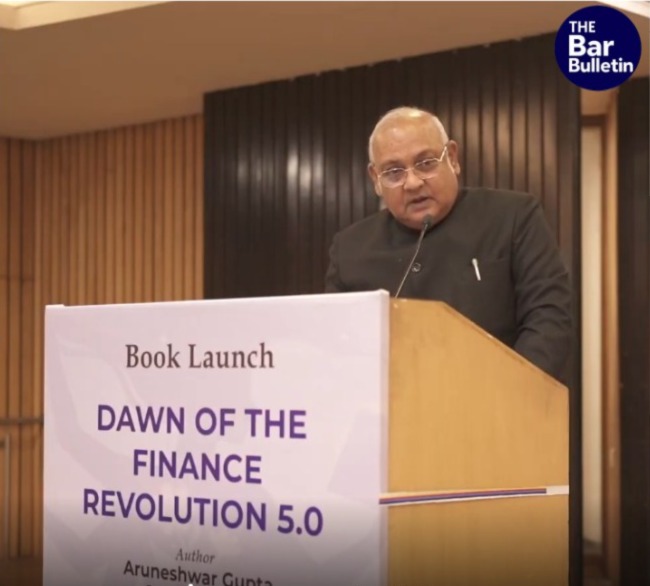

In his keynote address, Former Justice U. U. Lalit described the book as a true revolution in thought rather than merely a financial thesis. He highlighted the author’s central argument: modern societies rely almost entirely on measurable, monetary indicators- income, tax paid, assets held- to judge productivity and contribution. Yet such metrics, he argued, often fail to capture effort, struggle, empathy, and service.
Justice Lalit applauds Aruneshwar Gupta’s “Dawn of the Finance Revolution 5.0” for taking the timeless question, whether money is the root of evil, into an entirely new dimension. Drawing from Hamilton, Nehru, and Ayn Rand, he praised the book’s path-breaking attempt to unite measurable economic outcomes with immeasurable social contributions through a new social impact framework, calling the idea original, courageous, and truly mesmerising.

The concluding remarks framed the book as “a statesman’s brief for the next phase of human civilisation.”