


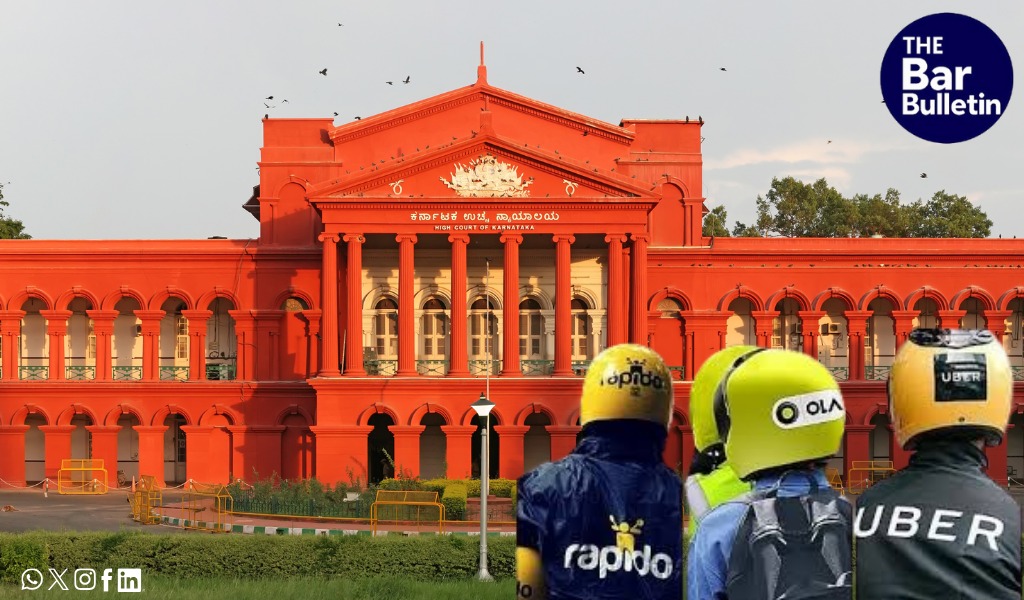

The Karnataka High Court (Bengaluru Bench) has ruled that the right to operate a bike taxi service is a fundamental right to carry on a trade or business under Article 19(1)(g) of the Constitution of India. Hence, a blanket prohibition on this activity, effected by refusing to register vehicles or grant permits without any basis in a valid law, rule, or notified policy, is an unreasonable restriction and is not saved by Article 19(6).
Under the statutory framework of the Motor Vehicles Act, 1988, read with the Central Government notification S.O. 1248(E), the Court explained that a motorcycle is classifiable as a “motorcab”, “contract carriage”, and “transport vehicle”. Therefore, there is no legal impediment to registering a motorcycle as a transport vehicle and granting it a contract carriage permit.
The Court also explained that the Karnataka On-demand Transportation Technology Aggregators Rules, 2016 (KODTTA Rules) are “vehicle agnostic” to the extent that the definition of “taxi” includes a “motorcab”, which in turn includes a motorcycle. Thus, a licence to aggregate bike taxis can be granted under the existing KODTTA Rules, provided the aggregator makes an application specifying the motorcycle taxis to be onboarded.
Accordingly, the High Court granted liberty to the Motorcycle owners to file applications for the registration of their vehicles as transport vehicles, and directed the State Government to consider such applications for registration and for the grant of permits to operate them as contract carriages. Such applications shall not be denied on the ground that motorcycles cannot be operated as transport vehicles or contract carriages.
The Division Bench comprising the Chief Justice Vibhu Bakhru and Justice C M Joshi observed that a motorcycle falls within the definition of a ‘motorcab’ under Section 2(25) of the MV Act, as it is a motor vehicle constructed to carry not more than six passengers (in this case, one pillion passenger) for hire or reward. Consequently, a motorcycle used for hire falls within the definition of a “contract carriage” under Section 2(7) and a “public service vehicle” under Section 2(35) of the MV Act.
The Bench rejected the State’s argument based on the Central Motor Vehicles Rules, 1989 (CMV Rules), which used the expression ‘carrying passengers’ for three-wheelers and four-wheelers but not for two-wheelers. The Bench observed that this classification was for structural purposes and did not imply that motorcycles are not for carrying passengers.
The Central Government Notification S.O. 1248(E) dated 05.11.2004, issued under Section 41(4) of the MV Act, explicitly specifies “Motor cycle used for hire to carry one passenger on pillion” as a type of “Transport Vehicle”, added the Bench, while referring to a clarification issued by the Ministry of Road Transport and Highways (MORTH) on 22.01.2024, which expressly states that motorcycles fall within the definition of ‘contract carriage’ and advised all States/UTs to process applications for such permits.
The Bench went on to explain that the business of plying taxis is a legitimate trade protected under Article 19(1)(g) of the Constitution of India and is not res extra commercium. Any restriction on this right must be by a valid law, be in the interest of the general public, and be ‘reasonable’ as per Article 19(6) of the Constitution.
Thus, a complete prohibition of a business requires a higher degree of scrutiny. The State must demonstrate that a less drastic restriction would not suffice to achieve the public interest objective, added the Bench, while pointing out that the failure of the State to frame regulations cannot be inferred as a prohibition on carrying out the activity.
The Bench opined that the State Government’s power to control road transport is circumscribed by Section 67 of the MV Act. Any direction must be by notification in the official gazette and guided by objectives like passenger convenience, safety, and promoting competition. The Bench however found no stated policy of the Government of Karnataka prohibiting bike taxis. The 2019 Expert Committee report recommending against bike taxis in Bengaluru was never formally adopted as State policy.
On the contrary, the State’s notification of the ‘Karnataka Electric Bike Taxi Scheme, 2021’ (subsequently withdrawn) explicitly recognized the need for bike taxis for first and last-mile connectivity, which contradicted the claim that the State’s policy was to prohibit them, added the Bench.
Lastly, the Bench concluded that the refusal to grant permits appeared to be based on an “unwritten edict” rather than a formal, legally valid policy decision. Since, an aggregator’s licence is confined to the vehicles specified in the application and enclosed list, the aggregators cannot aggregate bike taxis unless those vehicles are specifically included in their licence.
Briefly, the appellants/ aggregators (Ola, Uber, Rapido) seeking to operate or expand their services to include bike taxis, made representations to the State authorities for necessary registrations and permits. The Rapido’s application was explicitly rejected by the Government of Karnataka. Whereas, Ola’s license had previously been suspended for operating bike taxi services, which was later restored upon payment of a penalty. The State authorities disputed the claim that motorcycle owners are entitled to render bike taxi services, asserting their right to decline such permits.
The appellants, therefore, sought directions to the State to permit the registration of motorcycles as transport vehicles, grant contract carriage permits, and allow the aggregation of motorcycle taxis. They also sought to prohibit the State from interfering with their business and to set aside the endorsement rejecting Rapido’s application.
The Single Judge held that while the Motor Vehicles Act, 1988 (MV Act) does permit motorcycles to be registered as transport vehicles, the petitioners had no crystallized right to ply them as taxis. Consequently, the Singke Judge could not direct the State Government to permit the service. The petitions were disposed of with a direction that aggregators cannot offer bike taxi services until the Government of Karnataka notifies relevant guidelines.
Appearances:
Senior Advocate K. Arun Kumar, along with Advocates Faisal Sherwani and Aditya Vikram, for the Appellant
Advocate General K. Shashikiran Shetty, along with Advocates Mahesh A. Chowdhary, Rashi Singh, Adoorya Harish, Omkar Margad, Nayana Tara B.G., S. Nataraja Sharma, N.P. Amruthesh, and Deeksha Amruthesh, for the Respondent
