


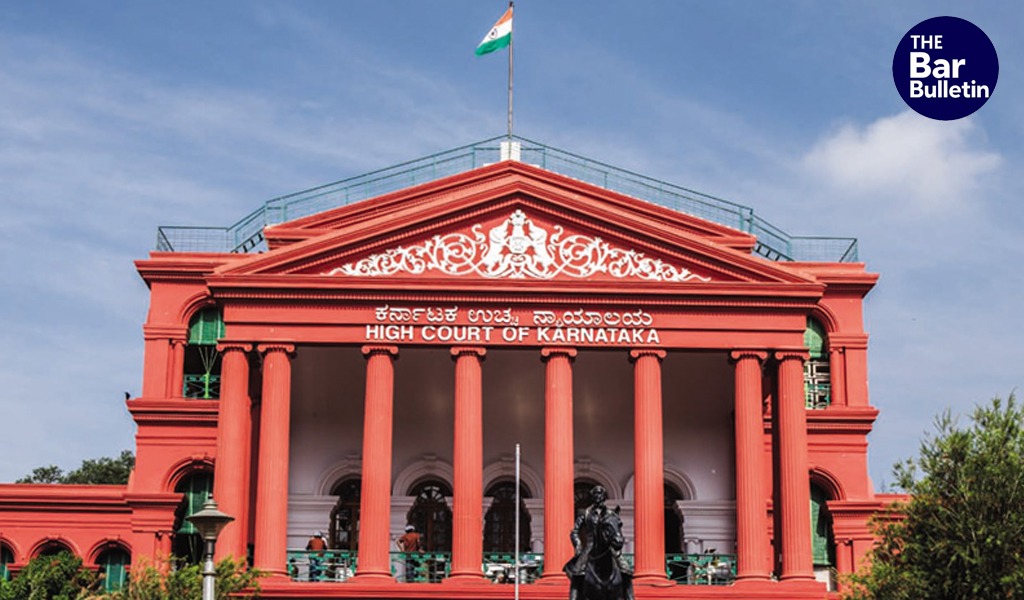

The Karnataka High Court allowed the writ petition. It quashed CGHS emails rejecting reimbursement and directed full reimbursement of medical expenses with interest, along with a policy-level direction to examine a cashless CGHS mechanism.
The petitioner, a 75-year-old retired IAS officer and a lifetime beneficiary under the Central Government Health Scheme (CGHS), approached the Court under Articles 226 and 227. She challenged three email communications dated 07.10.2024, 20.11.2024, and 04.03.2025 from CGHS, which rejected her medical reimbursement claim for her late husband’s CRT-D implantation. She sought quashing of those communications and a mandamus directing full reimbursement.
The petitioner’s husband, with a cardiac history including two bypass surgeries, was implanted with a CRT-D device on 31.10.2023 as an emergency measure to prevent sudden cardiac death. The petitioner filed a CGHS reimbursement claim on 26.12.2023, acknowledged by CGHS through SMS. After months of silence, CGHS sought an ECG report on 11.09.2024, then rejected the claim on 07.10.2024 stating that “experts” opined CRT-D was not justified and not an emergency, and reiterated that stance in subsequent emails. Meanwhile, the husband died on 18.03.2024 following another cardiac episode, with the claim still pending.
The petitioner argued that she could not second-guess doctors in an emergency and that CGHS’s rejection was arbitrary, inhumane, and contrary to Supreme Court precedent.
The petitioner relied heavily on the Supreme Court’s judgment in Shiva Kant Jha v. Union of India[1], where CGHS had rejected a pensioner’s emergency CRT-D reimbursement on similar grounds, and the Court ordered payment while emphasising the welfare nature of CGHS and the primacy of treating doctors’ judgment. She argued that requiring prior approval or second-guessing emergency medical decisions is incompatible with Article 21 and the object of CGHS.
The Bench comprising Justice Suraj Govindaraj accepted this approach, noting the “strikingly similar” facts to Shiva Kant Jha, and held that CGHS officers, who were not present during treatment, cannot sit in appeal over cardiologists’ clinical decisions with the benefit of hindsight. It also observed that the CRT-D likely prolonged the husband’s life by several months, underscoring its life-saving character.
The Court treated CGHS reimbursement as a facet of the State’s constitutional obligation under Article 21 (right to life and health) and Article 14 (non-arbitrariness), not as a matter of charity or unfettered discretion. It reiterated that CGHS is a welfare measure to ensure retirees are not left without medical care, that emergency treatment does not require prior permission, and that bona fide emergency expenses must be reimbursed even if technical committees later disagree.
The Court criticised CGHS’s mechanical, opaque handling, repeated delays, absence of a speaking order, and reliance on an ex post technical opinion, holding this to be manifestly arbitrary and violative of Articles 14 and 21. It invoked legitimate expectation and promissory estoppel, noting that government servants plan their post-retirement security on the assurance of CGHS coverage and the State cannot resile after beneficiaries incur catastrophic expenses in reliance on that assurance. The Court also raised a systemic concern about reimbursement-only models in emergencies and suggested a shift towards cashless treatment for CGHS beneficiaries.
The High Court allowed the writ petition, issued certiorari to quash the three impugned CGHS emails dated 07.10.2024, 20.11.2024 and 04.03.2025, and directed the respondents to make full reimbursement of all medical costs incurred for the CRT-D implantation within 30 days, together with interest at 12% per annum from 30.10.2023 (the date of payment for the procedure) until realisation.
It further issued a mandamus directing the Union and CGHS authorities to examine, at an appropriate administrative level, the feasibility and phased implementation of a cashless medical treatment mechanism under CGHS, at least for emergency and critical care, to prevent beneficiaries from being forced to first fund huge bills and then chase reimbursement.
Appearances:
Sri. A Madhusudhana Rao, Advocate for Petitioner
Smt. Reshma K. T., CGC for Respondents
[1] (2018) 16 SCC 187
