


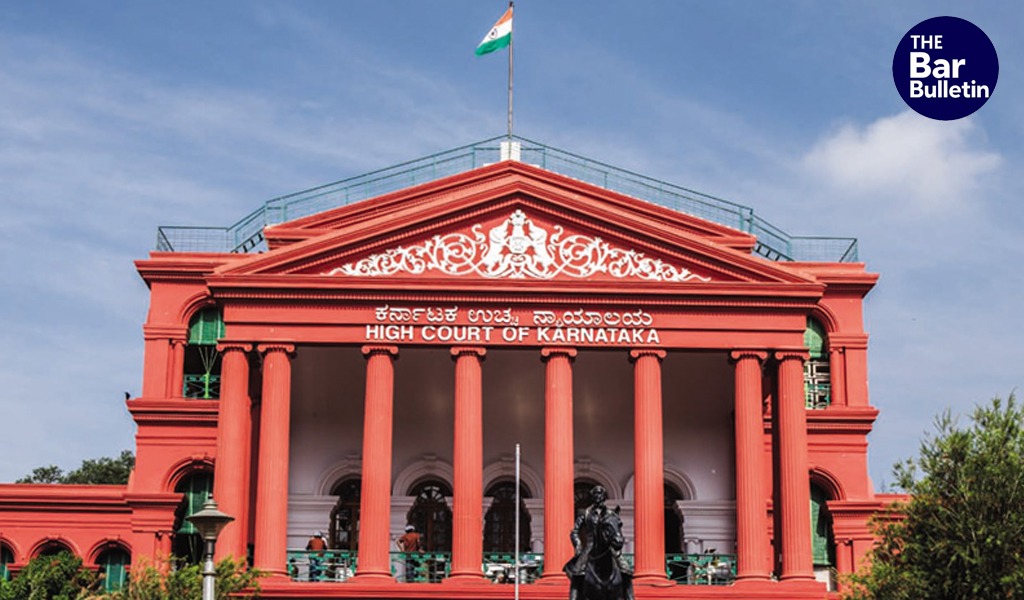

The Karnataka High Court (Bengaluru Bench) has asserted that under Section 153(2) of the Bruhat Bengaluru Mahanagara Pallike Act, 2020 (BBMP Act), a tenant who has leased land for more than one year and has constructed upon it is primarily liable for property tax. This statutory liability, combined with an express clause in the lease deed making the tenant responsible for taxes, gives the tenant a sufficient legal interest to maintain a writ petition challenging the tax.
Thus, a tenant has the locus standi to challenge the levy of property tax when a statute and a contractual agreement establish their primary liability for such payment, added the Court, while remanding the matter to the Single Judge for consideration on merits.
The Division Bench comprising Justice Anu Sivaraman and Justice Vijaykumar A. Patil observed that that the Single Judge had dismissed the writ petition primarily because the appellant company was not the owner of the property and therefore had no locus standi. The appellate court reviewed the pleadings, noting the averment that the appellant company is a family entity of sibling shareholders and that it has been discharging the property tax liability.
The Bench examined the registered lease deed, which leased the property to the appellant company for 20 years. It specifically analysed Clause 9 of the deed, which places the obligation to pay taxes on the tenant. The Bench noted that while the clause mistakenly uses the word “Lessor”, the context and covenants make it clear that it should be read as “Lessee”.
The Bench also gave significant weight to Section 153(2) of the BBMP Act, which explicitly states that if a land is leased for a term exceeding one year and the tenant has built upon it, the property tax on both the land and the building is “primarily payable by the said tenant”.
Finding that the submissions from both parties that the lease deed and related factual aspects had not been placed before the Single Judge, and they agreed to a remand for consideration on merits, the Bench recorded the appellant’s submission that all property taxes, except for the COVID-19 period, had been paid, and the BBMP’s response that challans for subsequent years could not be generated due to the pending dues for the COVID period.
Briefly, the appellants challenged the BBMP’s authority to levy property tax on their shopping mall, ‘GT World Mall’, during the period of the COVID-19 lockdown. They contended that the tax levy was arbitrary, violative of Article 14 of the Constitution, and an unreasonable restriction on their right to conduct business under Article 19(6).
The land on which the mall is constructed is owned by four brothers, who are also the sibling shareholders and directors of the appellant company. This land was leased to the appellant company for a term of 20 years via a registered lease deed, and Clause 9 of this lease deed stipulated that the lessee (the appellant company) is liable to pay all outgoings, including taxes, in respect of the property.
The Single Judge, however, dismissed the initial writ petition on the grounds that the appellants lacked locus standi (the right to bring an action) as they were not the registered owners of the property.
Appearances:
Advocates Ojaswi and Dhananjay K.V., for the Appellant
AGA Shwetha Krishnappa and Advocate B.S. Satyanand, for the Respondent
