


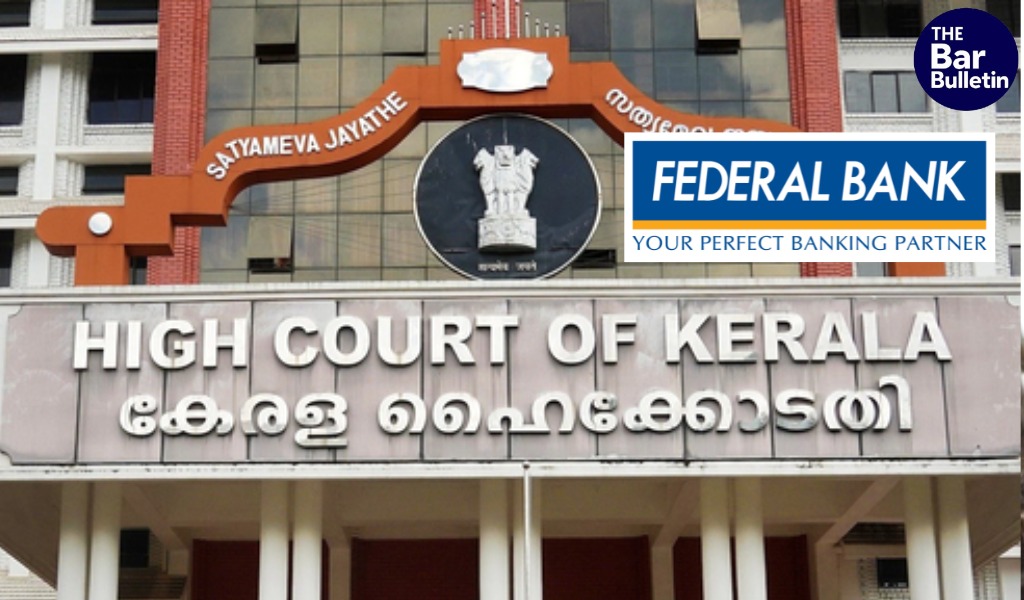

The Kerala High Court has allowed a writ appeal filed by Federal Bank Ltd., holding that the statutory restrictions under Section 22 of the Industrial Disputes Act, 1947 apply to all persons employed in a public utility service, including bank officers who do not fall within the definition of “workman”.
A Division Bench comprising Justice Sushrut Arvind Dharmadhikari and Justice Syam Kumar V.M. set aside a Single Judge judgment which had quashed conciliation proceedings initiated by the Regional Labour Commissioner (Central) in connection with a proposed strike/abstention from work by the Federal Bank Officers Association.
The writ appeal arose from a Single Judge order which had accepted the officers’ contention that, since they were not “workmen” under Section 2(s) of the ID Act, no industrial dispute could arise and the authorities lacked jurisdiction to invoke Section 22. The Single Judge had consequently restrained the labour authorities from proceeding with conciliation.
Reversing this view, the Division Bench held that the Single Judge had misread the statutory scheme. The Court noted that Section 22 consciously uses the phrase “no person employed in a public utility service”, unlike Section 23 which specifically refers to “workmen”. This distinction, the Bench observed, reflects legislative intent to impose a wider prohibition on strikes and lockouts in public utility services, irrespective of whether employees are classified as workmen.
The Court took note of the Central Government notification declaring the banking industry as a public utility service, and held that once such a notification is in force, the embargo under Section 22 automatically applies. Consequently, officers of banks cannot resort to strike or mass abstention from work during the pendency of conciliation proceedings, even if they are not workmen under the Act.
Rejecting the argument that conciliation under Section 22 presupposes an industrial dispute involving workmen, the Bench clarified that Section 22 operates independently and is intended to prevent disruption in essential services at the threshold. The provision, the Court held, is not contingent on the existence of an industrial dispute in the strict sense.
The Bench also reiterated that the right to strike is not a fundamental right, particularly in sectors of vital public importance such as banking, and can be regulated or restricted by statute in the larger public interest.
Accordingly, the Kerala High Court upheld the competence of the Regional Labour Commissioner (Central) to initiate and continue conciliation proceedings, set aside the Single Judge’s judgment, and allowed Federal Bank’s writ appeal.
Appearances:
For the Petitioner: Mr. C.U. Singh, Senior Advocate, and Mr. Benny P. Thomas, Senior Advocate, instructed by Mr. Abel Tom Benny, Mr. D. Prem Kamath, and Mr. Tom Thomas (Kakkuzhiyil).
For the Respondent: Mr. P. Chidambaram, Senior Advocate, assisted by Mr. P. Ramakrishnan, along with Mr. P. R. Ajith Kumar, Central Government Counsel.
