


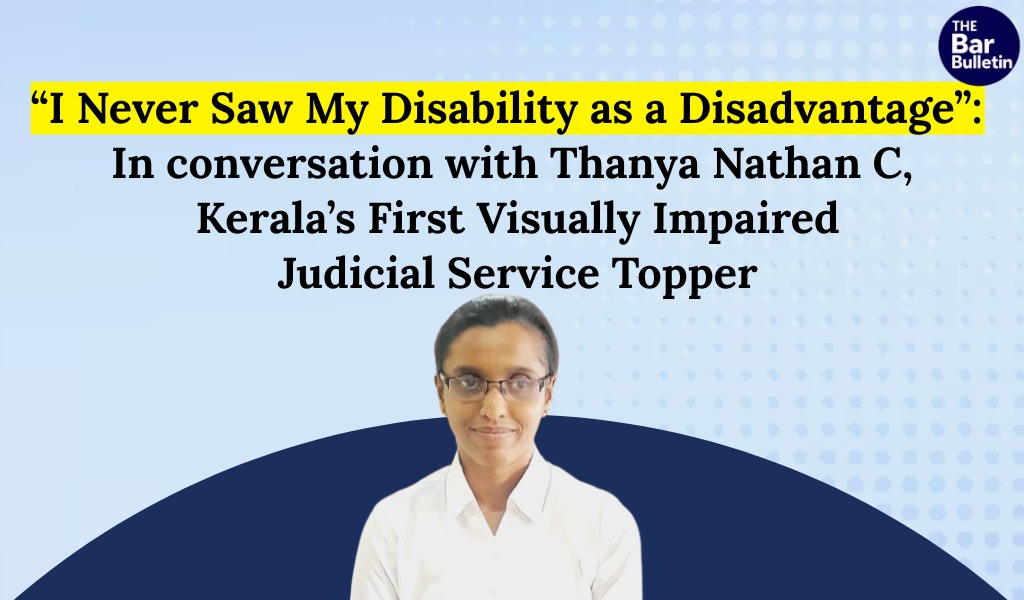
Thanya Nathan C created history by topping the merit list for Persons with Benchmark Disabilities in the Kerala Judicial Service Examination, following the Supreme Court’s landmark ruling allowing visually impaired candidates to appear for the exam. In this conversation with Bar Bulletin, she reflects on her journey through law school, advocacy, and judicial service preparation, the challenges of accessibility, and her vision for greater representation of persons with disabilities in the judiciary.
Q1. Your achievement stands out not only for the rank you secured but also for the barriers you navigated. Could you share what your journey through law school and judicial service preparation looked like as a blind student?
Thanya Nathan C:
First of all, I never consider my visual disability as a disadvantage. Being disabled is not anyone’s fault, it happens on its own. What matters is how we find ways to fit into life and discover opportunities that allow us to stand out.
I was fortunate to have a very supportive family and teachers during my school years. When I completed my 12th standard, I decided to pursue law. In Kerala, visually impaired advocates are still very rare. In fact, in my immediate circle, I did not know of any visually challenged person practising law. That made me think, why not try?
I appeared for the entrance examination of Kannur University, secured merit, and joined the five-year LLB programme in 2019. I graduated in 2024. Since August 2024, I have been practising as an advocate.
Judicial service was not my original goal. I always wanted to be an advocate. The thought of becoming a judge came only after I enrolled. But there was a huge uncertainty until 2024, visually impaired persons were not even allowed to appear for judicial service examinations. When the system itself does not allow you, you cannot even dream.
The Supreme Court’s judgment permitting visually impaired candidates to appear for the judicial service examination changed everything. I am deeply grateful for that ruling. My seniors and family encouraged me to at least attempt the examination to experience the process.
Appearing for the preliminary exam itself felt like a dream come true. Whether I cleared it or not did not matter at that point. I had made the attempt. When the prelims result came and I qualified, that is when I began serious preparation.
Time was limited, but I never stopped practising in court. I strongly believe that one should never distance oneself from the courtroom. Even as a judge, you sit in court every day. Practical exposure is crucial.
I prepared on my own for the mains examination, which in Kerala consists of four papers one General English paper and three law papers. I cleared the mains, and then came the interview stage, for which I sought guidance from Advocate Santosh from Thiruvananthapuram. After that, as they say, the rest is history.
Q2. What role did accessibility, whether in study materials, examinations, or institutional support play in your preparation, and where do you believe the system still needs urgent reform?
Thanya Nathan C:
Accessibility remains a major challenge and an area requiring urgent reform.
When I was pursuing my LLB, online study materials were still at a very early stage of development. There were very limited resources accessible to visually impaired students. I was constantly craving more reading material, but I had to make do with whatever was available.
I prepared my own notes in Braille script and relied heavily on those for my examinations. That is how I managed to secure the first rank in my LLB.
During judicial service preparation, the challenge became even greater with the introduction of the new criminal laws. Structured study materials on the new criminal statutes were simply not available. Bare Acts were the only source.
I had to read the sections, compare them with the old laws, identify similarities, and then incorporate relevant case law. This process was extremely time-consuming. For sighted candidates, structured notes are easily accessible, but for visually impaired aspirants, this gap makes preparation significantly harder. This is an area where institutional reform is urgently needed.
Q3. As someone who has topped the merit list for persons with benchmark disabilities, how do you view the representation of persons with disabilities within the judiciary, both at the entry level and on the Bench?
Thanya Nathan C:
At the entry level, representation is extremely limited. In Kerala, I am not personally aware of any other visually impaired advocate, though there may be some. Nationally as well, representation is minimal.
As far as the Bench is concerned, representation especially of blind persons is virtually zero. Visually impaired candidates were allowed to appear for judicial service examinations only recently, following the Supreme Court judgment. From what I have read, this is the first time such an achievement has occurred in India.
I truly hope this is just the beginning. More young persons with disabilities should enter the legal profession and aspire to the Bench. Knowledge of law itself is a powerful tool, and this profession offers immense opportunities for growth.
Q4. Judicial decision-making demands objectivity, empathy, and lived understanding. How do you think your experiences will shape your approach as a Civil Judge (Junior Division)?
Thanya Nathan C:
My experience as an advocate is still very limited, I am at an early stage, with just about a year of practice. However, even during this short period, I have experienced immense kindness and empathy from judicial officers.
Despite the fact that my presence in court as a visually impaired advocate was something new for many, the judiciary was always willing to accommodate and support me. That deeply inspired me.
If I become a judge, I would like to extend the same empathy and understanding to others, while remaining objective and committed to justice.
Q5. For aspiring law students with disabilities who may hesitate to aim for the judiciary, what message or advice would you like to share with them today?
Thanya Nathan C:
I would say, never hesitate. The door has now been opened. What we need to do is walk through it.
The path is not easy. There will be hurdles, no doubt. But with the right mindset, hard work, and consistency, success is possible. This is the time for more persons with disabilities to step forward and claim their space in the judiciary.