


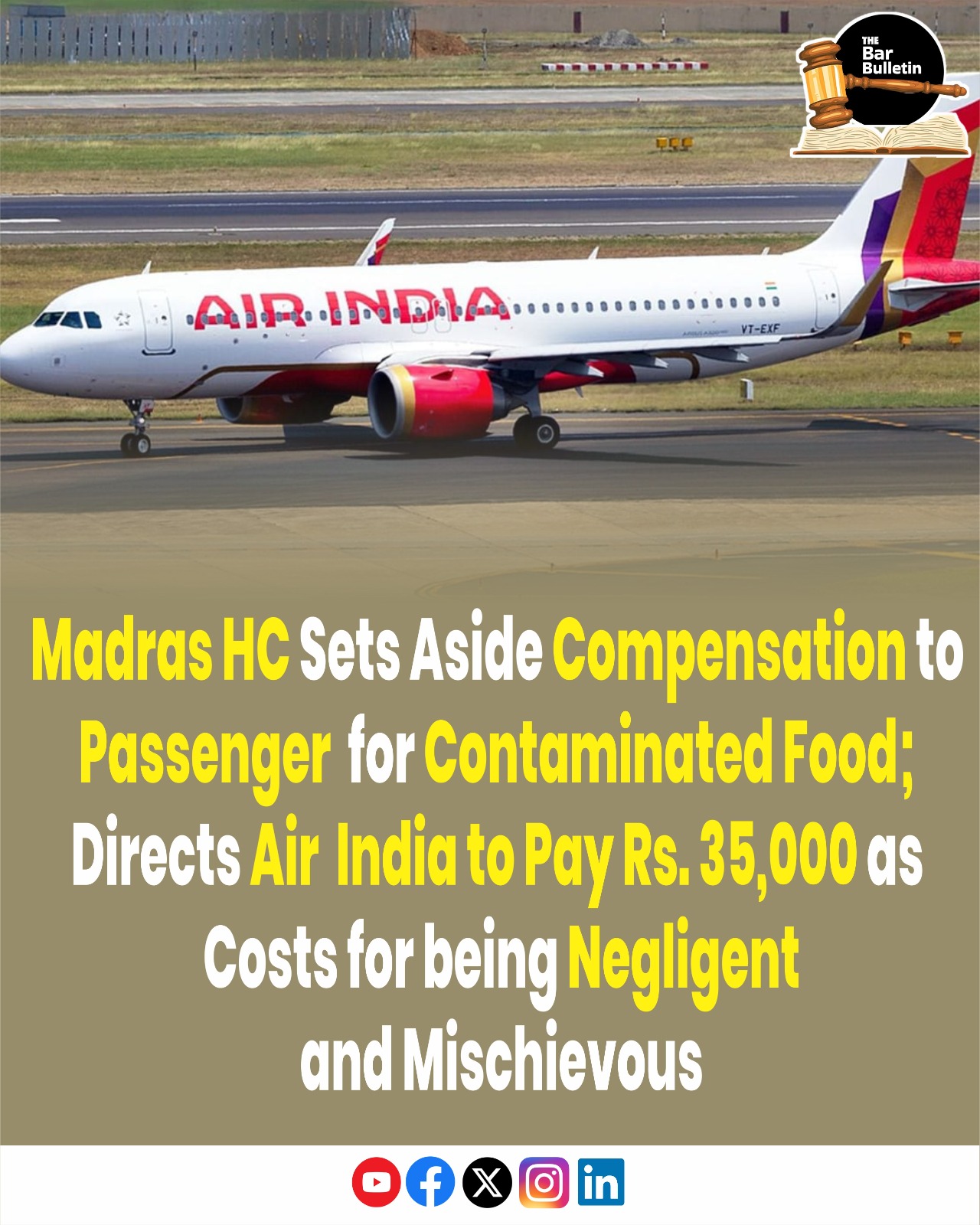

In an appeal suit under Section 96 of the Civil Procedure Code, 1908 (CPC), filed before the Madras High Court seeking directions to set aside the decree and judgment dated 21-06-2022 by the III Additional City Civil Court, Chennai, a Single Judge Bench of Justice P.B. Balaji did not find any perversity in the findings of the Trial Court against M/S Air India Limited (Air India), but, set aside the compensation awarded to the respondent for lack of proof regarding the injuries suffered.
By way of the impugned judgment, the appellants were directed to compensate the respondent by paying Rs. 1,00,000/-.
The respondent, a frequent flyer with Air India, traveled on the airline IC 574 on 26-06-2002 from Colombo to Chennai. In the sealed food packet served to him, the respondent noticed a few strands of hair. However, since there was no complaint box available and the flight staff did not hear him out, the respondent was unable to make a complaint.
The respondent fell ill and upon landing, he immediately filed a complaint before the Deputy General Manager (Commercial), M/s. Air India Limited, Airlines House, Chennai. On 12-07-2002, the appellants sent a letter to the respondent stating that the matter was under investigation. Thereafter, on 19-07-2002, the respondent sent a legal notice claiming compensation for the trouble that he went through. Hence, the respondent filed a suit claiming compensation of Rs. 11,00,000/-.
Air India contended that they had entrusted the catering services to Ambassador Pallava, a Five-Star Hotel in Chennai, who had not been made a party to the suit. They also contended that while opening the food packet, it was possible that the hair follicles of a co-passenger could have fallen in the dish. It was further submitted that the respondent had neither handed the food tray back nor requested any medical assistance from the staff on board, and hence, Air India could not be blamed.
The Trial Court held that Air India was negligent and proceeded to decree the suit for a sum of Rs. 1,00,000/- along with costs.
In the present matter, Air India submitted that in a suit for damages, it was incumbent on the plaintiff to enter the witness box and adduce evidence, which he failed to do. It was thus contended that the Trial Court ought to have dismissed the suit. The respondent submitted that since Air India had admitted the complaint, there was no necessity to lead any evidence regarding the negligence.
The respondent also submitted that the air ticket included meals to be provided by Air India and that they themselves would be liable for such negligence. It was contended that the burden could not be shifted to their contractor, Ambassador Pallava.
While deciding whether Air India had been negligent and deficient in service to the respondent, the Court noted that both sides had adduced no documentary or oral evidence. It was stated that, although Air India mentioned the respondent never complained to the on-board staff, the written statement indicates that the respondent’s oral complaint was radioed through the company channel. The Court said that res ipsa loquitur would govern the present case as the negligence was evident and the respondent was not required to prove anything.
Further, the Court did not find that the respondent had to be non-suited for not impleading the caterer. It was said that merely because Air India did not have any role to play in the preparation of the food, they could not contend that compensation, if any, had to be met by the caterer.
While deciding whether the suit was bad for non-joinder of the caterer, Ambassador Pallava, the Court stated that the ticket included meals to be provided on board and that the respondent had no privity of contract with the caterer. It was said that the food and beverages that are provided by airlines to the passengers on board are governed by an independent contract.
Hence, the Court held that Air India was vicariously liable to compensate the respondent for the negligence and found no error in the decision of the Trial Court.
While deciding whether the respondent was entitled to compensation of Rs. 1,00,000/- as awarded by the Trial Court, the Court said that the compensation payable would be based only on the actual loss or hardship suffered. It was noted that since the respondent had opted not to lead any oral or documentary evidence, he could not be entitled to any compensation for want of proving the loss or injuries suffered.
Further, the Court said that even though the Trial Court, on its own motion, proceeded to award a minimum compensation of Rs. 1,00,000/-, the same was clearly unsustainable as there was no iota of evidence to establish the loss. Thus, the Court set aside the award of compensation by the Trial Court.
Lastly, the Court found that Air India was negligent and had mischievously attempted to pass on liability to the caterer. Considering such acts, the Court directed Air India to pay the costs of the suit amount to Rs. 35,000/- to the respondent within four weeks.
Appearances:
For Appellants – Mr. S. Satish Kumar
For Respondent – Mr. R. Subramanian for Mr. B. Ravi
