


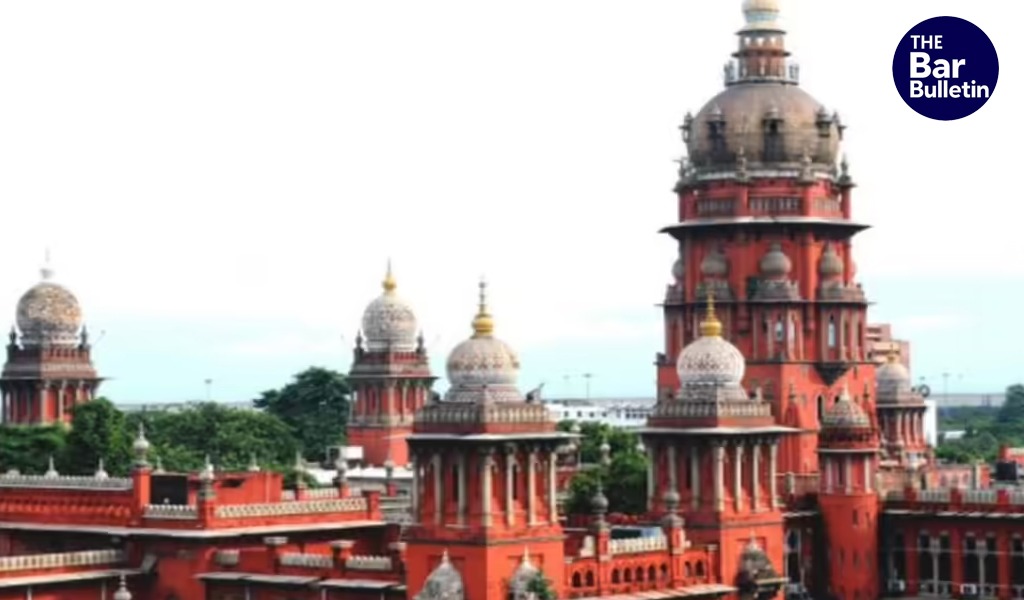

The Madras High Court has held that the collection of sensitive information from students, particularly those with stigmatic backgrounds, without a clear explanation of the purpose or the special attention to be provided, amounts to an absolute abuse of power.
Since the act of collecting and documenting such data in the manner prescribed is in violation of the right to privacy as recognized under Article 21 of the Constitution of India, the Court ruled that collection of such data constitutes discrimination and ill-treatment of the students and is contrary to constitutional guarantees.
The Division Bench comprising Dr Justice G. Jayachandran and Justice K.K. Ramakrishnan noted that the impugned proceedings indicated that the information was collected to show some special attention to students suffering from various stigmas. However, it was not explained as to what special attention was to be shown to the students.
The Bench observed that the information sought was very sensitive and the manner in which it was to be collected would necessarily traverse into the privacy of the young students. The third respondent claimed that they needed to document this information, and teachers were requested to collect the data and forward it through the EMIS website as per the demo video annexed to the impugned order.
The Bench found that the data sought to be collected, as well as the manner in which it was to be documented, was absolutely in violation of privacy and constituted clear discrimination and ill-treatment of the students of the Model School.
Reference was made to the judgment of the Supreme Court in Justice K.S. Puttaswamy (Retd.) and another vs. Union of India and others [AIR 2017 SC 4161], which held that privacy is a constitutionally protected right emerging primarily from the guarantee of life and personal liberty in Article 21 of the Constitution.
The Bench quoted the Supreme Court’s observations regarding the core of privacy, including the preservation of personal intimacies, the sanctity of family life, marriage, procreation, the home, and sexual orientation, and the right to be left alone.
Lastly, the Bench emphasized that privacy safeguards individual autonomy and recognizes the ability of the individual to control vital aspects of his or her life, and that privacy is not lost or surrendered merely because the individual is in a public place.
Briefly, a petition was filed as a Public Interest Litigation by Ameer Alam, aggrieved by the manner in which certain sensitive data from students of 9th to 12th standard were sought to be collected by the Member Secretary, Model School, Tamil Nadu Education Department. The impugned order required collection of data regarding students falling under various categories, including but not limited to: students with both parents not alive, students from refugee backgrounds, children of parents who are prisoners, students from nomadic and gypsy communities, students with separated or divorced parents, wards of sanitary workers, students who are survivors of abuse and violence, etc.
The petitioner challenged the legality of the impugned order and sought a direction to reconsider the criteria for data collection from students confidentially, without affecting their social environment. The third respondent filed a counter affidavit justifying the reasons for collecting the data. However, during the hearing, the counsel for the Model School was unable to satisfactorily explain the purpose for which such information was sought from the vulnerable section of students, except to state that the information was not collected in public and was well secured. The purpose for collecting such information was not explained in the counter affidavit either.
Appearances:
Advocate M. Aboobacker Siddik, for the Petitioner
Advocates P. Thilakkumar and Kavitha Deenadhayalan, for the Respondent
