


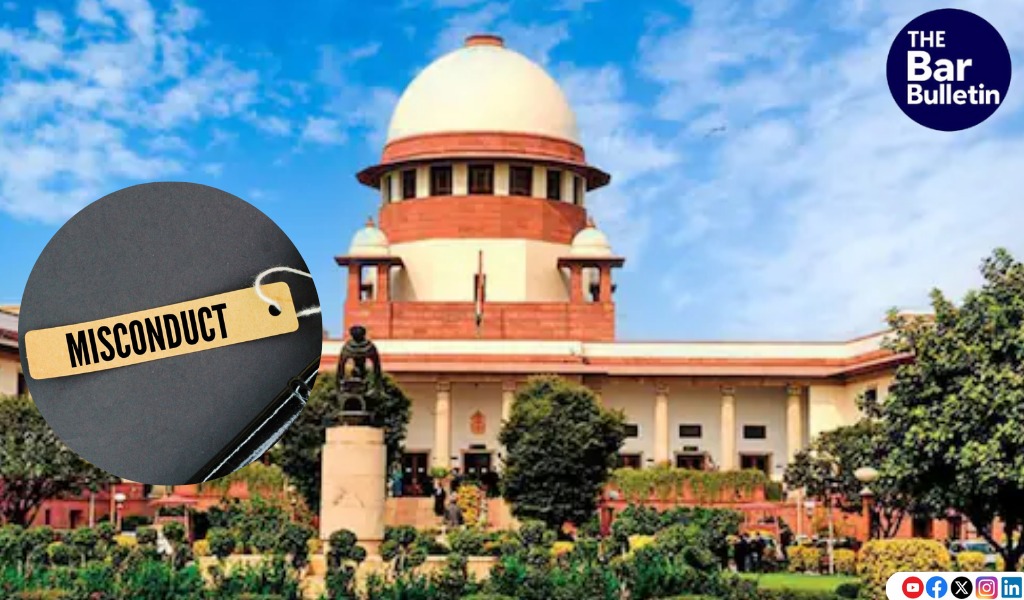

In a significant ruling protecting judicial independence, the Supreme Court set aside the removal of a senior judicial officer, cautioning against disciplinary action founded on mere suspicion. Justice J.B. Pardiwala observed that the initiation of departmental proceedings on tenuous grounds is a key reason trial judges hesitate to exercise discretion in bail matters. A Division Bench comprising Justice K.V. Viswanathan and Justice Pardiwala held that the mere possibility of an alternative conclusion in a judicial order cannot, by itself, constitute misconduct.
The Appellant, a judicial officer with nearly 27 years of unblemished service, was serving as First Additional District & Sessions Judge, Khargone, Madhya Pradesh. A general complaint alleged that bail in Excise Act cases involving large quantities of liquor was being granted through corrupt means, primarily implicating the Appellant’s stenographer. Following a preliminary inquiry, departmental proceedings were initiated against the Appellant based on four bail orders where Section 59-A of the MP Excise Act was not expressly referred to, despite bail being rejected in several similar cases.
The inquiry alleged mala fide conduct and application of “double standards”, even though the complainant was never examined and key witnesses, including the Public Prosecutor, supported the legality and impartiality of the bail orders. Despite one charge failing and the absence of evidence indicating corruption or extraneous considerations, the Appellant was removed from service in 2014. His appeal and subsequent writ petition before the Madhya Pradesh High Court were dismissed, affirming the inquiry findings.
Before the Supreme Court, the central issue was whether the Appellant’s removal from service, based solely on the inquiry report, was legally sustainable and whether it warranted interference from this court. Relying on the Supreme Court decision in R.R. Parekh v. High Court of Gujarat (2016) 14 SCC 1, the Court held that a disciplinary authority must determine whether the alleged misconduct reflects anything beyond an honest exercise of judicial discretion. It reiterated that it is not the correctness of a judicial decision, but the conduct of the officer, that is determinative.
The Court further cautioned that branding judicial orders as dishonest merely because they do not expressly cite a statutory provision would be a dangerous precedent, and consequently rejected the findings premised on the non-reference to Section 59-A(2) of the Excise Act. Holding the inquiry findings to be perverse
Accordingly, the Supreme Court set aside the High Court’s judgment and directed that the Appellant be deemed to have continued in service until attaining the age of superannuation.
Appearances:
For Appellant: Mr. Dama Seshadri Naidu, Sr. Adv., Mr. Yash S. Vijay, AOR, Mr. Kanu Agrawal, Adv., Mr. Chetan Kanungo, Adv., Ms. Anisha Mahajan, Adv., Mr. Shikhar Aggarwal, Adv.
For Respondent(s): Mr. Arjun Garg, AOR, Ms. Sagun Srivastava, Adv., Ms. Arushi Kulshrestha, Adv., Mr. Saaransh Shukla, Adv.
