


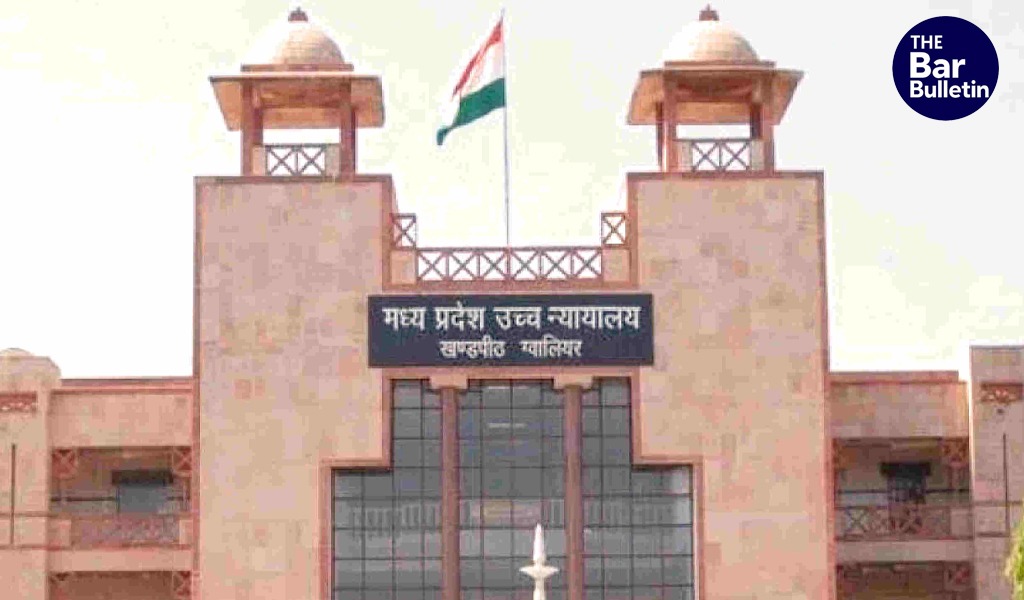

The Madhya Pradesh High Court has dismissed a writ petition, holding that the Petitioners fail to fulfil the eligibility criteria mentioned in the Madhya Pradesh Public Service Commission-issued advertisement. The Court further held that it lacks jurisdiction to interfere with the eligibility criteria prescribed by the competent authority, as the petitioner didn’t challenge.
The petitioner, aged 46 years, from the ST category, with requisite educational qualifications, applied for the post of Assistant Professor (Sociology) in accordance with Madhya Pradesh Public Service Commission’s Advertisement No. 47/2022 dated 30/12/2022, cleared the written examination, and was shortlisted for an interview. However, the interview under the 2022 recruitment was scheduled only in September 2025, by which time MPPSC issued Advertisement No. 29/2024 dated December 30, 2024, prescribing a reduced maximum age limit of 45 years as on January 1, 2025. As a result, the petitioner became overage and sought application of the earlier age limit as a compensatory measure.
While considering the matter, Justice Jai Kumar Pillai examined the scope of judicial interference in recruitment matters and held that each recruitment process is independent and governed by its own advertisement and eligibility conditions. The Court observed that even if there was a delay in concluding the earlier recruitment, such a delay does not create a vested right in favour of a candidate to seek eligibility under a subsequent advertisement framed on different terms. The Court further held that the doctrine of actus curiae neminem gravabit cannot be invoked to override clear and express eligibility criteria.
The Court rejected the plea of legitimate expectation, holding that no legitimate expectation can operate against an unambiguous policy decision, and noted that the petitioner had not challenged the validity or constitutionality of the revised age limit prescribed under Advertisement No. 29/2024. It was further observed that granting individual age relaxation through judicial intervention would amount to creating a special category, which is impermissible in-service jurisprudence.
Accordingly, the High Court held that the petitioner did not satisfy the age eligibility under Advertisement No. 29/2024 and that the Court lacked jurisdiction to interfere with or modify recruitment rules in the absence of a constitutional challenge. The writ petition was therefore dismissed as devoid of merit, and all pending applications were disposed of.
Appearances:
For the Petitioner – Advocate Kamlesh Manwani.
For Respondents – Advocate V.P. Khare and Raghav Shrivastava.
