


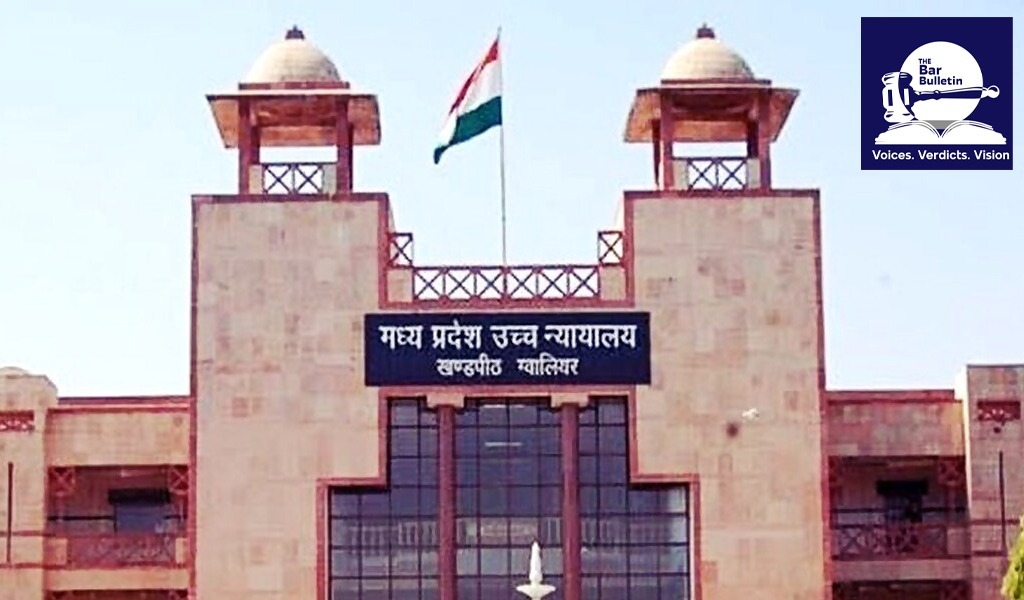

In an appeal filed under Section 23 of the Railways Claims Tribunal Act, 1987, before the Madhya Pradesh High Court to challenge an award dated 26-04-2011 passed by the Railway Claims Tribunal (Tribunal), a Single Judge Bench of Justice Himanshu Joshi set aside the impugned award and held the appellants entitled to compensation worth Rs. 8,00,000/- to be paid by the Railways.
On 11-11-2006, the son of the appellants was traveling in a passenger train with a valid ticket from Bhilai Power House Station to Durg. However, due to excessive rushing, the passengers were pushing each other, which resulted in the son falling from the train and eventually, his death. The matter was reported to the police, and an investigation was conducted.
After the appellants filed a claim before the Tribunal regarding their son’s death, the same was rejected by an order dated 26-04-2011, whereby it was found that the deceased was neither a bona fide passenger nor did he die because of falling from the train.
The Court perused the impugned award and noted that the Tribunal had rejected the claim mainly because the deceased’s traveling ticket was not produced. The Tribunal also observed that only the deceased’s Identity Card issued by the Railways was produced, and the claimants claimed it to be a valid ticket.
The Court said that the question to be decided was whether the deceased could be considered a bona fide passenger in the event of the non-availability of a traveling ticket. The Court perused the affidavit and the statement of the claimant, in which it was stated that information regarding the accident was given to him by one Deepak Kumar. It was noted that the DRM Report showed that the ticket produced before the Court was issued on 04-11-2006, with no nexus to the travel date, and that this finding was contrary to that of the Tribunal, which observed that it was not a ticket but an Identity Card.
The Court stated that it is well known that an Identity Card associated with an Indian Railway Season ticket can be valid for 7 years, and that the ID card is a separate document that must be presented along with the season ticket. Further, it was said that the Railways had not investigated which season ticket the ID card was issued for.
The Court referred to Kalandi Charan Sahoo v. General Manager, South Eastern Central Railway 2019 (12) SCC 387 and Bhola v. Union of India (2018) SCC OnLine Del and stated that the DRM Report was of no use since the same was filed within 12 months from the date of accident, was contrary to Sub-Rule (2) of Rule 6 of the Railways Passengers (Manner of Investigation of Untoward Incidents) Rules, 2020.
Further, another important aspect the Court considered was the failure of Railway functionaries to prevent gratuitous passengers from boarding trains. It was observed that it is the responsibility of the Railways to ensure that only valid ticket holders are on board, and if they fail to prevent a ticketless person from boarding, the Railways will be liable to pay compensation if that person is injured or dies in an accident. However, the Court added that it would be necessary to see that the person was not traveling with any mala fide intention and that there was no proof that the person was unauthorized.
The Court held that, in the absence of any specific evidence, the deceased could be presumed to be a bona fide passenger who had boarded the train with a valid ticket, as the investigation report and witness statements also indicated the same. It was established that the accident was a direct result of overcrowding caused by the overcrowding of ticketless travelers who were allowed to board the train.
The Court said that the failure of railway authorities to monitor and control boarding of ticketless passengers constitutes a serious lapse and that any omission regarding the safety of passengers as obligated under Sections 123(c) and 124A of the Railways Act, 1989 cannot be condoned. It was held that such failure amounts to contributory negligence on the part of the Railways Administration.
Thus, the Court set aside the impugned award and held the appellants entitled to compensation of Rs. 8,00,000/-, which was to be paid by the Railways within eight weeks.
Appearances:
For Appellants – Mr. Ratnakar Prasad Mishra
For Respondents – Mr. Satyendra Kumar Patel
