


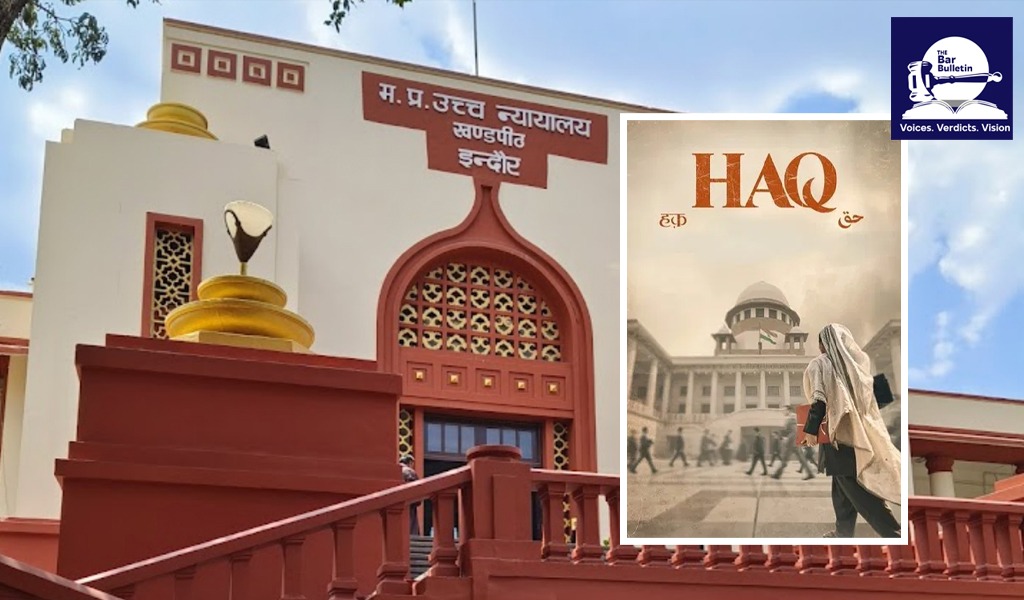

The Madhya Pradesh High Court at Indore has dismissed a writ petition filed by daughter of the late Shah Bano Begum, seeking to restrain the release, screening, and promotion of the film Haq, scheduled for release on November 7, 2025. The petitioner contended that the film dramatized her parents’ personal and matrimonial life without consent, thereby violating their privacy and dignity under Article 21.
Justice Pranay Verma held that the right to privacy and reputation extinguishes with a person’s death and cannot be inherited by legal heirs. Relying on K.S. Puttaswamy v. Union of India, (2017) 10 SCC 1 and Deepa Jayakumar v. A.L. Vijay, AIR 2021 Mad 167, the Court observed that posthumous privacy rights are not alienable. It noted that Haq was a dramatized and fictional adaptation of the book Bano: Bharat ki Beti inspired by the 1985 Shah Bano judgment, accompanied by a disclaimer clarifying that characters and events were fictitious.
The Court further held that once the Central Board of Film Certification (CBFC) issues a certificate, it is presumed that due scrutiny has been carried out, and any challenge must first be pursued under Section 5-E of the Cinematograph Act, 1952. The petitioner’s failure to avail this statutory remedy and the delayed filing barely a week before release rendered the writ petition untenable.
Finding no violation of fundamental rights or procedural impropriety in certification, the Court dismissed the petition as devoid of merit.
Appearance:
Shri Tousif Warsi, Advocate for the petitioner.
Shri Romesh Dave, Deputy Solicitor General for respondent No.1.
Shri H.Y. Mehta, Advocate with Shri Chinmay Mehta, Advocate for respondent No.3.
Shri Ajay Bagadia, Senior Advocate along with Shri Ritik Gupta, Advocate for the respondent No.5.
