


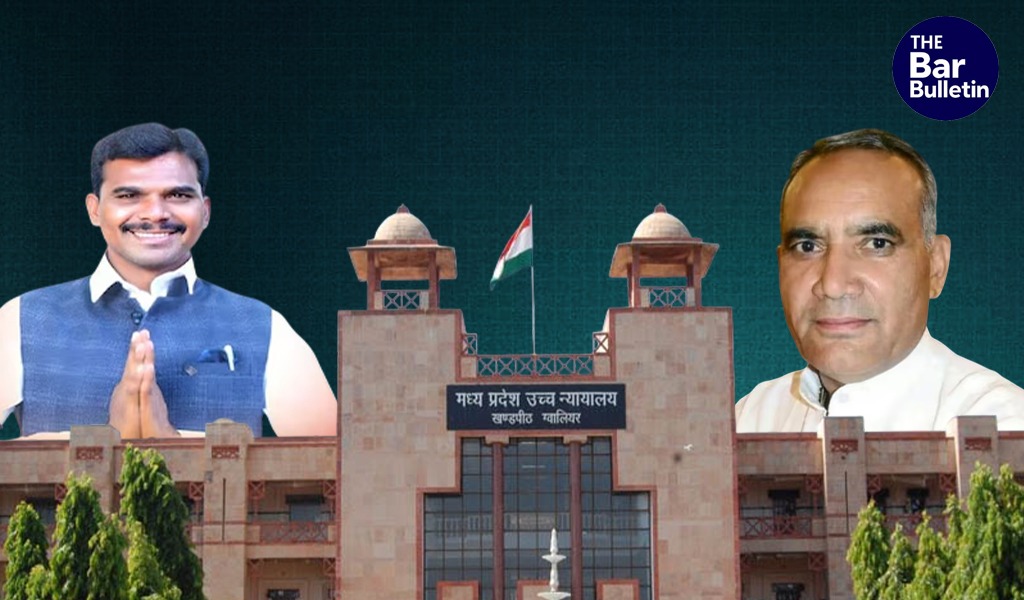

In an election petition filed before the Madhya Pradesh High Court under Section 80/81 of the Representation of People Act, seeking a declaration that the election of Mukesh Malhotra (respondent 1) is void and that Ramniwas Rawat (petitioner) is duly elected from Vijaypur, a Single Judge Bench of Justice G.S. Ahluwalia allowed the petition and declared the election of respondent 1 as null and void while declaring Ramniwas Rawat as MLA.
The Election Commission of India (ECI) issued a press note dated 09-10-2023, notifying and declaring the general election of the legislative assemblies of Madhya Pradesh. Ramniwas Rawat contested the election on the Indian National Congress (INC) ticket and was elected to the 16th assembly from Vijaypur. Thereafter, he resigned and joined the Bhartiya Janta Party (BJP), because of which the seat fell vacant, and a bye-election for the seat was declared by the ECI.
The election petitioner filed his nomination for the seat on BJP’s ticket, whereas, respondent 1 submitted his nomination paper on INC’s ticket. Respondent 1 was declared elected, and a certificate of election was issued. The contention of the present petition was that the affidavit to be filled in as per Form 26 had not been completed by respondent 1 and that he failed to disclose complete information regarding the criminal cases registered against him.
The cases against respondent 1 had been bifurcated by the petitioner, whereby group 1 mentioned cases that were disclosed but without giving complete details, and group 2 consisted of cases that were not disclosed at all.
Respondent 1 filed an application under Order 7 Rule 11 of the Code of Civil Procedure, 1908 (CPC), which was dismissed by this Court, and also filed an SLP before the Supreme Court, which was dismissed by an order dated 22-07-2025. Thereafter, he filed a written statement, admitting that all six criminal cases had been registered against him.
The election petitioner asserted that it is the fundamental right of every electorate to be informed about the criminal antecedents of a candidate and that respondent 1 deliberately mentioned ‘not applicable’ against two cases in which charges had already been framed. It was also contended that the respondent himself admitted that the residents of Vijaypur worship trees and that he was convicted for illegally cutting down 210 trees.
The Court noted that, regarding one of the crimes, the respondent had declared that charges had not been framed and had summarised the allegations as a verbal altercation, whereas charges under Sections 294, 323, and 506 of the Indian Penal Code, 1860 (IPC) had been framed. A similar declaration was noted in connection with another crime as well. It was stated that, although in his written statement the respondent claimed this was a bona fide mistake, he tried to shift the burden to the person who filled out the nomination paper in his evidence.
The Court stated that it was clear that the respondent was a law graduate and that his defence that the bona fide mistake had occurred due to a lack of knowledge was false. The Court stated that the moot question for consideration was what the purpose was behind declaring whether charges had been framed or not. It was said that ‘framing of charge’ is not a mere formality, but an application of judicial mind to the facts of a case to find out whether material collected by the investigator is sufficient to point out a grave suspicion that the accused might have committed the offence or not.
Further, the Court stated that a specific declaration by the candidate on this is necessary to inform the electorate that there is sufficient material against the candidate, warranting trial. The Court held that a specific declaration in Clause 5 of Part A of the affidavit that charges had not been framed was made with a clear intention to mislead the electorate.
The Court perused the orders framing charges against the respondent, wherein he was accused of using abusive language and assaulting three victims, including two women, and stated that the petitioner’s contention that the respondent had no respect for women appeared to be correct.
The Court noted that the respondent was convicted in a forest crime for an offence under Sections 26(1)(a)(g) and 66(i) of the Indian Forest Act. It was also noted that the respondent’s stand was that since he was sentenced to imprisonment till the rising of the court and a fine of Rs. 7000/- with default imprisonment of one month, he was not obligated to disclose the same.
The Court referred to Poonam v. Dule Singh & Ors. 2025 INSC 1284, wherein the Supreme Court had elaborately dealt with the evolution of law pertaining to disclosure of criminal antecedents and found it sufficient to mention that non-disclosure of complete information regarding the stage of pending cases, by itself, would amount to suppression of a material fact, resulting in a corrupt practice.
The Court noted that apart from being convicted of the forest offence, the respondent had also been convicted of assaulting the complainant with a shoe and of spreading hatred against a particular community, for which he was later acquitted. Even though the Court stated that disclosure of these cases was desirable, it was clarified that in view of Section 33-A of the Representation of the People Act, 1951, non-disclosure of these cases may not amount to a corrupt practice.
It was held that the suppression by the respondent had materially created an impediment in the free exercise of electoral rights and had deprived the voters from making an informed and advised choice. The Court held that this act by the respondent amounted to undue influence, and it was necessary to declare the result as null and void. Thus, Mukesh Malhotra was held guilty of corrupt practice, and his election in the bye-elections was declared null and void. It was stated that all adverse consequences as provided in the Representation of People Act, would follow.
Lastly, the Court declared Ramniwas Rawat as MLA from Vijaypur as he had secured the second highest votes in the bye-elections and directed the Election Commission as well as the Returning Officer to complete the formalities, while allowing the petition.
Appearances:
For Petitioner – Mr. MPS Raghuvanshi (Sr. Adv), Mr. Sanjay Dwivedi, Mr. Sankalp Sharma, Mr. Nipun Saxena, Mr. Dharmendra Dwivedi, Ms. Sonam Mittal, Mohd. Amir Khan, Mr. Manish Singh Gurjar, Ms. Deepali Dabas, Ms. Aadya Pandey, Ms. Tanya Agrawal, Mr. Dev Nagar, Ms. Namrata Tomar, Mr. Joyjeet Kumar Das, Mr. Harshit Raghuvanshi
For Respondents – Mr. Vivek K. Tankha (Sr Adv), Mr. Pratip Visoriya, Mr. Siddhant Gupta, Mr. Inder Dev Singh, Mr. Abhishek Singh Chauhan, Mr. Vishesh Dwivedi, Ms. Ayushi Sharma, Mr. Ravindra Sharma, Mr. Navnidhi Parharya, Mr. Priyanshu Yadav
