


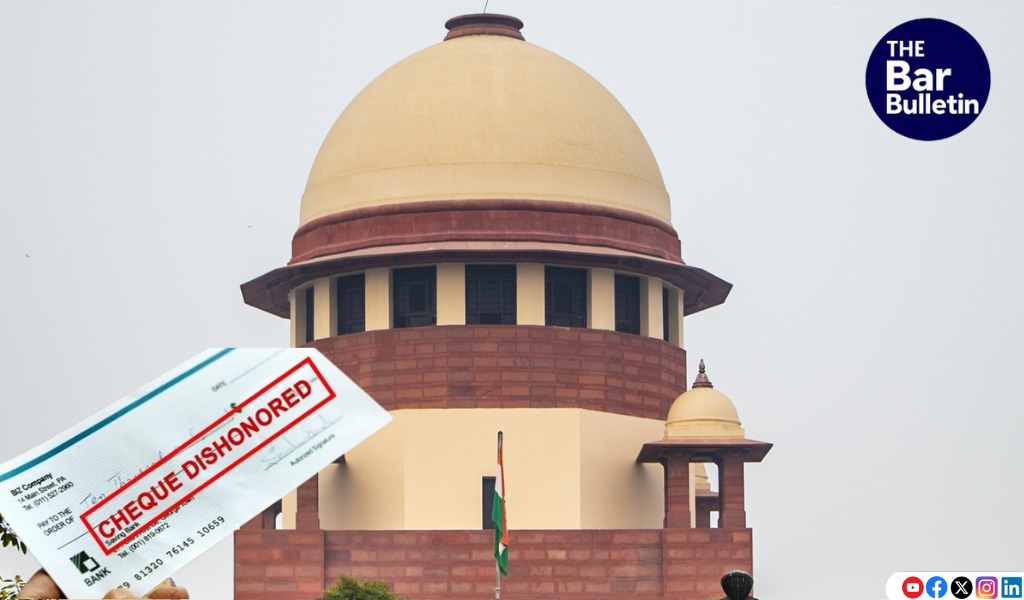

The Supreme Court has held that dishonour of different cheques issued on different dates, even if arising from the same transaction, can give rise to separate prosecutions under Section 138 of the Negotiable Instruments Act, 1881, and that quashing such complaints at the threshold is impermissible where disputed questions of fact are involved.
The case arose from an agreement to sell commercial units in Ghaziabad, Uttar Pradesh, under which the complainant paid ₹1.72 crore to the developer. Upon failure to execute the sale deeds within the stipulated time, cheques towards refund of the principal amount and an agreed appreciation amount were issued from the firm’s account, along with personal cheques issued by the proprietor as a guarantee. All the cheques were dishonoured on different dates, resulting in the filing of multiple complaints under Section 138 of the NI Act.
The Delhi High Court partly quashed one of the complaints on the ground that multiple proceedings arising from the same liability would amount to an abuse of process, while permitting the remaining complaints to continue. Aggrieved by the decision, both parties approached the Supreme Court.
A Bench of Justice Prashant Kumar Mishra and Justice Sanjay Karol held that each dishonoured cheque gives rise to a distinct cause of action once the statutory requirements under Section 138 are satisfied. The Court observed that whether the cheques were issued as alternatives, substitutions, or additional securities was a disputed question of fact which could not be adjudicated in proceedings under Section 482 CrPC. It accordingly restored the quashed complaint, holding that the High Court had exceeded its jurisdiction by conducting a premature evaluation of facts.
Dismissing the appeals filed by the accused, the Court further held that the remaining complaints prima facie disclosed the ingredients of an offence under Section 138 of the NI Act, clarifying that defences relating to absence of liability or prior repayment can only be examined during trial.
Accordingly, the Supreme Court restored the quashed complaint and directed that all proceedings be tried independently on their own merits, in accordance with law.
Appearance:
Appellant- Advocate Sameer Rohatgi, AoR Namit Suri, Advocate Rameezudin Raja, Advocate Pepakayala Geetanjali, Advocate Anish Singh.
Senior Advocate Harshvir Pratap Sharma, Senior Advocate Harshvir Pratapm Sharma, AoR Tejas Patel, Advocate Akul Krishnan, Advocate Sakshi Apurva.
Respondent- Senior Advocate Harshvir Pratap Sharma, AoR Tejas Patel, Advoate Akul Krishnan, Advocate Sakshi Apurva;
Advocate Sameer Rohatgi, AoR Namit Suri, Advocate Rameezudin Raja, Advocate Pepakayala Geetanjali, Mr. Anish Singh, Adv.
