


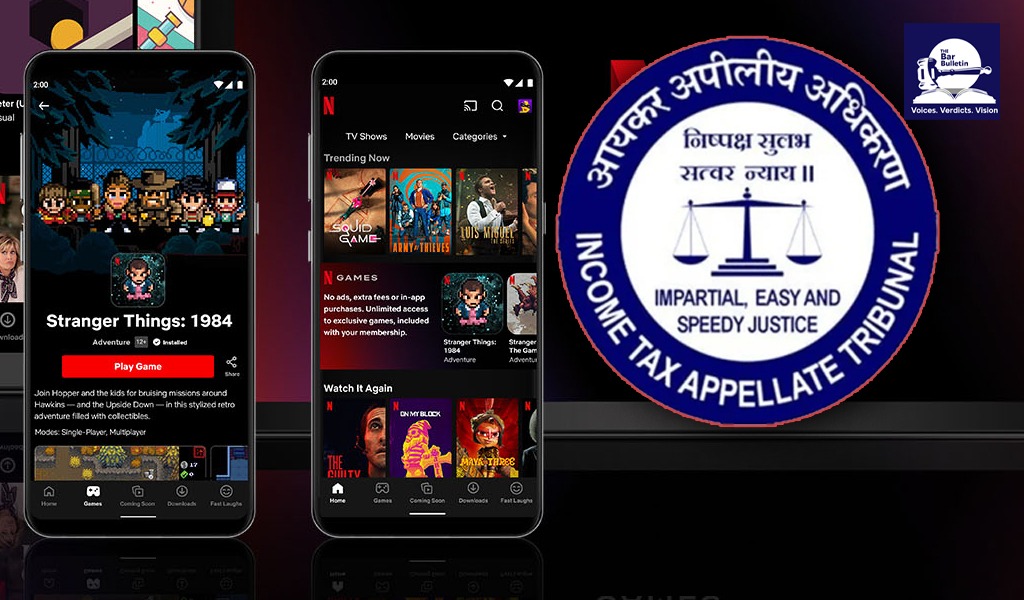

While holding recharacterization of Netflix Entertainment Services India (appellant) as a full-fledged entrepreneur or content provider contrary to law, the Mumbai Income Tax Appellate Tribunal (ITAT) accepted the arm’s length price determined by the appellant under the Transactional Net Margin Method (TNMM) and deleted the entire transfer pricing (TP) adjustment of Rs. 444.93 crores made in the hands of the appellant by treating it as a licensee of intellectual property owned by Netflix US.
Expressing concern over the increasing tendency of transfer-pricing officers (TPO) to conflate technological presence with economic ownership, the Tribunal held that the mere existence of servers, caches, or support personnel in a jurisdiction cannot by itself confer value-creation status. Unless an Indian entity controls, develops, or exploits the underlying intangible assets, its remuneration cannot exceed a routine distributor’s return.
The Tribunal clarified that the appellant’s functions are confined to distribution of access, marketing support, invoicing, and regulatory compliance, and it does not own any intellectual property or critical intangible assets. Further, the appellant bears no entrepreneurial risk, and all costs are reimbursed by its AE, i.e., Netflix US.
The Division Bench comprising Amit Shukla (Judicial Member) and Renu Jauhri (Accountant Member) observed that Netflix India’s FAR profile, asset composition, risk insulation, and contractual obligations unequivocally categorise it as a limited-risk distributor. Hence, attributing nearly half of Netflix’s global subscription revenue to its Indian subsidiary, which neither owns nor develops the underlying content or technology, violates the arm’s length principle enshrined in transfer pricing law.
The Bench went on to observe that entities engaged in marketing, promotion, and distribution of access to global OTT platforms are to be characterised as limited-risk distributors remunerated on a cost-plus or TNMM basis. Therefore, endorsing a royalty-based attribution absent local IP ownership is an improper approach, simply for making arm’s length price (ALP) additions.
The Bench also criticised the TPOs’ methodologies as offensive to the ALP principle codified in Article 9 of the OECD Model, by explaining that transfer pricing seeks parity between controlled and uncontrolled transactions, not the creation of income through internal allocation. Thus, to attribute 43% of global subscription revenue to an entity that neither owns nor develops the underlying content or technology is to violate the symmetry between function, asset, and risk, the triad that defines economic ownership.
Referring to TPO’s method as a textbook instance of circular reasoning to justify a notional benchmark, the Bench found that, having wrongly presumed that Netflix India is a licensor or owner of content and technology, the TPO has lifted royalty rates from unrelated third-party licensing agreements concerning film catalogues and software platforms transactions wholly alien to the appellant’s actual profile and constructed from them a blended royalty of 57.12% of revenue.
Briefly, the dispute arose out of a transfer pricing adjustment, treating Netflix India as a licensee of Netflix’s global content library and streaming technology. The TPO held that Netflix India should have paid deemed royalty and license fees for access to the intellectual property, far exceeding its declared profit margin of 1.36% on Indian operations. This adjustment, amounting to approx. Rs. 445 crores were confirmed by the DRP, who described Netflix India as an “extremely significant contributor” to Netflix’s global operations and a risk-bearing entity.
Appearances:
Advocates Porus Kaka, Divesh Chawla, and Harsh Shah, for the Appellant/ Taxpayer
Advocate Pankaj Kumar, for the Respondent/ Revenue
