


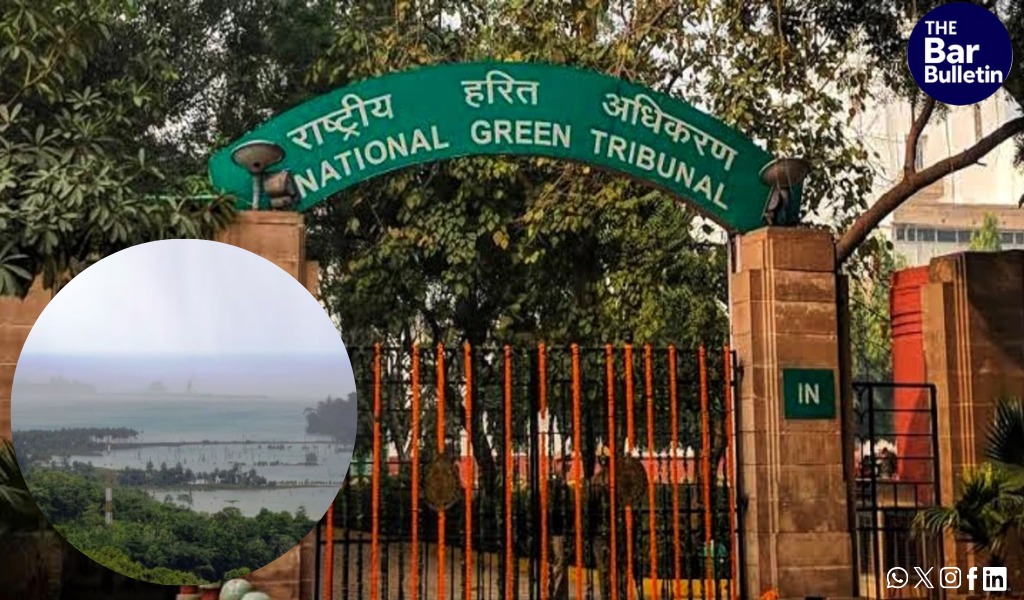

The National Green Tribunal’s Eastern Zone Bench at Kolkata on Monday dismissed a fresh batch of applications challenging the proposed International Container Transshipment Terminal (ICTT), township and power project in Great Nicobar Island, holding that no ground was made out to interfere with the environmental clearance already granted for the project.
A Bench headed by Justice Prakash Shrivastava, Chairperson of the Tribunal, disposed of the applications filed by environmental activist Ashish Kothari against the Ministry of Environment, Forest and Climate Change (MoEF&CC) and other authorities, observing that the issues raised had already been examined in the earlier round of litigation and subsequently addressed by a High-Powered Committee constituted on the Tribunal’s directions.
The applications alleged violation of the Island Coastal Regulation Zone (ICRZ) Notification, 2019, destruction of corals, inadequacy of environmental impact assessment data, and non-compliance with the Tribunal’s April 3, 2023 order. The applicant also sought punitive action against authorities for alleged willful breach of the earlier directions.
Rejecting these claims, the Tribunal noted that the High-Powered Committee had comprehensively examined all three outstanding issues: coral protection, adequacy of environmental data, and the project’s location vis-à-vis ICRZ-IA areas. It accepted the Committee’s findings that no major coral reefs existed within the project site at Galathea Bay and that scattered coral colonies in nearby areas would be safeguarded through scientifically approved translocation and long-term monitoring measures.
On the issue of environmental data, the Tribunal held that collection of single-season (non-monsoon) baseline data was in line with applicable EIA guidelines for port and harbour projects in the Andaman and Nicobar Islands, where no critical coastal erosion zones have been identified. It further accepted the conclusion of the National Centre for Sustainable Coastal Management that no part of the project falls within prohibited ICRZ-IA areas.
The Tribunal also reiterated the project’s strategic and national security significance, noting its location close to key international shipping routes and its stated role in strengthening India’s maritime and economic presence in the Indian Ocean region.
Emphasising the need for a balanced approach, the Bench observed that while environmental safeguards under the ICRZ Notification must be strictly enforced, development projects of national importance cannot be stalled on the basis of speculative apprehensions when adequate mitigation measures are built into the clearance conditions.
While dismissing the applications, the Tribunal directed the authorities concerned and the project proponent to ensure full and strict compliance with all environmental and coastal regulation conditions, warning that any violation at the execution stage would expose the project to legal and regulatory action.
