


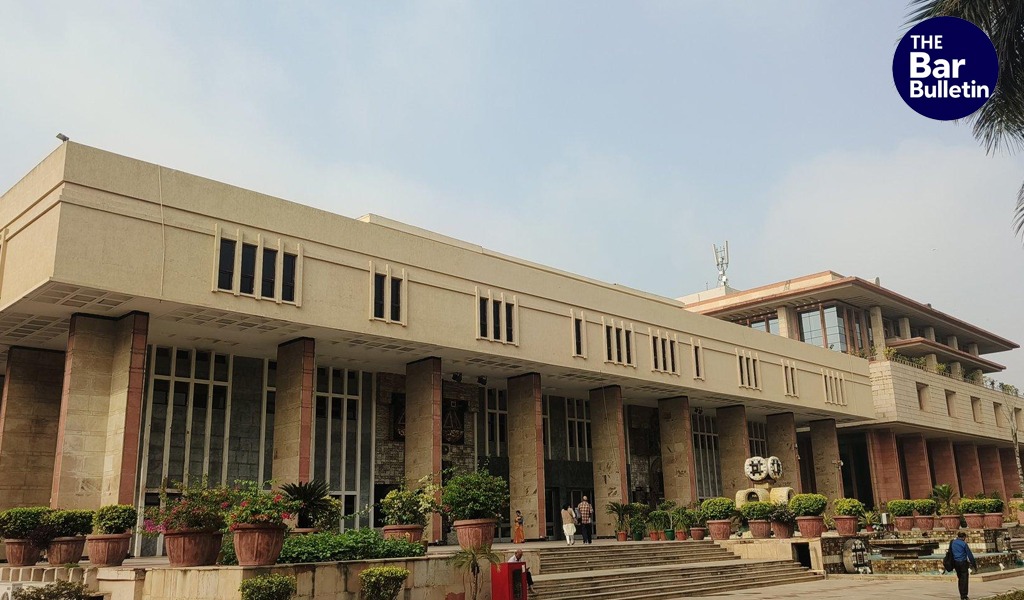

The Delhi High Court upheld the maintainability of a suit under Section 31 of the Specific Relief Act, holding that a non-executant can seek cancellation of an instrument where their rights are directly affected.
The dispute arose from competing claims over a Tihar property, where both parties relied on Agreements to Sell executed by the same vendor, one set of documents in favour of the respondent in 1988, and a subsequent Agreement to Sell executed in 2006 in favour of the appellant. Notably, neither party held a registered sale deed, and both asserted rights based on ancillary documents such as GPA, Wills, and receipts.
At the outset, the Court rejected the appellant’s challenge to maintainability, holding that the expression “any person” under Section 31 of the Specific Relief Act is of wide amplitude and includes persons deriving title from the same vendor. It clarified that a non-executant can maintain a cancellation suit where the impugned instrument, if left outstanding, poses a threat to their rights.
On merits, the Court addressed the central issue of competing claims in the absence of a registered conveyance. It observed that even though neither party had a registered sale deed, the Court is competent to assess better or superior title based on evidence and surrounding circumstances, holding:
“both the parties do not have a registered Sale Deed… it is manifestly evident that the respondent no. 1 has a superior right over the suit property.”
The Court found that the respondent’s rights, flowing from the earlier set of documents executed in 1988, prevailed over the subsequent transaction of 2006 executed by the same vendor.
Importantly, the Court also examined the defence of the appellant as a bona fide purchaser, and emphasised that such a purchaser is expected to exercise due diligence and vigilance before entering into a transaction. The Court underscored that a subsequent purchaser cannot claim protection where prior rights exist and could have been discovered through reasonable inquiry.
Reiterating the preventive nature of Section 31, the Court held that a person need not wait for an instrument to be enforced and may seek its cancellation to remove a cloud over title. It further clarified that the bar applies only where the impugned instrument is executed by a complete stranger to the plaintiff’s title, which was not the case here since both parties derived their claims from the same vendor.
Accordingly, the Court upheld the Trial Court’s decree declaring the 2006 Agreement to Sell as null and void and affirmed that the respondent had a superior right over the suit property.
Appearances:
For Appellant: Mr. Ashim Vachher, Sr. Adv. with Ms. Saiba. M. Rajpal, Advocate
For Respondent: Mr. Rajat Wadhwa, Mr. Gurpreet Singh, Ms. Anshika Juneja, Advocates
