


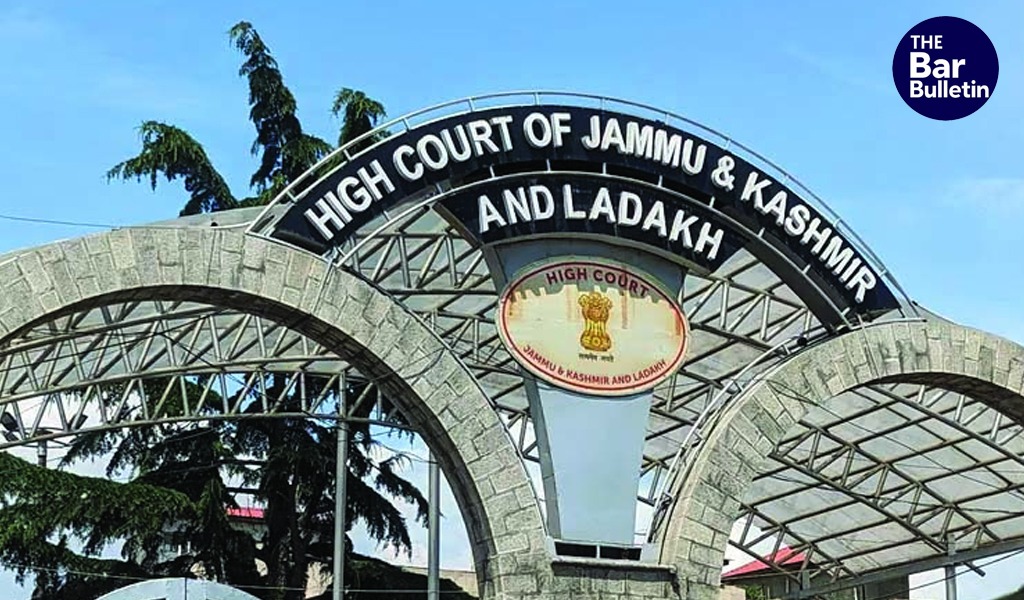

In an appeal filed before the Jammu & Kashmir and Ladakh High Court to assail a judgment of acquittal dated 12-10-2023 by the Additional Sessions Judge, Anantnag (Trial Court), whereby the respondents were acquitted of charges arising out of a First Information Report (FIR) for offences under Sections 376-D, 509, 506, 120-B, 201 of the Indian Penal Code, 1860 and Section 67 of the Information Technology Act, 2000, a Single Judge Bench of Justice Sanjay Dhar did not find any infirmity with the impugned judgment and dismissed the appeal.
On 29-04-2020, the prosecutrix lodged a report wherein it was alleged that the accused persons trespassed into her home where she was sitting with her two minor children and took them outside. Thereafter, they intoxicated and raped her while making a video of the act, which they circulated over WhatsApp. It was also alleged that the accused persons gave life threats to the prosecutrix in the event she informed the police.
Upon investigation, it was discovered that others were involved in the crime, and one person was taken into custody. Thereafter, the afore-mentioned offences were made out, and charges were framed.
At the stage of evidence, the accused persons made an application to shorten the proceedings before the Trial Court. Considering the evidence and the fact that the prosecutrix had turned hostile, the Trial Court, by a judgment dated 12-10-2023, acquitted the accused persons of charges under Section 376 of the IPC. Thereafter, on another application by the accused, the Trial Court acquitted the accused persons of all charges by exercising its powers under Section 362 of the Code of Criminal Procedure, 1973.
The Court perused the statement of the prosecutrix to test the merits of the contention regarding the legality of shortening the proceedings by the Trial Court and noted that the prosecutrix had mentioned that one of her relatives called her and informed her that some of her photos and videos were uploaded on Facebook. Hence, it was noted that she had turned hostile. In her cross-examination, the prosecutrix stated that the photographs were fake and mentioned that she had not been sexually assaulted.
The husband of the prosecutrix stated that he was informed of the incident by his wife, that one of the accused was his elder brother, that two of the accused were his nephews, and that another accused was also his brother.
The Court stated that the prosecutrix herself denied the occurrence and that, to prove an offence under Section 67 of the IT Act, the prosecution should have collected evidence to show that material in electronic form had been published or transmitted that could corrupt persons who read or saw it. The Court noted that the FSL expert’s report revealed that authentication tools were unavailable in the laboratory, which is why an opinion could not have been formed on the accused’s conviction for an offence under the IT Act.
Further, the Court stated that the investigating agency had not collected evidence to show that the photographs and videos seized during the investigation were published or transmitted via WhatsApp or Facebook. The Court stated that the case appeared to be one of fabricated allegations or an outcome of consensual sexual intercourse between the prosecutrix and the accused. Thus, it was held that the Trial Court was right in truncating the proceedings and acquitting the accused.
Failing to find any reason to interfere with the impugned judgment, the appeal was dismissed.
Appearances:
For Petitioner – Mr. Ilyas Laway, GA
For Respondents – Mr. Syed Sajad Geelani
