


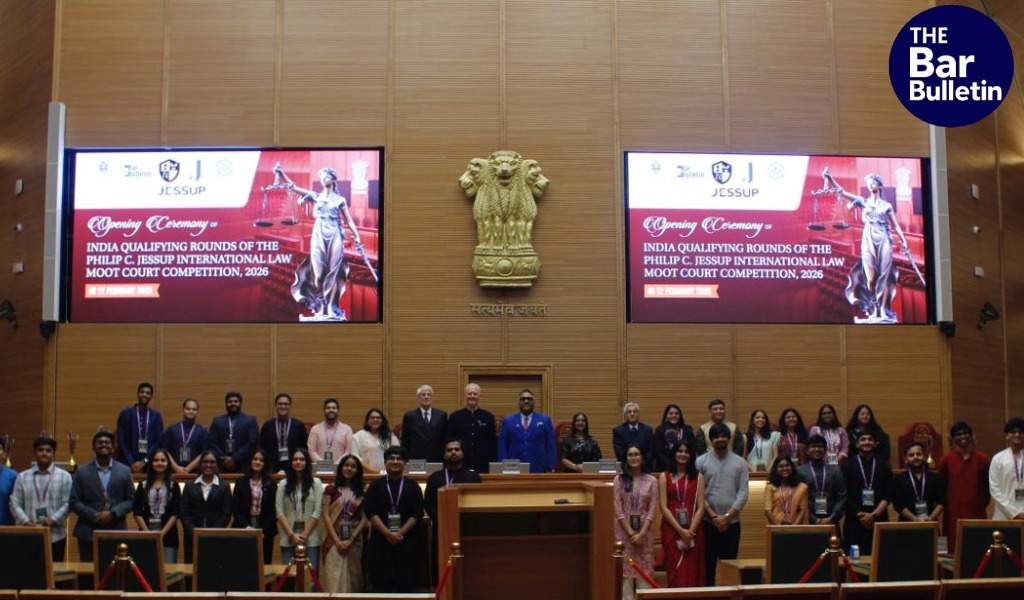

On an evening that felt equal parts pageant and pledge, the Nyayabhyasa Maṇḍapam, IMAANDAAR, at OP Jindal Global University, opened its doors to law schools across Indian with applications from 75 teams of which 65 have been qualified to participate, along with one friendly team from Bhutan, for the India qualifying rounds of the 67th Philip C. Jessup International Law Moot Court Competition. The ceremony set out a theme that, if international law’s authority is under pressure, mooting remains one of the most concrete ways to teach its language, defend its logic, and recruit the next generation of its practitioners.
A history in the making, as well as a constitutional reminder
Vice-Chancellor C. Raj Kumar opened with a blend of institutional pride and civic reflection. He situated the evening within the university’s meteoric rise. From a modest intake of one hundred students in 2009 to a multi-disciplinary institution counting tens of thousands, he celebrated the Nyayabhyasa Ma??apam itself as history in the making. “You are pioneers,” he told the assembled students and faculty, noting that this was the first competitive moot to be held in the world’s largest moot court.
Professor Raj Kumar threaded the launch of the grand moot hall into a longer story about nation-building. Recalling India’s constitutional founding amidst the “darkness” of partition and deprivation, he urged students to see law as an instrument of hope: the Constitution was written by people who imagined a future far better than their present, and that imagination, coupled with institutions, even raised life expectancy and transformed civic life. Mooting, he said, trains precisely the skills necessary to sustain democratic institutions and public trust in the rule of law, i.e., rigorous argumentation, fidelity to process, and the habit of speaking truth to power.
He closed with an unexpectedly warm personal anecdote, the family conversation that sent him to law school decades ago and using it to remind students that career choices change across generations. “You are the future,” he said, inviting many in the room to consider legal academia by way of teaching, research, and mentorship as modes of shaping law for generations to come.
Enjoy the process, build friendships, keep faith
Executive Dean Dipika Jain offered a short, gracious exhortation and encouraged all the students to make sure to enjoy the process. Her words were both encouragement and calibration, because as she said, recognition of the hard work that precedes competition, and an insistence that mooting is a formative space where skills and friendships are built. She thanked the organizers and volunteers and reminded participants that standing to argue is itself an act of intellectual courage.
Why Jessup matters when the law looks fragile
Professor B.S. Chimni, renowned international law scholar and the pioneer of TWAIL, delivered the ceremony’s most pointed diagnosis of the moment. He began by acknowledging what some contemporary critics loudly assert: that international law is, at times, treated as peripheral or even irrelevant by great powers. He pointed to some recent and rather blunt public statements by officials that have been used to justify such dismissal and then offered the counterargument central to his address and his long-standing and celebrated work on TWAIL that, for many weaker states, international law is the only shield against imperial power. In such circumstances, training a generation fluent in the grammar of international law is not an academic luxury but a political necessity.
Professor Chimni traced the intellectual lineage of the Jessup enterprise, i.e., its problem-solving liberal internationalism, and observed that the competition’s pedagogy equips students with the doctrinal and rhetorical tools required in international adjudication. He noted the extraordinary growth of Jessup in India (recalling that an Indian law school first won the competition only in 1999) and urged participants to remain in contact after the rounds, building networks that can sustain a Global-South voice in international legal debates.
A “Tale of Two Cities” and the persistent relevance of law
Drawing on memory and mentorship, Professor Guðmundur Eiríksson, a former judge of the ITLOS and law professor, opened with Charles Dickens: “It was the best of times, it was the worst of times.” He used this paradox to frame international law’s dual character; its capacity both to confront horrific politics and to provide legal remedies even in moments of extreme tension.
By citing the International Court of Justice and canonical scholarship. Professor Erickson urged a measured optimism: the court and related institutions remain, imperfectly, instruments through which the legal consequences of political violence can be addressed.
His remarks were a paean to the three-fold professional ideal, i.e., scholarship, craft, and idealism, embodied by Judge Philip Jessup and invoked the conviction that “this too shall pass,” that the temporary eclipse of faith in international law must be met with sustained commitment rather than despair.
Justice, judges and the power of public argument
Justice Michael D. Wilson spoke with the cadence of a jurist who has spent his life on oral advocacy. He brought the courtroom to life as a crucible of transparency and truth, and described mooting as training in the “most powerful force civilisation has”: the rule of law exercised through public argument. Inviting students to consider the bench and becoming future judges, he distilled two indispensable qualities of a judge, honesty and independencem and urged advocates to master facts and law with equal rigour. His applause for the Nyayabhyasa Mandapam was more than mere aesthetic; rather, it was an argument that spaces dedicated to public oral advocacy shape judges and lawyers who will protect the weak and hold power accountable.
Voices that disturb and make history heard
Professor Anjali Chawla, the Director of JGLS Moot Court Society, who has relentlessly stewarded the society’s work, read the competition through a civic and humanistic lens. Echoing Hannah Arendt’s and James Baldwin’s insistence that speech and art disturb complacency, she urged participants to remember the human stories at the heart of doctrinal disputes. The Jessup proposition on indigenous peoples and extractive projects, she said, asks competitors not only to parse doctrine but to listen: to make law speak for memory, culture and identity.
Assistant Faculty Director Apoorv Gupta closed the ceremony on an evocative quote borrowed from H.L.A. Hart, a reminder that the vitality of law depends on those who take its rules seriously enough to interpret and defend them. He thanked the international guests, the judges, faculty and the Moot Court Society, and invited all present to put in all their heart for the competition while also enjoying the experience.
A living classroom for troubled times
Whether the theme is constitutional imagination (as Professor Raj Kumar urged), the Global-South’s defensive need for international law (as Professor Chimni insisted), the best of times or the worst of times (as Professor Eiríksson said) or the day-to-day craft of judges and advocates (as Justice Wilson described), the Jessup rounds are a living classroom for grappling with legal complexity and moral urgency.
As students disperse into three days of rounds inside the Nyayabhyasa Ma??apam, they do so under a set of expectations voiced repeatedly from the dais: argue with rigor, listen with humility, build lasting networks, and consider academia as one path to shaping law’s future. The competition’s proposition on indigenous rights and extractive projects places those expectations exactly at the crossroads where law meets lived experience. If international law is to retain its force, as the speakers said, it will be because new advocates learned to make it speak for justice.