


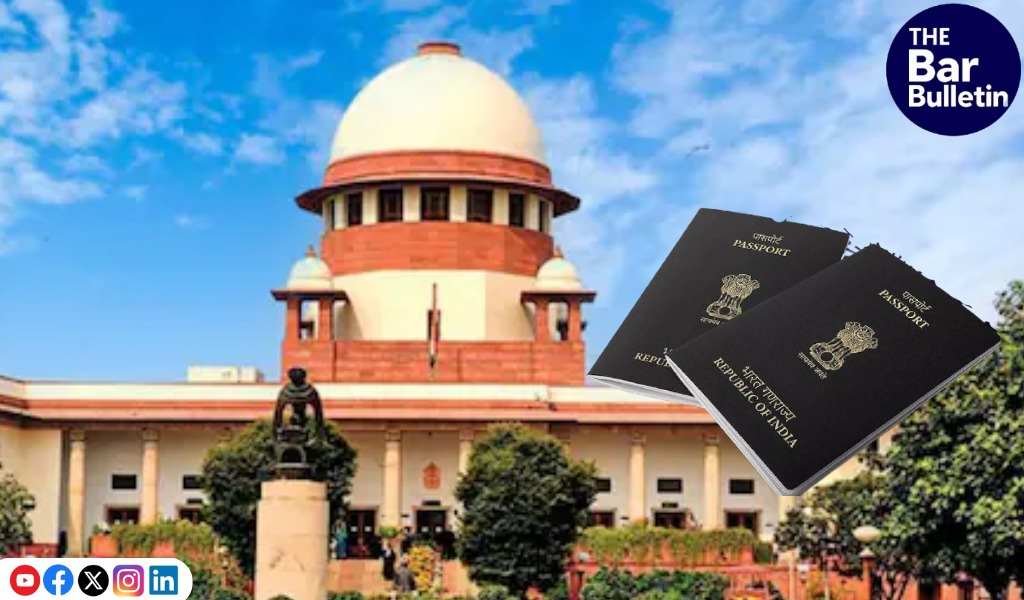

The Supreme Court allowed the appeal, setting aside Calcutta High Court’s orders and directed re-issue of the appellant’s passport for ten years.
The appellant, an Indian citizen and accused in an NIA case and a convicted appellant in a CBI case, approached the Supreme Court after the Calcutta High Court refused relief. He sought renewal of his ordinary passport, which expired on 28 August 2023, relying on permissions granted by the Delhi High Court and the NIA Court, Ranchi. The core legal issue was whether Section 6(2)(f) of the Passports Act, 1967, read with notification GSR 570(E) dated 25.08.1993 and the MEA Office Memorandum dated 10.10.2019, still barred re-issue despite those judicial permissions.
The appellant’s passport was deposited with the NIA Court pursuant to an earlier Jharkhand High Court order restricting his travel. The NIA Court on 10.07.2023 allowed release of the passport for renewal, with a bar on obtaining visas or travelling abroad without its permission and a direction to redeposit the renewed passport. On 04.09.2023, the Delhi High Court granted no objection for renewal for ten years, retaining the condition that he shall not leave India without its permission.
The Regional Passport Office, Kolkata, nonetheless treated Section 6(2)(f) an absolute bar unless the criminal court simultaneously authorised a specific foreign trip, and declined to re-issue a ten-year passport. A single judge and then a Division Bench of the Calcutta High Court upheld this view, prompting the present appeal.
The Union contended that GSR 570(E) requires the criminal court to specify either the period of passport validity or the period of travel abroad, failing which only short-period passports are possible, and that no such express permission to depart had been granted in the NIA case.
The appellant argued that he fell within the exempted class under GSR 570(E) because criminal courts had consciously allowed renewal while retaining strict prior-permission control over any travel abroad.
The Supreme Court Bench comprising Justice Vikram Nath and Justice Augustine George Masih rejected this narrow reading, holding that GSR 570(E) does not demand a one-time, trip-specific licence and that courts may instead permit renewal while reserving full control over each instance of travel, which equally satisfies the statutory objective of ensuring the accused’s presence.
The Court analysed Sections 5, 6, 7, 8, 9, 10 and 22 of the Passports Act along with Rule 12 of the Passport Rules, notification GSR 570(E) and the 2019 OM, and held that renewal or re-issue is governed by the same statutory conditions as first issue, but subject to exemptions validly granted under Section 22.
It explained that GSR 570(E) creates a controlled exemption for persons with pending criminal cases, allowing passports where the criminal court has applied its mind and imposed conditions, and that the notification provides default validity rules but does not create any new absolute bar. The Court found that the NIA Court had granted no objection for renewal (with conditions) and the Delhi High Court had expressly authorised ten-year renewal while retaining its own travel-permission condition.
These orders, read together, satisfied the requirement of “permission to depart from India” within GSR 570(E), even though they did not pre-sanction particular trips. The Court cited Vangala Kasturi Rangacharyulu v. CBI[1] to emphasise that conviction plus a pending criminal appeal does not empower the passport authority to refuse renewal solely on that basis. It also relied on Article 21 jurisprudence to reiterate that the right to travel abroad and to hold a passport is part of personal liberty.
In result, the Supreme Court allowed the appeal and set aside both the single judge and Division Bench decisions of the Calcutta High Court, holding that they erred in treating Section 6(2)(f) as an inflexible bar despite the statutory exemption regime and the criminal courts’ permissions. The Court directed the respondents to re-issue an ordinary passport to the appellant for the normal period of ten years, within four weeks of production of the judgment before the RPO, Kolkata, subject to usual procedural requirements.
The passport will remain strictly subject to existing and future orders of the NIA Court, Ranchi, and the Delhi High Court, including that the appellant shall not leave India without prior permission of the concerned court and shall deposit the passport there as and when directed. The Court clarified that its ruling is confined to the interplay of the Passports Act, GSR 570(E) and the OM in this factual matrix, that it does not affect the merits of the criminal proceedings or the powers of those courts to vary bail or travel conditions, and that the passport authority retains its impounding and revocation powers under Section 10 if warranted by future developments.
Appearances:
For Petitioner(s): Mr. Anup Kumar, AOR; Ms. Gauri Subramanium, Mrs. Shruti Singh, Mrs. Neha Jaiswal, Mr. Shivam Kumar, Mr. Abhisek Kumar, Ms. Vartika Vaishnavi, Advocates.
For Respondent(s): Mrs. Aishwarya Bhati, A.S.G.; Mr. Raj Bahadur Yadav, AOR; Ms. Chitrangda Rastravara, Mr. Gopi Chand, Mr. Ashok Kumar B, Dr. Arun Kumar Yadav, Mr. Raghav Sharma, Advocates.
[1] Vangala Kasturi Rangacharyulu v. Central Bureau of Investigation, 2021 SCC OnLine SC 3549
