


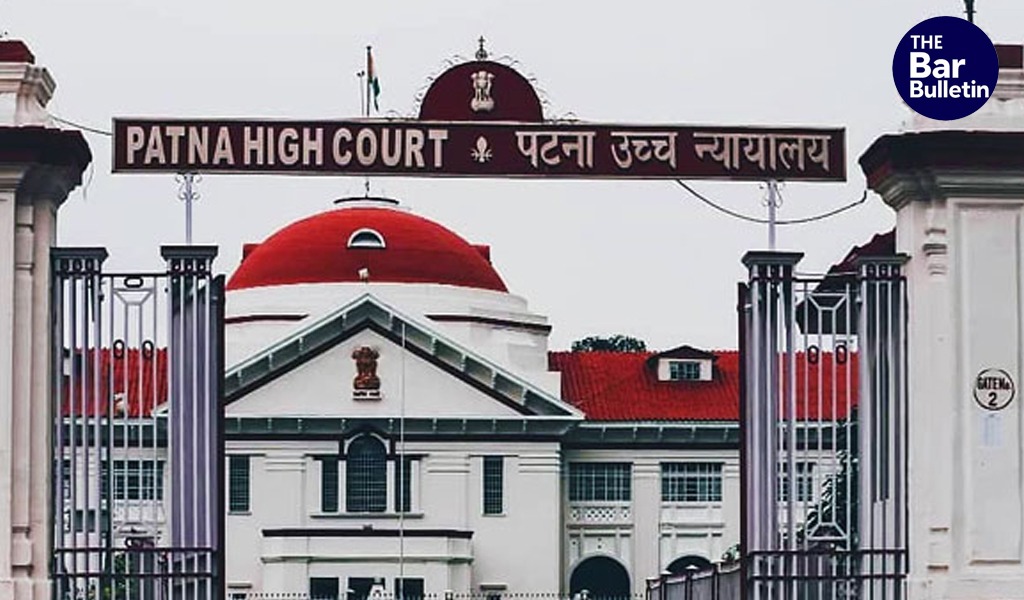

The Patna High Court has held that a constitutional court can grant remedy in public law for the violation of fundamental rights. Citing the Supreme Court’s judgment in Nilabati Behera (Smt) Alias Lalita Behera vs. State of Orissa [AIR 1993 SC 1960], the High Court affirmed that compensation can be awarded based on strict liability for the contravention of fundamental rights, and the principle of sovereign immunity is not an applicable defence.
The Court stated that refusing compensation for such a gross violation of the fundamental right to liberty would be a mere “lip-service” to the right itself. Furthermore, when the State is made liable for costs or compensation due to the misuse of power by its officials, the amount should be recovered from the erring officials.
The Court held that the present case was a clear case of unlawful arrest and detention, resulting in the petitioner suffering incarceration for over two and a half months due to the misuse of power by the police and the failure of the lower court to protect his liberty. Accordingly, the Court directed the immediate release of the petitioner from the observation home.
For the physical and mental agony suffered, the Court awarded compensation of Rs. 5 lakh to be paid by the State to the petitioner. Additionally, a litigation cost of Rs. 15,000 was awarded to the petitioner. The Court also directed the Director General of Police, Bihar, to conduct an inquiry and ensure the awarded compensation and costs are realized from the salaries of the erring officials responsible for the unlawful arrest.
The Division Bench comprising Justice Rajeev Ranjan Prasad and Justice Ritesh Kumar observed that the petitioner’s arrest was conducted in complete disregard of the established legal procedure, constituting a gross violation of his fundamental rights under Article 21 of the Constitution.
The Bench noted that once a chargesheet had been filed showing the petitioner as not sent up for trial, it was incumbent upon the I.O. to seek the court’s permission for any further investigation, which was not done. The Bench, therefore, criticized the Magistrate for mechanically remanding the petitioner to custody without applying judicial mind to the fact that he was not a charge-sheeted accused.
The Bench further observed that the DIG’s directive to investigate “assuming the allegations true” was contrary to the cardinal principle of presumption of innocence in criminal jurisprudence. Thus, the Bench found that the sole basis for the arrest was the DIG’s supervision note, as the I.O. had failed to collect any further cogent material against the petitioner.
Briefly, the petitioner, Md. Jahid, was named as one of fourteen accused in Puraini P.S. Case No. 128 of 2025, lodged on 11.07.2025 in connection with a land dispute. A counter-case was also filed by the petitioner’s mother. During the initial investigation, the Investigating Officer (I.O.) found insufficient material against ten of the accused, including the petitioner. Consequently, when chargesheet was filed on 01.09.2025, the petitioner was listed in Column No. 12 as an individual not sent up for trial.
Subsequently, upon a complaint by the informant, the Deputy Inspector General of Police (DIG), Koshi Range, issued a supervision note directing the I.O. to arrest the remaining accused persons. Acting solely on this directive and without collecting any new evidence or seeking permission from the court for further investigation, the I.O. arrested the petitioner. It was later established that the petitioner was a juvenile, approximately 15 years and 6 months old at the time of the alleged offence.
Appearances:
Advocates Shashwat Kumar, Aman Alam, and Amarnath Kumar, for the Petitioner
Advocate P.N. Sharma, for the Respondent
