


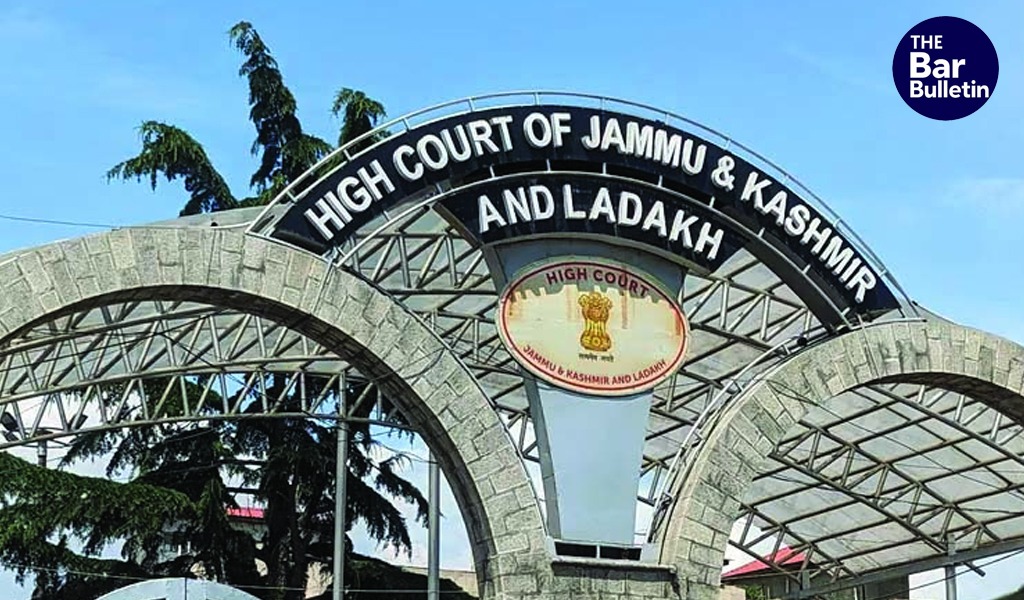

In a writ petition filed before the Jammu & Kashmir and Ladakh High Court against an order dated 11-05-2021 by the Additional Secretary, Jammu and Kashmir Legislative Assembly Secretariat, whereby the petitioner was suspended from his service, a Single Judge Bench of Justice Rahul Bharti quashed the impugned order and restored the petitioner to his service at the post from which he was suspended.
The petitioner, a government employee, was appointed as a Class-IV employee in 2014 and was thereafter suspended by the Secretary, J&K Legislative Assembly, Civil Secretariat. The petitioner contended that he had been discharging his duties to the best of his abilities.
It was further asserted that a First Information Report (FIR) was registered by the Police Station vigilance Organization, Jammu, against the petitioner’s father, who was accused of committing an offence under Section 5 of the J&K Prevention of Corruption Act, 2006. The father was arrested in 2017 and was later released on bail.
The petitioner contended that the matter of suspension of a government employee is covered by the Jammu and Kashmir Civil Services (Classification, Control, and Appeal) Rules, 1956, and that he could not be held liable because of his father’s implication in the said FIR. It was submitted that if the FIR were to serve as the basis for the petitioner’s suspension, it should have occurred immediately after the FIR was registered, not after six years.
The Court noted that, even though the respondents contended that they had initiated a regular departmental inquiry against the petitioner, no order setting up the inquiry was referred to in their reply. It was said that the very fact that the suspension order had no context relatable to the petitioner in terms of the discharge of his duty rendered the suspension order bad.
It was said that the basis of criminal jurisprudence is that penal acts do not pass on to the legal heirs of an accused person. The Court stated that even if the petitioner’s father was involved in illegal acts, it would not mean that the petitioner was to be perceived, projected, or subjected to bad treatment, as was done in the impugned suspension order.
Thus, the Court held that the impugned order was utterly misconceived and quashed the same while restoring the petitioner to his service at the post from where he was suspended.
Appearances:
For Petitioner – Mr. Vikram Sharma (Sr. Advocate), Mr. Sachin Dev Singh
For Respondents – Mrs. Monika Kohli (Sr. AAG)
