


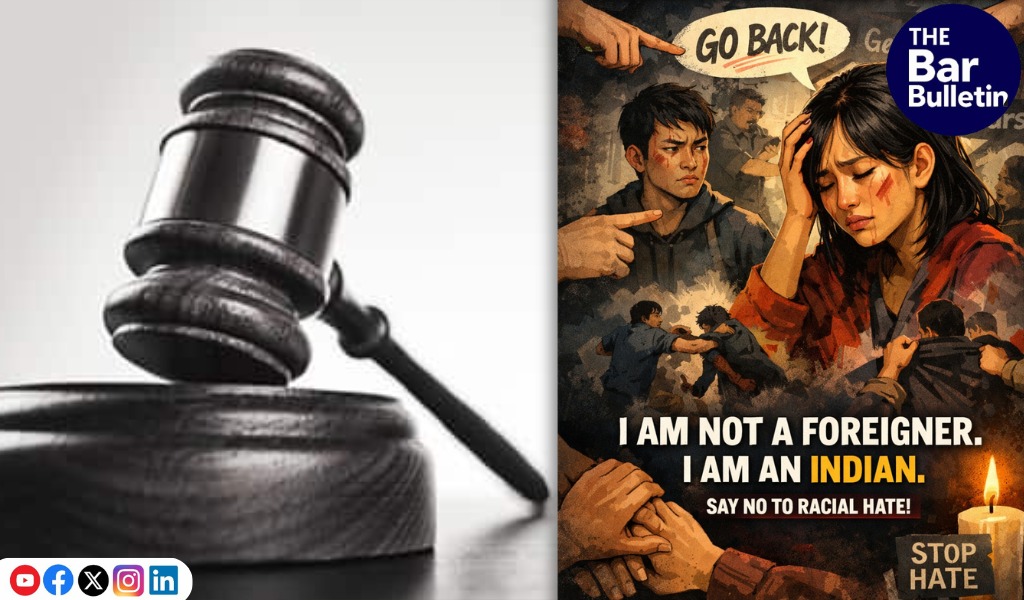

A Public Interest Litigation (PIL) has been filed on December 29, 2025, before the Supreme Court seeking judicial intervention to address ‘a continuing constitutional failure reflected in repeated instances of racial abuse, dehumanisation, and violence against Indian citizens belonging to the North-Eastern States and other frontier regions, who are routinely targeted across the country solely due to their physical appearance and ethnic features, and are subjected to racial slurs such as “Chinese” or “chinky”.’ This leads to ‘social exclusion, psychological trauma, and, in extreme cases, fatal violence’, the PIL stated.
The petition, filed by Advocate-on-Record Anoop Prakash Awasthi under Article 32 of the Constitution, has been triggered by the alleged racially motivated killing of a 24-year-old MBA student from Tripura, who succumbed to injuries on December 27, 2025, following an assault in Dehradun, Uttarakhand. According to the petition, the victim and his younger brother were subjected to racial slurs linked to their North-Eastern appearance before the assault escalated into fatal violence.
Placing reliance on parliamentary replies of the Ministry of Home Affairs from 2017, the petitioner contends that the Union Government has long acknowledged incidents of racial attacks against North-Eastern citizens but has failed to establish any dedicated statutory or institutional framework to address such crimes. The petition argues that racially motivated violence continues to be treated as ordinary crime, resulting in dilution of its constitutional gravity and erasure of bias motivation at the investigation stage.
The PIL highlights that even after the enactment of the Bharatiya Nyaya Sanhita, 2023 (BNS) & Bhartiya Nagarik Suraksha Sanhita, 2023 (BNSS), there is no effective mechanism mandating recognition of racial motivation at the stages of FIR registration, investigation, or prosecution. It is argued that this legislative and institutional vacuum violates Articles 14, 15, 19, and 21 of the Constitution, as well as the constitutional value of fraternity enshrined in the Preamble.
Invoking the Supreme Court’s decision in Vishaka v. State of Rajasthan, the petitioner has sought interim judicial guidelines until appropriate legislation is enacted. The reliefs sought include recognition of racial slurs as a distinct category of hate crime, creation of nodal agencies at the Centre and State levels, establishment of dedicated police units to deal with racial crimes, and sensitisation programmes to address systemic discrimination against North-Eastern citizens.
The matter has been filed as a Public Interest Litigation and is yet to be taken up for hearing by the Supreme Court.
IN THE SUPREME COURT OF INDIA EXTRA-ORDINARY WRIT JURISDICTION Click here