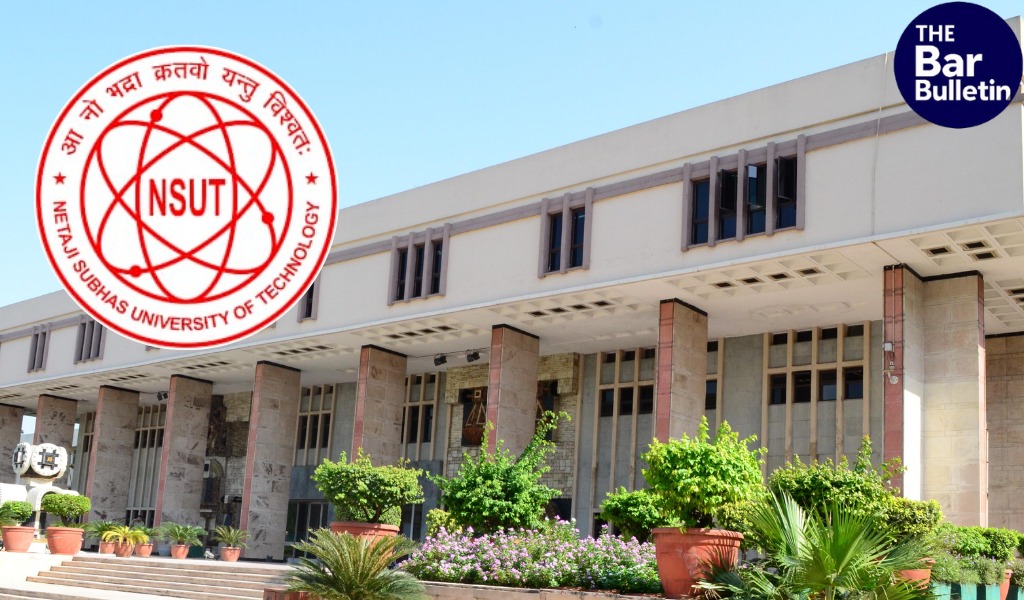

The Delhi High Court has observed that an individual appointed under the special provisions of Statute 16 of the First Statutes is considered an ‘employee’ under Section 2(k) of the Delhi Netaji Subhas University of Technology Act, 2017. Hence, the termination of such an employee on grounds of misconduct must adhere to the procedure laid down in Statute 24(4) of the First Statutes, which requires providing a reasonable opportunity of showing cause against the proposed action.
Furthermore, the Court clarified that any administrative action leading to civil consequences, particularly removal from employment based on allegations of misconduct, must comply with the principles of natural justice. This includes the right to a pre-decisional hearing and the opportunity to confront the evidence forming the basis of the action. The Court also said that a post-decisional hearing does not cure the procedural defect, especially when the adverse material is not disclosed to the affected individual.
The Court held that there was no good ground to interfere with the judgment and order passed by the Single Judge, and dismissed the intra-court appeal filed by the Netaji Subhash University of Technology. The Court also upheld the decision to quash the termination notice and affirmed the direction for the appellant-University to issue a fresh Show Cause Notice in accordance with the law, thereby allowing the respondent an opportunity to respond to the allegations before any fresh decision is taken.
The Division Bench comprising the Chief Justice Devendra Kumar Upadhyaya and Justice Tejas Karia observed that the University’s First Statutes provide for two modes of appointment: a regular mode under Statute 15 and a special mode under Statute 16, which empowers the Board to invite a person of high academic distinction to a post.
The Bench noted that the procedure used to appoint the respondent did not conform to the regular appointment process under Statute 15, as the Selection Committee’s composition was different and there was no evidence of a widely published advertisement. The Bench also found that the respondent’s appointment was referable to Statute 16 of the First Statutes. Consequently, the Bench opined that the respondent qualifies as an ‘employee’ under Section 2(k) of the Delhi Netaji Subhas University of Technology Act, 2017.
It was an admitted fact that no opportunity was afforded to the respondent before the termination notice was issued, remarked the Bench, while pointing out that even if Statute 24(4) were not applicable, the principles of fair play and natural justice necessitate giving an opportunity of hearing when an action with civil consequences, such as removal from employment for alleged misconduct, is taken.
Thus, the Bench concurred with the Single Judge that the post-decisional hearing provided to the respondent was inadequate as he was never confronted with the material evidence against him, namely the student complaints and the committee’s report.
Briefly, the respondent was appointed as a Visiting Faculty in the Department of Mathematics at the appellant-University, following the recommendation of a Selection Committee, and an Offer of Appointment was issued for an initial period of one year, which the respondent accepted.
In the meantime, the University received complaints from students alleging that the respondent was not taking classes properly and had incorrectly marked answer sheets. A committee formed by the University re-evaluated the answer sheets of 223 students and found cause to upgrade the marks of 194 students. Based on these findings and a recommendation from the Head of the Department (Mathematics), the University issued a termination notice to the respondent with immediate effect.
The respondent challenged this termination by filing a writ petition, during the pendency of which, the University provided the respondent with a post-decisional personal hearing and passed a speaking order justifying the termination. The Single Judge however, quashed the termination notice, and directed the University to issue a fresh Show Cause Notice (SCN) along with all relevant documents.
Appearances:
Advocates Avnish Ahlawat and Nitesh Kumar, for the Appellant
Advocates Tushar Singh and Akshra Arshi, for the Respondent
