



The Bombay High Court has ruled that a post-employment restrictive covenant that prevents an individual from exercising a lawful profession is prima facie a ‘restraint of trade’ and void under Section 27 of the Indian Contract Act, 1872. Such a covenant cannot be enforced against an employee who is not a signatory to the agreement containing it and has not received any consideration for such a restriction.
The Court went on to observe that a party seeking equitable relief under Section 9 of the Arbitration and Conciliation Act, 1996, must approach the court promptly and with clean hands, making a full and candid disclosure of all material facts. Substantial delay and suppression of vital information are grounds for refusing such relief.
Emphasising that the power under Section 9 of the 1996 Act to grant interim measures against a third party to an arbitration agreement must be exercised sparingly and is generally limited to preserving the subject matter of the arbitration, the Court stated that an order cannot be wholly directed against a third-party concerning property that does not form the subject matter of the dispute between the arbitrating parties.
The Court clarified that an injunction will not be granted where damages are an adequate remedy, and if the petitioner can be compensated with monetary damages for the alleged breach, the court is less likely to grant the drastic relief of an injunction.
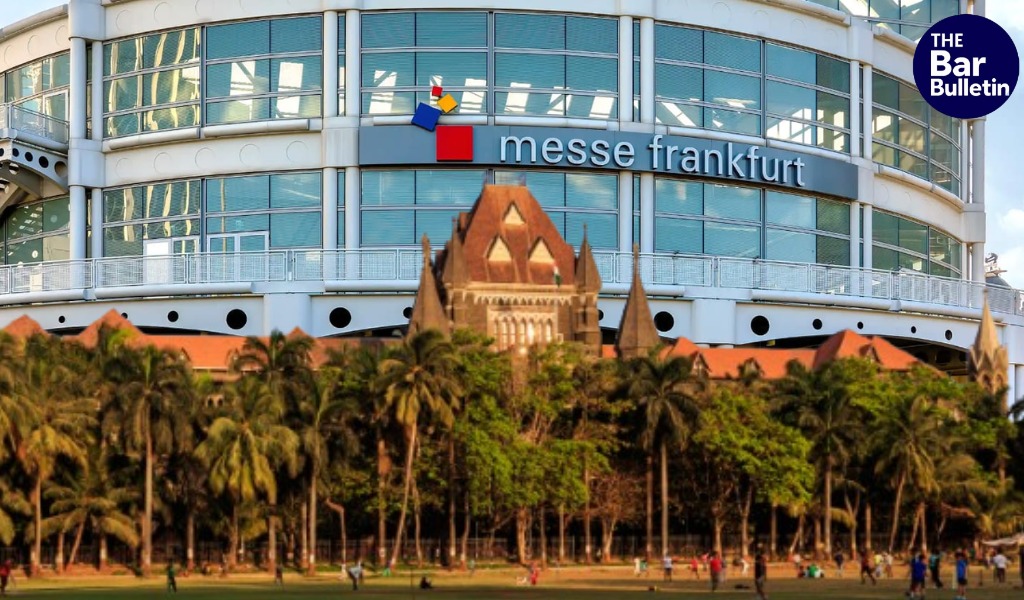
Accordingly, the Court held that Messse Frankfurt Trade Fairs India (Petitioner) had failed to make out a case for the grant of interim measures. Consequently, the Arbitration Petition was dismissed, while clarifying that its observations were prima facie in nature and would not influence the final decision of the arbitral tribunal.
A Single Judge Bench of Justice Sandeep V. Marne considered the delay in filing petition and noted that the Petitioner had knowledge of the impugned exhibitions and Respondent No. 2’s alleged involvement as early as January 2025 but filed the petition only on 8 December 2025. This was considered a substantial delay, and the Bench found that the Petitioner created a “false urgency” by relying on a recent investigator’s report.
As far as suppression of material facts are concerned, the Bench found that the Petitioner had suppressed a vital email dated 28 March 2024, where the Petitioner had rejected Respondent No. 3’s request to employ Respondent No. 2 and expressed willingness to “take the hit” of losing business. The Bench held that non-disclosure of this email, which negated the possibility of ill-intention on the part of Respondent Nos. 1 and 3, disentitled the Petitioner from seeking any equitable relief.
As regards reliability of the IIRIS Report is concerned, the Bench observed that the report itself contained several caveats, such as not naming sources, being an abridged version, and not guaranteeing absolute accuracy. Thus, it was too dangerous to rely upon such speculative report for making a prima facie determination.
As far as association of Respondents with the Impugned Exhibitions is concerned, the Petitioner failed to prima facie prove that Respondent Nos. 1 and 3 were associated with the impugned exhibitions. The Bench found the circumstantial evidence, such as Respondent No. 2 retaining a cabin in Respondent No. 1’s office and his presence at another industry event, to be insufficient to infer collusion, and dismissed the allegations as ‘mere surmises’.
Further, on the applicability of Non-Compete Clause to Respondent No. 2, the Bench held that Respondent No. 2 was prima facie not bound by the non-compete covenant as he was not a signatory to the Asset Purchase Agreement (APA) or the amended APA. Citing Section 27 of the Indian Contract Act, the Bench distinguished between restrictive covenants operative ‘during’ employment and those ‘after’ termination. The Bench added that a post-employment restriction is a restraint of trade and void. An employer cannot bind an employee to a non-compete obligation with a third-party post-employment, especially when the employee received no consideration for it.
Lastly, as regards interim measures against third parties, the Bench observed that the impugned exhibitions were organized by Respondent No. 6, a non-signatory to the arbitration agreement. While the power under Section 9 can be used to grant interim relief against a third party, it must be exercised sparingly. The Bench held that this was not a case of preserving the subject matter of arbitration in the hands of a third party; rather, it was a direct attempt to seek an injunction against a third party’s property, which is impermissible.
Briefly, the dispute arises from an Asset Purchase Agreement (APA) dated 24 September 2018, and an amended APA, through which the Petitioner, a subsidiary of a German event organizing company, purchased the intellectual property, goodwill, and other assets of three exhibition shows from Respondent No. 1, Netlink Solutions India Limited, for a consideration of Rs. 15.24 Crores. The Respondent No. 3 is the founder director of Respondent No. 1.
The agreements contained a ‘non-compete and non-solicit’ clause, which restricted Respondent Nos. 1 and 3 from engaging in any similar or competing business for five years after their exit, which occurred in 2024. The amended APA also named Respondent No. 2, Mr. Rakesh Desai, an ex-representative of Respondent No. 1, in the non-compete clause.
The Petitioner alleged that Respondent Nos. 1, 2, and 3, in concert with Respondent Nos. 4 to 6, were organizing competing exhibitions titled ‘Indian Gifts & Premium Show’ and ‘PPS Expo-Pen, Paper & Stationery Show’, scheduled for January 2026. This was claimed to be a breach of the non-compete covenants. The Petitioner sought an injunction to restrain the holding of these exhibitions and a deposit of Rs. 2.50 crores towards damages and losses, based on a report from a private investigator, IIRIS Consulting Services Pvt Ltd.
Appearances:
Senior Advocates Navroz Seervai and Sharan Jagtiani, along with Advocates Pradeep Bakhru, Piyush Kranti and Aishwarya Patwa, for the Petitioner
Senior Advocate Ashish Kamat, along with Advocates Shrey Fatterpekar, Bankim Gangar, Shanay Shah, Drasti Jani, Vishal Kanade, Pranav Nair, Omkar Khanvilkar, Rashmin Khandekar, Kartik Gantha, and Rishabh Shah, for the Respondent
