


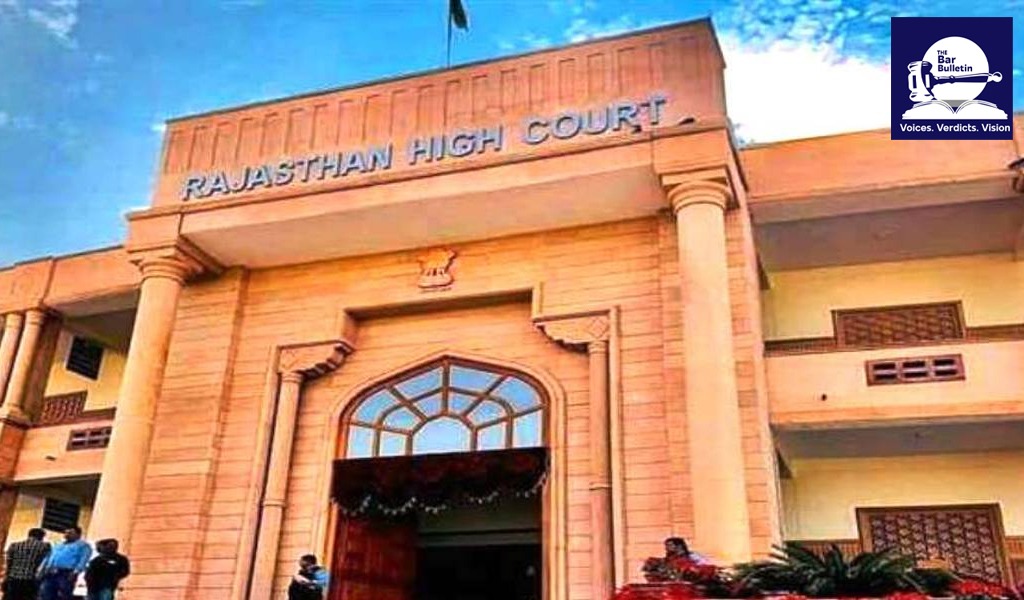

After the Rajasthan High Court was directed to decide the present petition expeditiously by the Supreme Court vide order dated 03-03-2025, a Single Judge Bench of Justice Anoop Kumar Dhand declined to quash the First Information Report (FIR) against the petitioner and held that the practice of advocates or their clerks in filing an affidavit/petition/application with their own signatures could not be appreciated and must be deprecated.
By the present petition, a prayer was made to quash a First Information Report (FIR) for offences under Sections 420, 467, 468, 471, and 120-B of the Indian Penal Code, 1860. The petitioner submitted that the respondent filed a suit for partition before the Court of the Additional District Judge, Kota, and that since the proceedings were extremely slow-paced, the petitioner filed a petition seeking a direction for expeditious disposal of the same. However, it was pointed out that neither the cause title nor the signatures were matching with the civil suit or the respective party’s name.
It was submitted that an advocate, who received the required papers from the petitioner’s local counsel, filed the petition mentioned above and that the advocate’s clerk had put his own signature under the name of the petitioner, after which the file was listed and the petition was disposed of by this Court on 27-02-2024, directing the trial court to dispose of the pending civil suit expeditiously.
Thereafter, the counsel of the complainant-respondent realized the mistake, and the petitioner submitted an application with original signatures for clarification of the situation, but the office again pointed out a mismatch of the cause title. Thereafter, a peremptory order was passed to remove the defects in the petitioner’s absence, which could not be complied with, and the case was dismissed.
The complainant submitted an application under Section 340 of the Criminal Procedure Code, 1973, to initiate proceedings against the petitioner, but later withdrew it. The petitioner submitted that he had never affixed his signature to any document under the name of the other side and that he had filed a complaint against his local counsel before the Bar Association, Kota, as well as the Rajasthan Bar Council for committing such a nuisance.
Subsequently, the trial court rejected the civil suit, and the petitioner submitted that an FIR had been lodged against him only to pressure him into settling the dispute. However, the respondent submitted that the petitioner had forged the respondent’s signature, obtained a wrong order, and used it before the trial court for his personal gain.
The Court noted that when the matter was listed before this Court, the proceedings arising out of the impugned FIR were stayed and the Registrar (Judicial) was directed to hold an enquiry. Upon said enquiry, statements of the witnesses were recorded, and the Registrar concluded that the mistake took place because of the advocate who filed the petition, the local counsel, the advocate clerk, as well as the oath commissioners.
Further, it was noted that the name of the complainant had been incorrectly incorporated as the petitioner in the cause title of the petition, seeking direction for expeditious disposal of the suit. The Court said that the fact that mischief had been committed with the Court’s record could not be ignored and that such practice of filing a petition with incorrect signatures of a party was not appreciable on the part of the litigant, lawyers, or their clerks.
The Court stated that there has been a growing trend of advocates’ clerks or advocates signing affidavits imperviously and oblivious to the contents. It was said that the advocate-client relationship is accepted as a fiduciary relationship and that the communication is privileged, which is why neither the brief of a case nor the permission to represent a party is to be shared by the advocate with his clerk.
The Court held that nothing entitles or enables an advocate’s clerk to appear before the Court on behalf of an advocate, and similarly, a clerk cannot swear affidavits for petitions/applications on behalf of a party before the court. It was said that fraud played on this Court by an advocate or even by an advocate’s clerk is a severe form of contemptuous attitude.
The Court stated that if the advocate or the clerk has no personal knowledge of a particular document produced by a party, it must be appropriately verified before being brought on record, and the party may also be asked to swear an affidavit. Further, the Court stated that it could not adjudicate on the correctness of the allegations levelled in the FIR and that they must be investigated.
The Court was not inclined to quash the FIR, as it could not allow anyone to commit mischief with the court records. Thus, the Court disposed of the present petition and directed the Investigating Officer (IO) to investigate the matter in accordance with the judicial enquiry conducted by the Registrar. Further, the Court directed that if the IO concludes that a cognizable offence is made out against anyone, then a notice under Section 35 of the Bharatiya Nyaya Sanhita, 2023 would be given to such person before further proceedings. It was said that if the IO finds that the order dated 27-02-2024 had not caused any prejudice to anyone, then the matter may be concluded accordingly.
Thus, the Court disposed of the petition and cautioned that lawyers and clerks were expected not to make such a blunder in the future in the interest of the litigant and the judicial administration system. Lastly, the matter was directed to be placed before the Chief Justice, with a notice to be issued with reference to the present case for cautioning the advocates’ clerks.
Appearances:
For Petitioner – Ms. Harshita Sharma, Mr. Vivek Yadav, Mr. Tushar Sharma, Ms. Swadha Bhargav, Dr. Mahesh Sharma
For Respondents – Mr. Amit Gupta, Mr. Anil Kumar Sharma
