


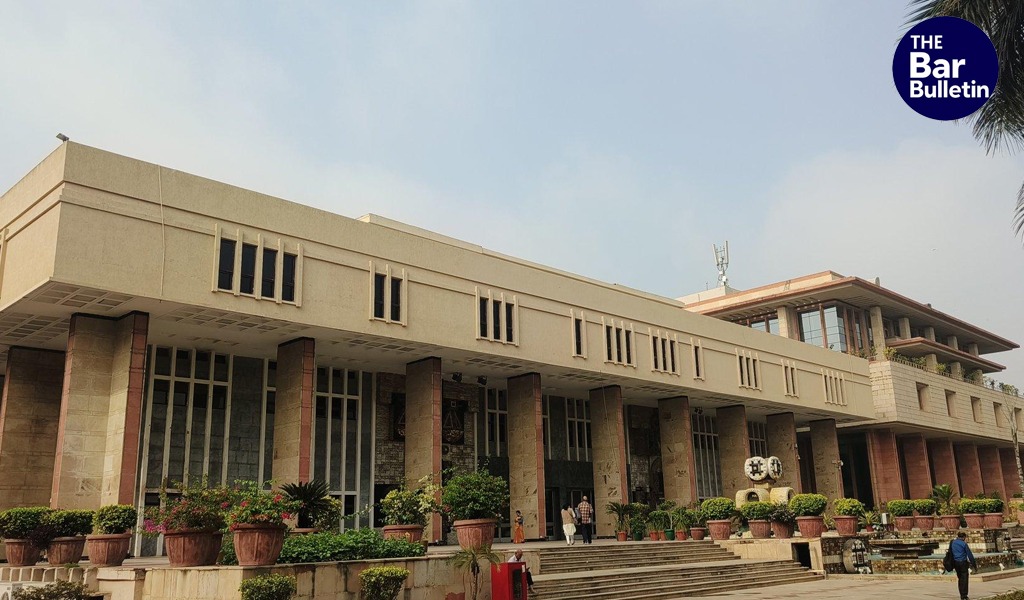

The Delhi High Court has held that the expression ‘public servant’ under Rule 11(2) of the Export Inspection Agency Employees (Classification, Control and Appeal) Rules, 1978 (EIA), is wide enough to include a retired public servant, particularly when they are remunerated for performing a public duty, as there is no specific language in the rule excluding them.
The Court explained that the requirement under Rule 11(4) of the EIA Rules for an employee “to be heard in person” pertains to the stage of the inquiry itself before the Inquiring Authority, and does not create a right to a separate personal hearing before the Disciplinary Authority after the submission of the inquiry report.
In a disciplinary proceeding where the Disciplinary Authority agrees with the findings of the Inquiring Authority, the Court explained that the principles of natural justice and procedural fairness are met by providing the delinquent employee with a copy of the inquiry report and an opportunity to submit a written representation against it before a final order of punishment is passed.
The Court, therefore, concluded held that there was no illegality in the appointment of the retired public servant as the Inquiring Authority and no violation of Rule 11(4) of the EIA Rules. The disciplinary proceedings were conducted in accordance with the rules.
The Division Bench comprising the Chief Justice Devendra Kumar Upadhyaya and Justice Tejas Karia analysed Rule 11(2) of the EIA Rules, which allows the appointment of a “public servant” to inquire into charges. It compared this with similarly worded rules under the CCS (CCA) Rules and Railway Servants Rules, and observed that an exclusion of a class of persons (like retired officers) must be explicitly stated in the rule or follow by necessary implication, which is not the case in Rule 11(2) of the EIA Rules.
The Bench referred to Section 21 of the Indian Penal Code, 1860, which defines “public servant” to include any person remunerated by fees for the performance of any public duty. Since the retired officer appointed as Inquiring Authority was remunerated, he would fall under this definition. Therefore, the Bench explained that the expression “public servant” in Rule 11(2) of the EIA Rules includes a retired public servant, and the appointment was not illegal.
The Bench observed that the Single Judge had misread and misapplied Rule 11(4). This rule requires the Disciplinary Authority, upon serving the charge sheet, to ask the employee to submit a written defence and state “whether he desires to be heard in person”. The Bench clarified that this provision applies at the initial stage of the proceedings, and the “opportunity to be heard in person” refers to the hearing during the inquiry before the Inquiring Authority, not a separate personal hearing before the Disciplinary Authority after the inquiry report is submitted.
The Bench noted that the procedure post-submission of the inquiry report is governed by Rule 11(23) and Rule 12. The only requirement, if the Disciplinary Authority agrees with the Inquiring Authority’s findings, is to provide a copy of the report to the employee for a written representation. Since the petitioner was provided with the inquiry report and submitted a representation against it, the Bench pointed out that the procedure was duly followed, and there was no violation of Rule 11(4) or the principles of natural justice.
Lastly, the Bench rejected the petitioner’s argument that the findings were based on no evidence. It observed that both the Inquiring and Disciplinary Authorities had elaborately considered the evidence on record before concluding that the charges were proven. The Bench reiterated the settled legal principle that judicial review does not extend to re-appreciating the adequacy or reliability of evidence unless the findings are perverse, which was not the case here.
Briefly, the petitioner, a Technical Officer with the Export Inspection Council (the respondent), underwent a disciplinary proceeding, which culminated in a charge sheet containing three articles of charge. The first article was disobedience of an order to proceed on tour to the Sub-Office in Kanpur, which was considered a violation of Rule 3(1)(ii)(iii) of the Central Civil Services (Conduct) Rules, 1964. The second article was wilful disobedience for submitting a vague tour programme and not proceeding to Kanpur despite instructions, also amounting to a violation of Rule 3(1)(ii)(iii) of the CCS (Conduct) Rules, 1964. The third article relates to use of impolite, indecent, derogatory, and irresponsible language against superior officers in letters, constituting a violation of Rule 3(1)(ii)(iii) of the CCS (Conduct) Rules, 1964.
The petitioner initially challenged the charge sheet in a writ petition, which was later withdrawn. One Inder Singh, a retired Deputy Secretary, was appointed as the Inquiring Authority. The petitioner objected to this appointment, arguing that a retired official is not a “public servant” under Rule 11(2) of the Export Inspection Agency Employees (Classification, Control and Appeal) Rules, 1978. The objection was however rejected, and the Inquiring Authority submitted a report, which was served to the petitioner for his comments.
After considering the petitioner’s representation, the Disciplinary Authority passed a punishment order, inflicting the penalty of reduction in rank from Technical Officer to Junior Scientific Assistant. The petitioner’s statutory appeal was also dismissed by the appellate authority.
When the petitioner challenged these orders in a petition, the Single Judge found that the appointment of a retired officer as the Inquiring Authority violated Rule 11(2) of the EIA Rules. However, no de facto prejudice or bias was established against the petitioner due to this appointment. There was a violation of Rule 11(4) of the EIA Rules because the petitioner was not granted a personal hearing before the Disciplinary Authority despite requesting one. Consequently, the Single Judge quashed the punishment and appellate orders and remitted the matter to the Disciplinary Authority to provide a personal hearing.
Appearances:
Appellant in person
CGSC Sandeeep Mahapatra and Radhika Bishwajit Dubey, along with Advocates L.R. Khatana, Mrinmayee Sahu Tribhuvan, Gurleen Kaur Waraich, Kritarth Upadhyay, Saksham Sharma, and Mathy V Kutty, for the Respondent
