


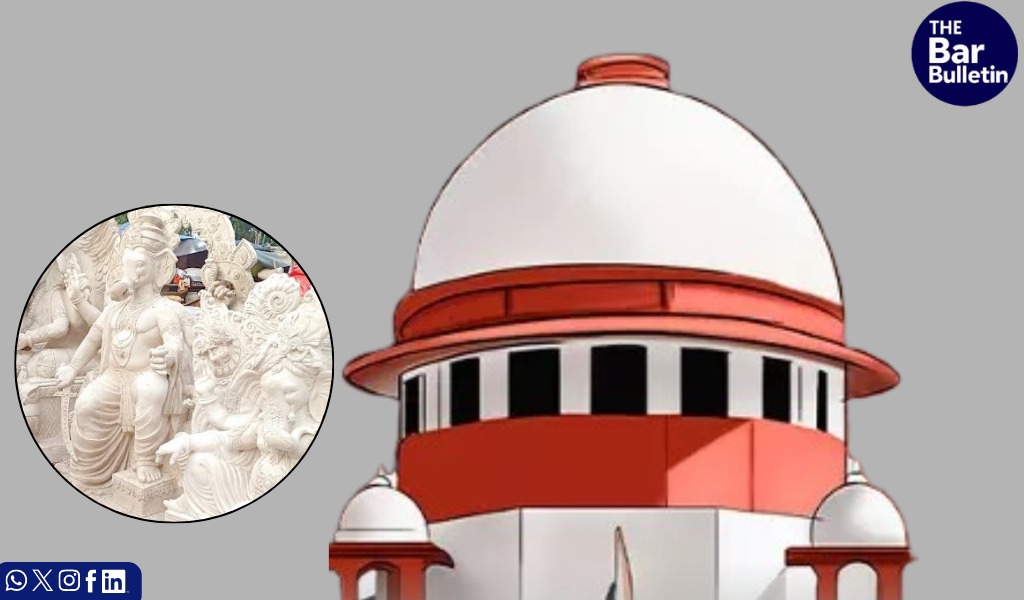

The Supreme Court declined to entertain a plea challenging the ‘dilution’ of Central Pollution Control Board (CPCB) guidelines on idol immersion, observing that the issue was already pending consideration before the Bombay High Court.
The petitioner argued that the 2020 CPCB guidelines, which restrict the use of Plaster of Paris (POP) idols, have been repeatedly upheld by multiple benches, including three benches of the Supreme Court, and therefore cannot be treated as merely advisory.
“These 2020 guidelines have been tested by 13 different benches, including three benches of this Court, and have been held to be binding,” counsel for the petitioner submitted.
According to the petitioner, the Bombay High Court had observed that the guidelines were advisory in nature, which allowed the Maharashtra government to introduce fresh immersion guidelines permitting POP idols until 2026. The petitioner sought liberty to challenge this “dilution” of the CPCB’s 2020 framework.
Opposing the plea, the State of Maharashtra argued that the matter was already under examination by the High Court and the dispute essentially involved two aspects: the validity of the CPCB guidelines and the state’s immersion policy.
The Bench of Chief Justice Surya Kant and Justice Joymalya Bagchi noted that the High Court was already seized of the matter and it would be appropriate for the petitioner to pursue his arguments there.
“We are informed that the CPCB guidelines of 2020 are under challenge before the High Court and the matter is serious. That being so, we dispose of this special petition with liberty to the petitioner to assist the High Court in those proceedings,” the Court observed.
The Court clarified that all issues, including whether the CPCB guidelines are advisory or binding and whether their dilution by the state policy is permissible, can be raised before the High Court.
Accordingly, the Supreme Court disposed of the special petition, granting liberty to the petitioner to amend his pleadings and raise all relevant challenges before the Bombay High Court, which is already considering the issue.