


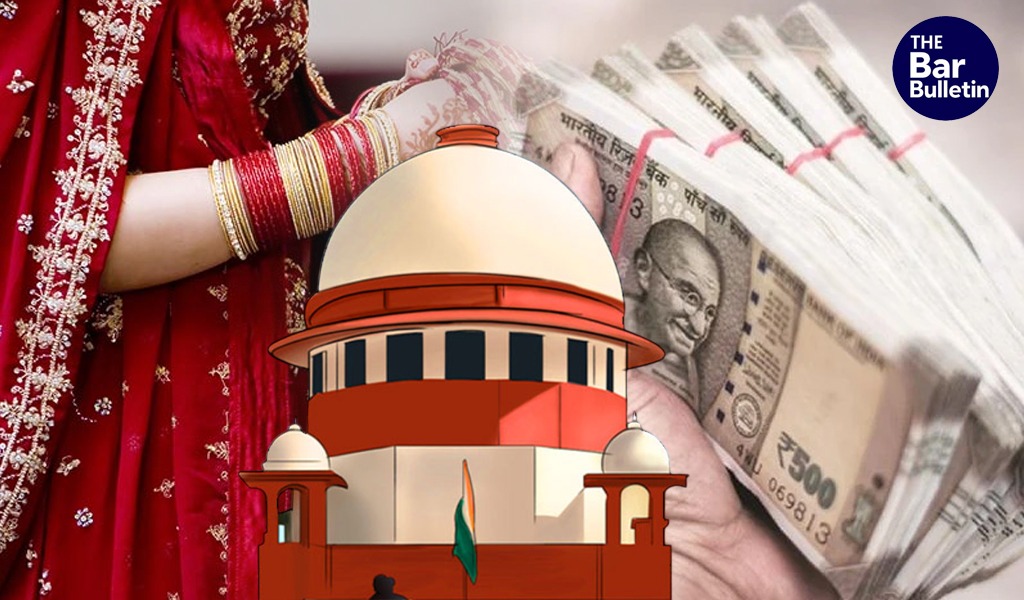

In a batch of appeals filed before the Supreme Court against a judgment of the Allahabad High Court whereby the respondents were acquitted, and the judgment of conviction dated 07-10-2003 by the Additional Sessions Judge, Bijnor, was set aside, a Bench of Justice Sanjay Karol and Justice Nongmeikapam Kotiswar Singh set aside the impugned judgment while restoring the conviction done by the Trial Court and issued directions as part of resolution for the judicial tension in dowry laws.
In the present matter, the respondent and his family repeatedly demanded a coloured television, a motorcycle, and Rs. 15000/- from the deceased and her father, only after a year of the respondent’s marriage to the deceased. When the respondent was informed of the inability of the deceased’s family to comply with the demand, all accused persons before the Trial Court allegedly assaulted the deceased and threatened to kill her upon failure to fulfil their demands.
Scared by such threats, the deceased called for help, but by the time a few people reached, the accused persons had poured kerosene on the deceased and set her on fire. A First Information Report (FIR) was lodged regarding the incident, and once the investigation was complete, a challan was presented for trial.
8 witnesses were examined by the prosecution before the Trial Court, and the defense led no evidence other than depositions in statements under Section 313 of the Code of Criminal Procedure, 1973. The father of the deceased testified to the fact that the deceased had consistently mentioned the demand for dowry since she got married. Among the accused, the Trial Court found only the husband, along with his mother, guilty of the offences and convicted them accordingly.
The two convicts assailed the judgment of the Trial Court, and the High Court acquitted both the accused while observing that the evidence led by some of the witnesses could not be relied upon. Aggrieved, the State filed the present appeal.
The Court referred to various provisions as well as judgments and examined the scope of the Court’s power under Article 136 of the Constitution of India in criminal matters. It was stated that, in the present matter, since the lower courts had arrived at opposite findings, the evidence on record must be analysed to decide the same.
The Court noted that the defense had led no evidence. The father’s evidence was also perused, wherein it was said that the demand for dowry had been consistent and that he had already informed her daughter’s in-laws that providing said dowry would be beyond his financial capabilities. The Court noted that the deceased had informed her father that she had been warned of the consequences of non-fulfilment of their demand.
The Court then took note of the evidence led by the maternal uncle of the deceased, who, along with another, saw some of the accused persons, including the husband, fleeing from the spot. It was also noted that he had not actually seen them setting the deceased ablaze.
Further, the Court noted a few inconsistencies in the evidence led by the deceased’s mother, who stated that there was no demand at the time of the marriage, whereas, according to the father, he had given dowry even then. It was noted that the mother also stated that her daughter lived happily in her matrimonial home.
The Court stated that the demand for dowry was established beyond doubt and that it could also not be disputed that the said demand was reiterated just a day before the deceased’s death. It was said that the expression ‘soon before her death’ as explained in Ashok Kumar v. State of Haryana (2010) 12 SCC 350, was met in the present case, and all essentials as noted in Pawan Kumar v. State of Haryana (1998) 3 SCC 309, were satisfied. It was further stated that the presumption under Section 113-B of the Indian Evidence Act, 1872 came into effect as soon as it was proved that the deceased had been subjected to cruelty before her death.
The Court said that the disregard of the evidence led by the maternal uncle of the deceased by the High Court was not justified, as he had not testified to the fact that he was an eyewitness, but only that he had seen the accused persons fleeing. The Court said that it would be unfair and unjust to cast doubt on the testimony of the maternal uncle only based on conjectures and surmises.
The Court said that the High Court was misdirected by the use of the word ‘happily’ in the testimony of the father and that the use of one word does not colour the entire evidence, as the sum of the evidence has to be understood. Regarding the mother’s statement, the Court stated that there was nothing else that could lend credence to the statement and that the mother had also testified to the demand of dowry.
Further, the Court stated that the High Court’s reasoning in acquitting the convicts was fallacious. It was noted that the High Court recorded that, as per the mother’s statement, there was no demand for dowry before marriage. However, the Court found it difficult to accept this, as the father’s statement regarding the provision of dowry at the time of marriage was unrebutted, and the Dowry Prohibition Act, 1961, does not distinguish between demands made before or after marriage.
The Court observed that, while reversing the findings of the Trial Court, the High Court had failed to assign any reasons for those findings being erroneous/perverse, or illegal. Thus, the Court held that the High Court had erred in setting aside the conviction and allowed the present appeal.
The Court restored the conviction of the husband and his mother by the Trial Court. However, it was noted that the deceased’s mother-in-law was 94 years old, and considering the humanitarian grounds that dictate that imprisoning her may be inhumane, the Court refrained from incarcerating her. The husband was directed to surrender within four weeks for serving the sentence awarded by the Trial Court.
The Court said that it has been noted time and again that the DPA suffers from various difficulties in its implementation. It was stated that the oscillation between ineffectiveness and misuse creates a judicial tension that needs urgent resolution. In view of this, the Court issued the following directions –
• The State and Union Government were directed to consider necessary changes in educational curricula across levels to reinforce the constitutional provision that parties to a marriage are equal.
• Appointment of Dowry Prohibition Officers in States, who must be aware of their responsibilities and given the necessary wherewithal to carry out the duties.
• Periodical training to be given to police officials and judicial officers for them to be able to fully appreciate the social and psychological implications that are present in such cases.
• High Courts were directed to ascertain the number of cases dealing with Section 304-B and 498-A that were pending from the earliest to the latest for expeditious disposal.
• The District Administration, along with the District Legal Services Authority, was directed to involve civil society groups and social activists for conducting workshops/awareness programs at regular intervals to provide relevant information regarding dowry to people who are outside the educational fold.
The matter is now listed after four weeks for the States and High Courts to file affidavits on compliance with the directions issued.
Appearances:
For Appellant(s) – Mr. Abhishek Saket, Mr. Sudeep Kumar, Ms. Amruta Padhi, Ms. Chanchal Sharma, Ms. Manisha, Ms. Rupali
For Respondent(s) – Ms. Sadhna Sandhu, Mr. Shekhar Kumar, Mr. Bhanu Pratap Gupta, Ms. Shikha Sandhu, Ms. Rita Gupta, Mr. Nikhil Kumar Sharma, Mr. Shantanu Krishna
