


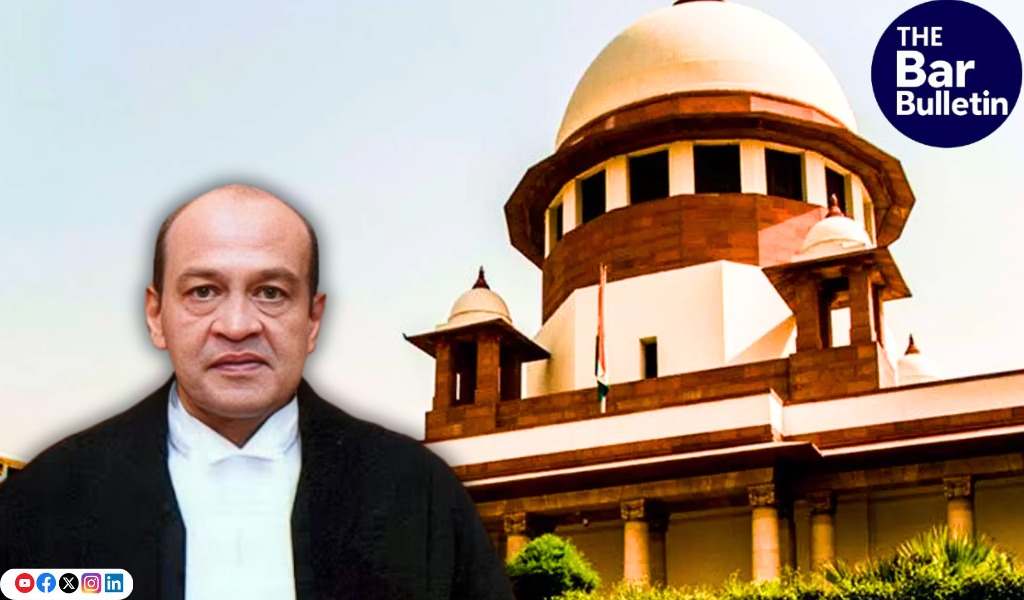

The Supreme Court on Wednesday resumed hearing a writ petition filed by Allahabad High Court Justice Yashwant Varma, seeking to quash the Lok Sabha Speaker’s decision to constitute a three-member inquiry committee under the Judges (Inquiry) Act, 1968, in connection with impeachment proceedings against him.
A Bench comprising Justices Dipankar Datta and Satish Chandra Sharma continued to hear extensive submissions on the interplay between Article 124(5) of the Constitution, the Judges (Inquiry) Act, and Article 91, which empowers the Deputy Chairman of the Rajya Sabha to discharge the Chairman’s functions in certain situations.
Senior Advocate Sidharth Luthra, appearing for Justice Varma, argued that the constitutional scheme under Article 124 occupies the entire field relating to removal of judges and excludes reliance on Article 91. He submitted that two identically worded motions based on the same allegations had been moved in the two co-equal Houses of Parliament, raising the central question of whether such motions could legally meet different fates. Sr Adv Sidharth Luthra contended that the matter could have awaited the appointment of a new Chairman of the Rajya Sabha, rather than being decided by the Deputy Chairman.
The Bench queried whether, in the absence of express exclusion, Article 91 could be said to be inapplicable. Justice Datta observed that constitutional silence could not automatically imply exclusion, cautioning against an interpretation that would create a functional vacuum.
Senior Advocate Mukul Rohatgi, also appearing for Justice Varma, submitted that Article 91 has “no place” in the scheme for removal of a judge, which he described as special constitutional business, distinct from the ordinary business of the House. He argued that permitting the Deputy Chairman to act would lead to an absurdity and conflict of interest, as the Deputy Chairman remains a member of the House and could even be a signatory to the impeachment motion. In contrast, Rohatgi emphasised, the Chairman of the Rajya Sabha is expected to act as a completely non-partisan, neutral arbiter.
Responding to the Court’s queries, Sr Adv Rohatgi clarified that his case was not that the motion ought necessarily to have been admitted in the Rajya Sabha, but that the Deputy Chairman ought not to have acted at all. Justice Datta questioned whether such a position would paralyse constitutional functioning during vacancies, referring to historical instances of prolonged constitutional interregnums.
Solicitor General Tushar Mehta, appearing for the Union of India and both Houses of Parliament, defended the statutory and constitutional framework. He submitted that the proviso to Section 3(2) of the Judges (Inquiry) Act is intended to prevent the constitution of multiple inquiry committees and to ensure that only one motion and one committee operate at any given time. Admission of a motion, he stressed, is not automatic and requires application of mind by the Speaker or Chairman, a position supported by precedent, including the Justice Dinakaran case.
The Solicitor General argued that the interpretation which furthers inquiry into serious allegations and advances the object of the Act should be preferred. He submitted that judicial review at this stage was unwarranted, particularly in the absence of any allegation of bias against the Speaker, and reiterated that the Judges (Inquiry) Act has been recognised by this Court as having high constitutional efficacy.
The hearing also proceeded against the backdrop of an affidavit filed by the Secretary General of the Lok Sabha, which maintains that the petition is barred by Article 122 of the Constitution, that the Rajya Sabha motion was never admitted by the Deputy Chairman acting under Article 91, and that consequently, the Speaker was fully competent to independently constitute the inquiry committee.
The matter remains pending for further hearing.