


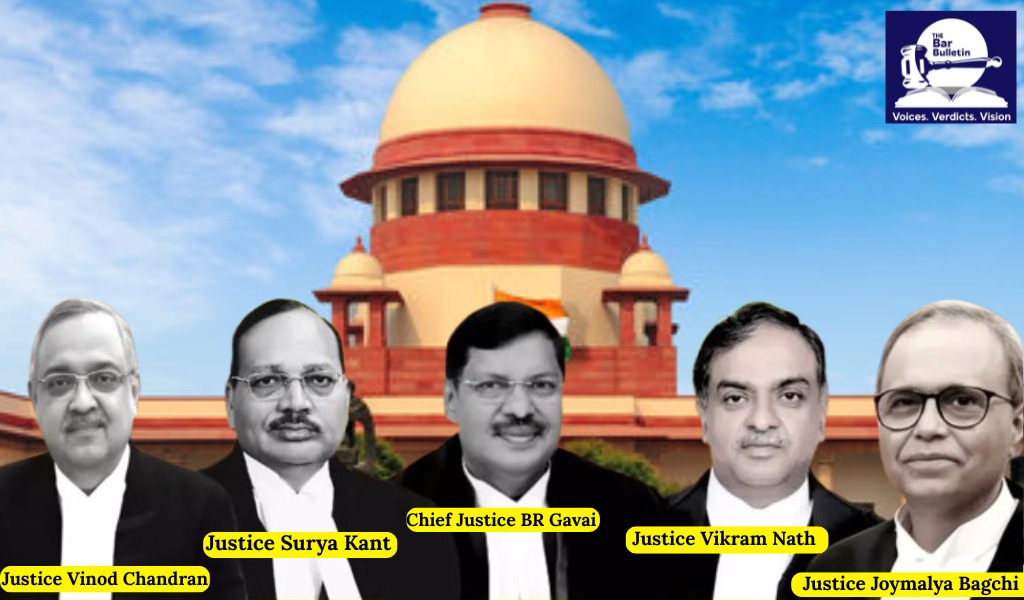

In a major ruling impacting the structure of the Higher Judicial Service (HJS) across all States, the Supreme Court has declined to recognise any quota or preferential classification for Regular Promotee (RP) judges based on their length of service as Civil Judges. A Constitution Bench led by the Chief Justice of India B.R. Gavai held that “heartburn” or perceived disadvantage experienced by RPs does not constitute a valid legal basis to alter seniority rules or create separate promotional channels within HJS.
The Court emphasised that once officers from all three streams: Regular Promotees (RPs), Limited Departmental Competitive Examination (LDCE) candidates, and Direct Recruits (DRs) enter the common cadre of District Judges, they lose their ‘birthmark’ of origin and must be treated uniformly. Seniority, the Court held, must be determined exclusively within the HJS and not based on career history in the lower judiciary.
Rejecting proposals for weightage based on prior Civil Judge service, or for parallel seniority lists, or quotas for higher grade scales, the Court said such measures would “sacrifice merit” and disrupt established principles of service jurisprudence. It reaffirmed that career progression is neither a right nor an entitlement, and that existing accelerated mechanisms including LDCE and eligibility of judicial officers to compete for direct recruitment already provide adequate opportunities.
To ensure uniformity across States and avoid disparities caused by different roster systems, the Court introduced a mandatory annual 4-point roster (2 RPs : 1 LDCE : 1 DR) for determining seniority of all appointees in any recruitment year. It also clarified how delays in recruitment, non-initiation of selection in a given year, or unfilled vacancies should be handled to maintain consistency.
Invoking Article 142, the Bench issued 14 binding directions, requiring all States and High Courts to amend their HJS service rules within three months to implement the framework. They are:
• Perceived discontent or heartburn, without a legal claim or legitimate expectation, cannot justify creating artificial classifications within a common cadre.
• The disparate and inconsistent statistical data does not establish that such discontent among RPs in the HJS is legally justified.
• There is no common or nationwide pattern of disproportionate representation of DRs that undermines the prospects of RPs or LDCE officers in the HJS.
• Data in many States shows natural prevalence or equivalence of RPs in the HJS, consistent with their 75% quota.
• Upon entry into the HJS, officers from all three sources lose the ‘birthmark’ of their origin, and form one unified cadre.
• Fixation of Selection Grade and Super Time Scale depends solely on merit-cum-seniority within the HJS, not on length or quality of service as a Civil Judge.
• Performance or length of service as a Civil Judge cannot be used as an intelligible differentia for classification within the HJS.
• Individual career aspirations cannot dictate seniority rules or the structure of the HJS, which must serve the objective of a strong and independent judiciary.
• Existing accelerated pathways LDCE, DR recruitment and reduced qualifying service already provide sufficient opportunities for advancement from lower rungs.
• Seniority within the HJS shall be determined strictly through an annual 4-point roster in the sequence: 2 RPs, 1 LDCE, 1 DR.
• Officers appointed through a recruitment process completed within the same calendar year of initiation shall receive seniority of that year, provided no other appointments for the subsequent year have been made.
• If recruitment for a given year is not initiated within that year, seniority for the resulting appointees shall correspond to the year in which recruitment concludes and appointment is made.
• Unfilled DR and LDCE posts may be filled by RPs, but only against later RP positions in the roster; the 50:25:25 ratio must still be applied to the entire cadre when computing vacancies.
• All States must amend their statutory HJS rules, in consultation with the High Courts, to prescribe the modalities of the annual roster and to implement these directions.
