


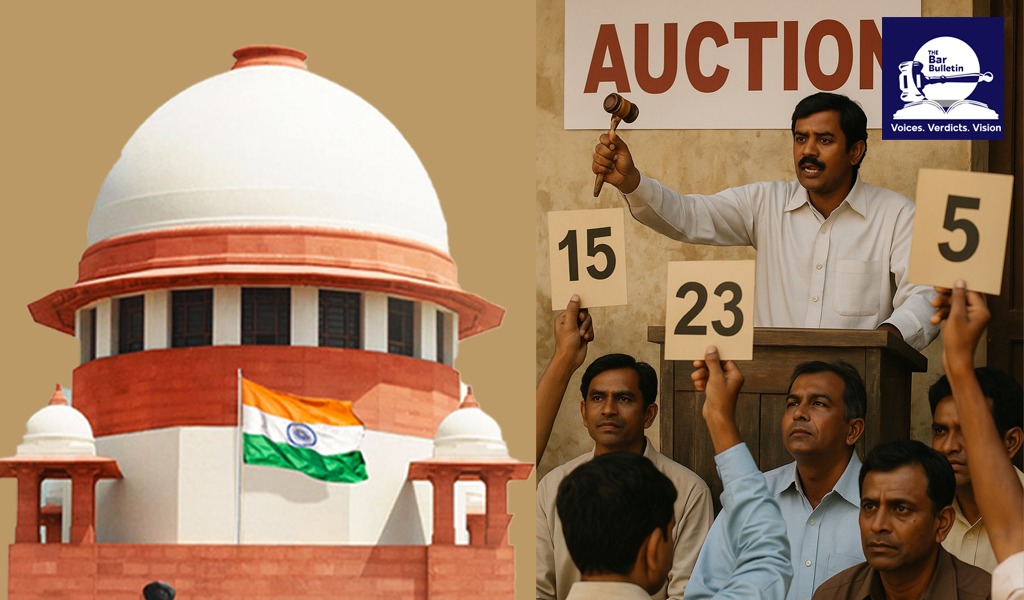

The Supreme Court has set aside a 2009 judgment of the Madras High Court that had invalidated an auction sale of 2002. The Bench of Justice Sanjay Kumar & Justice Alok Aradhe held that judgment debtors who were fully aware of the execution proceedings, and participated in them at various stages, cannot later challenge the sale on grounds they failed to raise before the proclamation was settled.
The Supreme Court also clarified that Order XXI Rule 90(3) CPC acts as a bar to later objections regarding alleged irregularities if the judgment debtor had notice and an opportunity to object before the sale.
The case stemmed from a money decree passed in 1997, where the decree holder secured an ex parte judgment for ₹3.75 lakh with 18% annual interest for a loan taken in 1992. When the judgment debtors failed to satisfy the decree, the decree holder initiated execution against their residential property in Chennai, measuring 2120 sq ft.
Over the next few years, the executing court made multiple attempts to auction the attached property. Each attempt failed due to a lack of bidders, leading to successive reductions of the upset price from ₹16.25 lakh to ₹11 lakh. Significantly, the judgment debtors were issued notice at each stage; they even appeared and filed counterclaims during the initial reduction proceedings before choosing to remain absent in later stages.
Eventually, in September 2002, the property was sold to the auction purchaser (Appellant) for ₹11.03 lakh, and the sale certificate was issued in January 2003. It was only after the sale was completed and the decree holder had received the proceeds that the judgment debtors moved an application under Order XXI Rule 90 CPC, alleging that the upset price was reduced without proper notice and that the entire property need not have been sold.
Both the executing court and the first appellate court rejected these objections, holding that the judgment debtors had participated in earlier stages and deliberately chosen not to contest later reductions. However, the Madras High Court, in 2009, set aside the sale on the ground that the executing court failed to examine whether only a portion of the property could have satisfied the decree in terms of Order XXI Rule 66(2)(a) CPC, relying on Ambati Narasayya vs. M. Subba Rao and another, 1989 Supp (2) SCC 693. Although the High Court acknowledged that Order XXI Rule 90(3) CPC bars judgment debtors from raising objections they could have taken before the sale proclamation, it declined to apply this bar, holding that the executing court itself had erred on that very issue.
This led to the present appeal, where the Supreme Court considered whether Order XXI Rule 90(3) CPC would have an overriding effect barring the judgment debtors from seeking invalidation of the sale when they could have but never raised the ground, that the entire property need not have been sold to satisfy the decree, at a point of time before the last sale proclamation.
The Supreme Court held that the Madras High Court erred in setting aside the 2002 auction sale despite the clear statutory bar under Order XXI Rule 90(3) CPC, which prohibits judgment debtors from raising any ground that could have been taken before the sale proclamation was settled. The Court emphasised that, unlike earlier precedents such as Ambati Narasayya v. M. Subba Rao, 1989 Supp (2) SCC 693 and Takkaseela Pedda Subba Reddi v. Pujari Padmavathamma, (1977) 3 SCC 337, which were decided under the unamended Rule 90, the present case involved an execution sale held after the 1976 amendment introducing sub-rule (3).
Referring to the later and directly applicable ruling in Desh Bandhu Gupta v. N.L. Anand (1994) 1 SCC 131, the Court held that where a judgment debtor had notice of the execution proceedings and the opportunity to raise objections, but chose not to, he is precluded from challenging the sale on those grounds at a later stage. The Supreme Court found that the judgment debtors were repeatedly served, participated in earlier stages of reduction of the upset price, and later voluntarily abstained; therefore, they could not now contend that the executing court failed to consider the sale of only part of the property under Order XXI Rule 66(2)(a) CPC.
The Court also referred to Bhikchand Mutha v. Shamabai Gugale, 2024 INSC 411, for the principle that courts must examine whether the sale of part of the property would suffice, but clarified that this obligation does not override the statutory bar when debtors had notice yet failed to raise such objections in time.
Concluding that the High Court “failed to give effect” to Rule 90(3), the Supreme Court restored the executing court’s and appellate court’s orders and upheld the 2002 auction sale.
Apperances
Appellants- Mr. S. Nagamuthu, Sr. Adv. Mr. R. Ayyam Perumal, AOR Mr. Shreyash Kaushal, Adv. Mr. Umesh Kumar Ranjan, Adv. Ms. Archana Sharma, Adv. Mr. Rao Raj Bahadur Singh, Adv. Mr. A. Sai Kumar, Adv.
Respondents: Mr. Anand Padmanabhan, Sr. Adv. (N/P) Mr. Gururaj C.B., Adv. Ms. Ruchi Arya, Adv. Mr. Arimardhan Sharma, Adv. Mr. Pramod Dayal, AOR Mr. Alok Kumar Pandey, Adv. Mr. Sunil Kumar Sharma, Adv. Ms. Himangi Saikia, Adv.
