


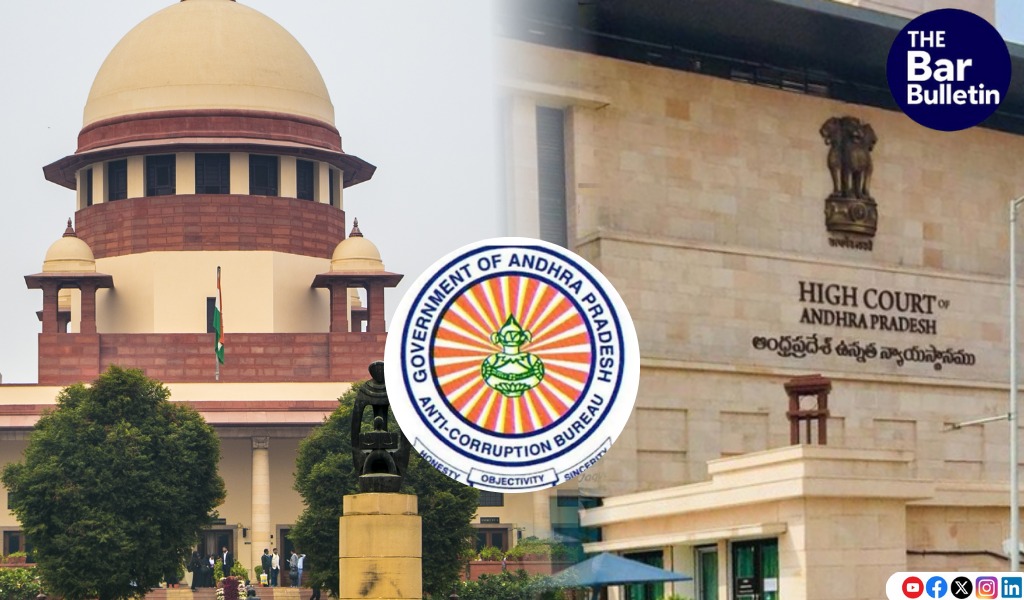
The Supreme Court has set aside the impugned judgment of the Andhra Pradesh High Court which had quashed a batch of FIRs registered by the Anti-Corruption Bureau (ACB), Andhra Pradesh, on the ground that the ACB’s Central Investigation Unit at Vijayawada was not duly notified as a “police station” under Section 2(s) of the Code of Criminal Procedure, 1973. Terming the High Court’s approach as a “travesty of justice”, the Court held that FIRs under the Prevention of Corruption Act, 1988 could not be nullified on such hyper-technical reasoning.
A Bench comprising Justice M.M. Sundresh and Justice Satish Chandra Sharma examined the effect of the Andhra Pradesh Reorganisation Act, 2014, particularly Sections 100 to 102, and reiterated that all laws, notifications, and government orders in force prior to bifurcation continued to operate unless altered, repealed, or amended by a competent authority. The Court held that G.O.Ms. No. 268 dated 12.09.2003, which declared ACB offices as police stations and conferred statewide jurisdiction on the Joint Director, Central Investigation Unit, continued to have the force of law even after the bifurcation of the erstwhile State.
Rejecting the High Court’s insistence on a fresh notification post-reorganisation, the Supreme Court observed that no legal vacuum was created by the formation of the State of Telangana and the residual State of Andhra Pradesh. The relocation of the ACB’s Central Investigation Unit from Hyderabad to Vijayawada did not divest it of jurisdiction, particularly in view of the deeming provisions under the 2014 Act and binding Government Orders and Circulars.
The Court further clarified that G.O.Ms. No. 137 dated 14.09.2022, issued during the pendency of the proceedings, was merely clarificatory in nature and did not involve retrospective application of law. Courts, it held, must adopt a pragmatic and purposive approach while interpreting transitional statutory provisions, especially in matters involving anti-corruption investigations.
Setting aside the impugned judgment, the Supreme Court restored the FIRs and permitted the ACB to proceed with the investigations, while directing that no coercive steps be taken against the accused during the pendency of investigation and granting liberty to them to raise all other permissible grounds after its conclusion. The High Court has been directed not entertain any more challenge to the FIRs or the pending investigation.
Appearances:
For Petitioner(s): Mr. Sidharth Luthra, Sr. Adv. Mr. Siddharth Aggarwal, Sr. Adv. Ms. Prerna Singh, Adv. Mr. Guntur Pramod Kumar, AOR; Ms. Rajni Gupta, Adv.; Mr. Vishwajeet Singh, Adv.; Mr. Karl P Rustomkhan, Adv.; Mr. Parv Arora, Adv.
For the Respondent(s): Mr. Veerla Satheesh Kumar, Adv.; Mr. V Elangovan, Adv.; Ms. Anu Gupta, AOR
Mr. Sriram P., AOR; Mr. Bhushan Mahendra Oza, AOR; Ms. Nidhi Mittal, AOR
Mr. Suresh Babu, Adv. Mr. Navin Suresh, Adv. Mr. C. K. Sasi, AOR; Dr. Kk Geetha, Adv.; Ms. Meena K Poulose, Adv.; Mr. Suresh Babu, Adv.
Mr. Navin Suresh, Adv.; Mr. C. K. Sasi, AOR; Dr. Kk Geetha, Adv.; Ms. Meena K Poulose, Adv.
