


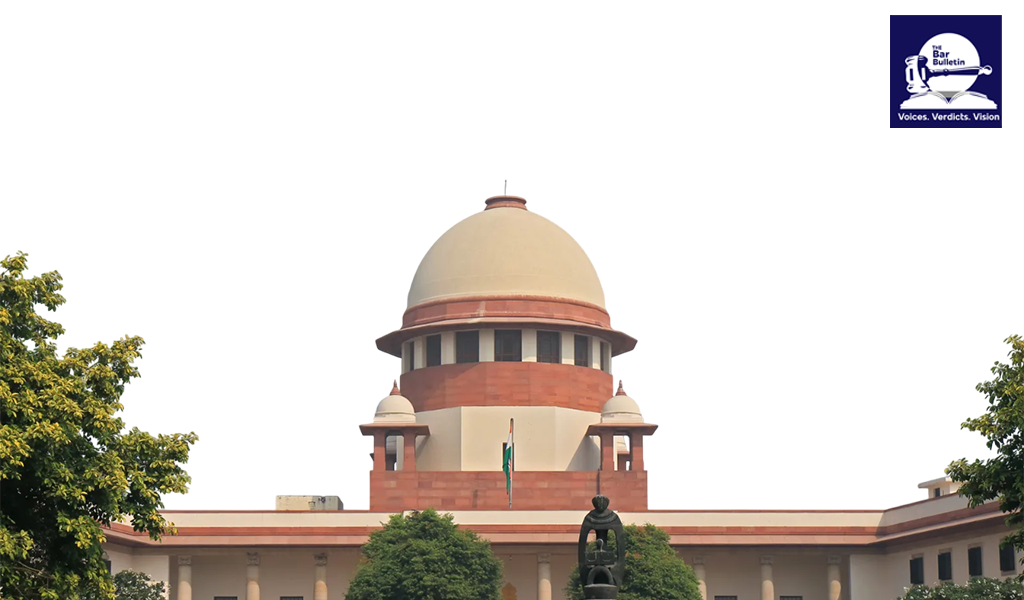

The Supreme Court has dismissed the Arbitration Petition filed by Balaji Steel Trade seeking constitution of a sole arbitral tribunal in India, holding that the dispute arises exclusively under a Benin-seated arbitration clause contained in the Buyer–Seller Agreement (BSA) executed with Fludor Benin S.A. The Bench of Justice Pamidighantam Sri Narasimha and Justice Atul S. Chandurkar concluded that the petition was fundamentally “misconceived” and legally untenable, since Part I of the Arbitration and Conciliation Act, 1996 does not apply to a foreign-seated arbitration.
Balaji Steel Trade had entered into a 2019 BSA with Fludor Benin S.A. (Respondent), a Benin-incorporated company, for the supply and sale of cottonseed cake. The BSA contained an arbitration clause mandating that arbitration shall take place in Benin, and the Addendum clarified that the contract would be governed by Benin law. Subsequently, the petitioner entered into separate Sales Contracts with Vink Corporations DMCC, Dubai and High Seas Sale Agreements (HSSAs) Tropical Industries International Pvt. Ltd., Delhi), both containing Indian arbitration clauses.
Disputes arose regarding alleged short-supply and performance under the BSA. While Fludor Benin initiated arbitration proceedings before CAMEC–CCIB in Benin, the petitioner resisted and invoked arbitration in India against all three respondents under Section 11(6) read with Section 11(12)(a) of the Arbitration and Conciliation Act, 1996.
The petitioner argued that its later Sales Contracts (with Vink Corporation DMCC) and High Seas Sale Agreements (with Tropical Industries International Pvt. Ltd.) contained Indian-seated arbitration clauses. And they had effectively novated the earlier BSA or created a composite transaction justifying a unified Indian arbitration.
However, the Supreme Court rejected this, calling the BSA the “mother” agreement that governed the long-term commercial relationship, while the later contracts were ancillary, relating only to individual consignments.
On maintainability of the Section 11(6) Petition in International Commercial Arbitration, the Court held that Part I of the Arbitration and Conciliation Act, 1996, including Section 11, applies only to India-seated arbitrations, and since the BSA designates Benin as the juridical seat governed by Benin law, the petition is not maintainable. Referring to the Constitution Bench ruling in the BALCO, vs Kaiser Aluminium Technical Services Inc., (2012) 9 SCC 552, the Court reiterated that Indian courts have no jurisdiction to appoint arbitrators for foreign-seated arbitrations.
On the seat of arbitration, the Court found the BSA “unequivocal”: arbitration would “take place in Benin” and the contract would be governed by Benin law, leaving no ambiguity about the juridical seat. By choosing a foreign seat, the parties had implicitly excluded the operation of Section 11, which applies only when the arbitration is seated in India.
Another decisive factor was litigation history. After Fludor invoked arbitration before CAMEC-CCIB in Benin, the Delhi High Court dismissed Balaji’s anti-arbitration suit on 08 November 2024, holding that the BSA governed the dispute and that Benin was the agreed arbitral seat. The Supreme Court treated these findings as ‘issue estoppel’, preventing the petitioner from reopening identical questions under a Section 11 petition.
By the time the Section 11 petition came up, the Benin arbitral tribunal, constituted under the Benin Arbitration Act, had already delivered a final award on 21 May 2024. The Court said that allowing a parallel arbitration in India over the same subject matter would violate principles of finality, undermine the doctrine of kompetenz–kompetenz and territorial principle that courts of the seat (Benin) exercise supervisory jurisdiction over the arbitration.
The Bench also rejected reliance on the Group of Companies doctrine, noting no evidence of a shared intention to bind non-signatories to the BSA’s arbitration clause merely because all entities belonged to the TGI Group. The Court, referring to Cox & Kings Ltd. v. SAP India (P) Ltd., 2023 SCC OnLine SC 1634, underscored that the group-of-companies doctrine is to be invoked only in exceptional situations, and only when there is clear evidence that all concerned parties intended to bind even a non-signatory to the arbitration agreement.
Holding that Indian courts lack jurisdiction to appoint an arbitrator where parties have chosen a foreign seat, the Supreme Court dismissed the petition.
Appearances
Petitioner-Mr. S. S. Shroff, AOR
Respondent: Mr. Abhijnan Jha, AOR Mr. Pallav Mongia, AOR