


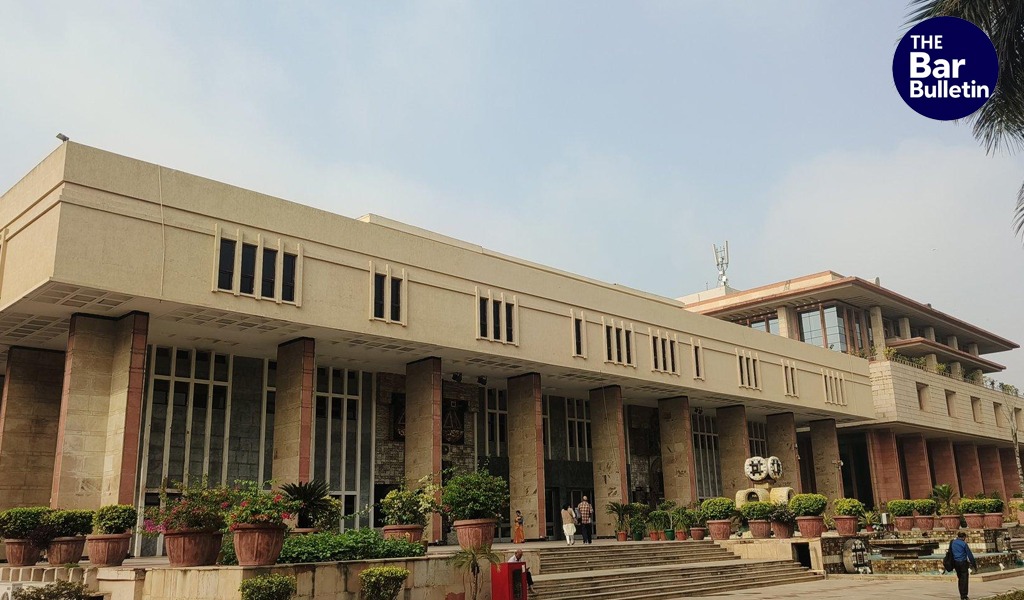

The Delhi High Court has dismissed an appeal filed by the Union of India against the rejection of its challenge to an arbitral award, holding that courts have no power to condone delay beyond the outer limit of 120 days prescribed under Section 34(3) of the Arbitration and Conciliation Act, 1996. Crucially, the Court clarified that the benefit of Section 14 of the Limitation Act, 1963 ceases from the date a party becomes aware of a valid objection to the jurisdiction of the court where proceedings are pending.
The dispute arose from a construction contract awarded by the Union of India for the construction of a Kendriya Vidyalaya school and a boundary wall in Bihar, originally valued at approximately Rs. 8.79 crore. Owing to substantial delays that ultimately extended completion to June 2018, the contractor attributed responsibility to the Union and raised claims for escalation, overheads, and idle resources, thereby increasing the executed contract value to over Rs. 15.36 crore.
Arbitral proceedings culminated in an award dated 22.12.2024, granting the contractor more than Rs. 5.11 crore along with pendente lite interest and costs. The Union of India received intimation of the award via email on 01.01.2025 and later obtained a physical copy on 06.01.2025.
The Union first instituted Section 34 proceedings before the Principal District Judge, Patna, on 26.03.2025. The petition was dismissed on 17.06.2025 for lack of territorial jurisdiction, as Delhi was held to be the juridical seat of arbitration. Thereafter, a fresh Section 34 petition was filed before the Delhi High Court on 23.08.2025, accompanied by a plea for condonation of delay. The learned Single Judge rejected the petition as time-barred, leading to the present appeal under Section 37.
The Division Bench comprising Justice Nitin W. Sambre and Justice Ajay Digpaul examined the computation of limitation under Section 34(3) and the Appellant’s contention that time spent bona fide prosecuting proceedings before the Patna court should be excluded. The Court noted that once an objection to territorial jurisdiction had been raised, the Appellant ought to have acted with due diligence rather than await dismissal of the proceedings.
The Bench observed that Section 14 is meant to protect parties acting with due diligence and good faith, and its benefit “stops running” from the date the jurisdictional defect is brought to the party’s knowledge. Time spent thereafter cannot be excluded for the purpose of limitation.
Relying on Simplex Infrastructures Limited vs Union of India (2019) 2 SCC 455 and other similar judgments interpreting the phrase “but not thereafter”, the Court reiterated that courts lack authority to condone delay even by a single day beyond the aggregate 120-day period prescribed under Section 34(3). Even after excluding the period during which proceedings were pursued before the Patna court, the challenge before the Delhi High Court remained barred by limitation.
Finding no infirmity in the Single Judge’s reasoning or in the statutory scheme governing limitation for Section 34 challenges, the Division Bench held that the appeal lacked merit and dismissed it.
Appearances:
For Appellant: Mr. Piyush Hans, Adv.
For Respondent: Dr. Amit George, Mrs. Manmeet Kaur Sareen, and Mr. Adishwar Suri, Advs.
