


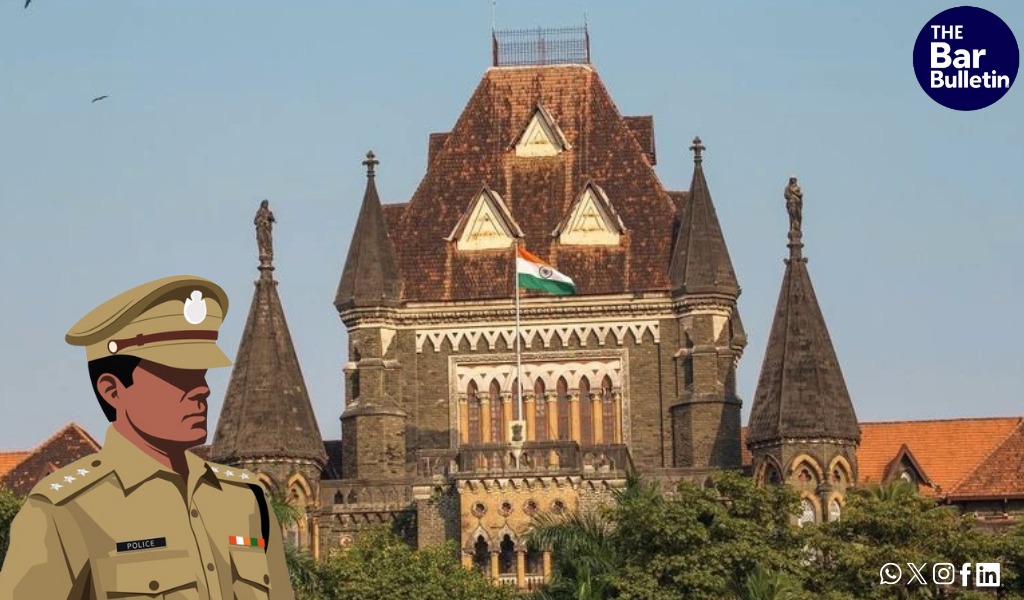

The Bombay High Court (Nagpur Bench) held that prior sanction under Section 197 of the CrPC is a mandatory prerequisite for a court to take cognizance of an offence alleged against a police officer, where the impugned act, even if illegal or in excess of authority, is reasonably connected to the discharge of official duties.
The Court clarified that an assault committed by a police officer on an accused person who is in custody during the course of an investigation is considered an act “purporting to act in the discharge of his official duty”. The fact that the officer exceeded the scope of their authority does not, by itself, remove the statutory requirement of obtaining prior government sanction before initiating prosecution.
Accordingly, the Court held that the initiation of criminal proceedings and the issuance of process against the applicants were illegal due to the lack of prior sanction under Section 197 of the CrPC. The criminal case pending before the Magistrate, along with the order issuing process, was quashed and set aside. However, the Court permitted the complainant to pursue the complaint afresh after taking appropriate steps to seek and obtain the requisite sanction in accordance with the law.
A Single Judge Bench of Justice Urmila Joshi-Phalke extensively analysed legal principles governing the requirement of sanction under Section 197 of the CrPC, relying heavily on the Supreme Court’s judgments in D. Devaraja vs. Owais Sabeer Hussain and G.C. Manjunath vs. Seetaram. The Bench observed that the protection of sanction is imperative to shield police officers from harassing and frivolous proceedings, allowing them to discharge their duties without fear of vindictive retaliation.
The Bench noted that this protection is not absolute and does not apply to acts entirely outside the scope of official duty. The determinative test is whether the alleged act is “reasonably connected” to the discharge of official duty. The Bench also observed that even if a police officer acts in excess of their duty, the protection remains available, provided there is a reasonable nexus between the act and the performance of the official duty.
An act is considered under “colour of duty”, no matter how illegal it may be, if it is connected to the discharge of an official duty like an investigation, added the Bench, while pointing out that in the present case, the alleged assault occurred while the complainant was in police custody as an accused in a criminal case.
The Bench, therefore, found that while the police officers may have acted in excess of their duty, their actions had a reasonable connection to the performance of their official functions. Consequently, the alleged acts, though grave, squarely fall within the ambit of ‘acts done under colour of, or in excess of, such duty or authority’, as envisaged under Section 197 of the CrPC.
Briefly, the case involves an application filed by two police officers, Mahesh Chate (retired) and Vikram Sali (serving), to quash criminal proceedings initiated against them by the non-applicant, Anup Jaiswal. The non-applicant was an accused in a crime registered for obstructing police officers in the discharge of their duties. He alleged that following his arrest on March 25, 2013, he was subjected to police atrocities while in custody, which resulted in severe injuries. Upon being produced before the Magistrate, he complained of the assault, and the Magistrate ordered a medical examination and recorded his statement.
An enquiry was conducted, and based on the complainant’s statement and the medical and enquiry reports, the Magistrate took cognizance and issued process against the applicants for an offence under Section 323 of the IPC. The complainant challenged this order in a revision, and the Additional Sessions Judge, considering the medical evidence which showed a fracture of the 11th rib, directed that process be issued under Section 326 of the IPC.
The applicants then filed the present application to quash these proceedings, arguing that the cognizance was illegal due to the absence of sanction under Section 197 of the CrPC.
Appearances:
Advocate Kartik Shukul, for the Applicant
Advocate J.B. Kasat, for the Complainant
