


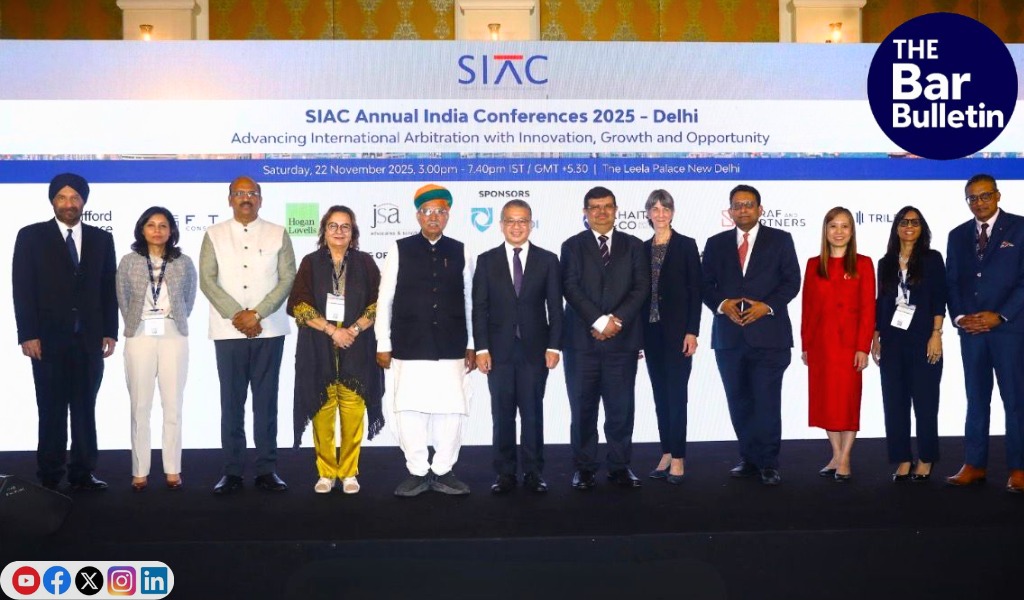

The Singapore International Arbitration Centre (SIAC) organised its Annual India Conferences 2025 in Mumbai and Delhi on November 21 and 22, 2025, respectively. The theme of the Conferences was “Advancing International Arbitration with Innovation, Growth and Opportunity.” The Conferences brought together judicial dignitaries, leading legal practitioners, and industry experts to discuss key issues in international arbitration.
SIAC ANNUAL INDIA CONFERENCES 2025, DAY 1-MUMBAI
The Conference commenced with Opening Remarks by SIAC CEO, Ms. Gloria Lim, who reflected on Mumbai’s entrepreneurial character, and its central role in India’s commercial landscape. She stated that the Annual India Conference provides SIAC with a valuable opportunity not only to engage with the vibrant legal community, but also to reaffirm the deep, longstanding relationship that SIAC shares with India. She expressed SIAC’s appreciation for the trust placed in the institution by Indian users over the years.
The Welcome Address was delivered by SIAC Chairman, Mr Davinder Singh SC. Drawing on his long association with India, Mr Singh SC reflected on the country’s integral role in SIAC’s development over the years. He noted that Indian parties, counsel, and arbitrators have been central to SIAC’s growth, highlighting their depth of expertise and increasing prominence on the global arbitration stage. He reaffirmed that India would continue to remain a key focus of SIAC’s vision and future direction.
This was followed by a Fireside Chat on the theme “The Evolving Landscape of International Arbitration: Perspectives from Policy, Practice, and Business”. The session was moderated by Mr Cyril Shroff, Member of the SIAC Board of Directors and Managing Partner at Cyril Amarchand Mangaldas. The panellists were Minister Edwin Tong SC, Minister for Law and Second Minister for Home Affairs, Singapore; Ms Lucy Reed, President of the SIAC Court of Arbitration and Independent Arbitrator at Arbitration Chambers, New York; and Mr Darius J. Khambata SA, Member of the SIAC Court of Arbitration and Barrister at One Essex Court.
The discussion examined how geopolitical shifts and rapid technological developments, particularly artificial intelligence, are reshaping international arbitration. Minister Edwin Tong SC spoke about changing global investment patterns and the accelerated adoption of technology following the COVID 19 pandemic, observing that AI will fundamentally alter the way lawyers work and how arbitral proceedings are conducted. Ms Reed underscored the importance of stability and predictability in international arbitration, including strong confidentiality safeguards. She traced the evolution of the arbitral framework over several decades, noting that its development has been gradual and cumulative rather than confined to recent years. Mr Khambata SA highlighted the importance of government support, robust ethical frameworks, and strong institutions in establishing credible arbitral seats. He also commented on India’s “Resolve in India” vision, noting that its success would depend on openness, regulatory clarity, and a measured approach to the participation of foreign practitioners.
The first panel discussion, titled “Inside the Boardroom: General Counsel’s Concerns in Cross Border Arbitrations”, was moderated by Mr Ankit Goyal, Partner, Foreign Law Practice, Allen & Gledhill LLP. The panel featured Ms Shreya Jain, Partner, Shardul Amarchand Mangaldas & Co; Mr Sujeet Jain, Chief Legal and Regulatory Officer, Nykaa; Mr Ashish Kabra, Head of the Singapore Office and International Dispute Resolution and Investigations Practice, Nishith Desai Associates; Mr Mohit Saraf, Founder and Managing Partner, Saraf & Partners; and Mr Rajagopal Venkatakrishnan, Senior Vice President (Legal), Reliance Industries Limited.
The discussion focused on how general counsel assess risk, manage cross border disputes, and balance legal strategy with commercial priorities. In response to a “GC reality check” question on when companies opt for arbitration and when they resist it, Mr Venkatakrishnan noted that such decisions are generally guided by the nature of the commercial relationship, considerations of business continuity, and the potential operational impact of commencing arbitration. Mr Jain highlighted the heightened sensitivity of listed companies, noting that while arbitration is confidential, the possibility of related court proceedings entering the public domain remains a key board level concern, particularly in light of regulatory requirements. Mr Saraf observed that boards often evaluate arbitration through a cost benefit lens. While arbitration offers neutrality and subject matter expertise, he noted that delays in enforcement can diminish the practical value of awards. Ms Shreya Jain and Mr Ashish Kabra acknowledged these challenges but reiterated that arbitration, particularly institutional arbitration, remains the most effective mechanism for resolving cross border disputes, noting the predictability of timelines in foreign seated arbitrations.
The panel also discussed drafting of arbitration clauses. The panellists noted that dispute resolution clauses are often finalised late in commercial negotiations, leading to poorly drafted clauses that create complications later. They noted that the choice of an appropriate dispute resolution mechanism often turns on the relative bargaining power of the parties. Common drafting pitfalls highlighted included excessive customisation, the absence of a mandatory reference to arbitration or clear timelines in multi-tier dispute resolution clauses, and the omission of the governing law of the arbitration agreement.
The second panel discussion, titled “High Stakes and New Frontiers: Institutional Arbitration for Resolving Disputes in Private Wealth, Private Equity and Sports”, was moderated by Mr Nish Shetty, Partner, Clifford Chance. The panellists were Mr Shunsuke Domon, Partner, Anderson Mori and Tomotsune; Ms Rinki Ganguli, Managing Director, Brookfield Asset Management; Ms Una Khng, Head of Commercial Disputes, Heimsman LLC, Singapore; Mr Hormuz Mehta, Partner, JSA Advocates and Solicitors; Mr Raj R. Panchmatia, Partner, Khaitan & Co; and Mr Bissheesh Roy, Senior Legal Manager, BCCI.
The discussion examined how institutional arbitration is evolving to address disputes in sectors marked by high value, complexity, and time sensitivity. In the context of private wealth disputes, Mr. Panchmatia noted that the sector is developing rapidly in India, with numerous family offices being established domestically. He observed that family office charters, which serve primarily as constitutional documents, do not always include arbitration clauses, though related agreements, such as shareholder agreements, often do. Mr. Mehta added that private wealth disputes in India would benefit from legislative support. Many disputes remain informal, underscoring the need for legislative intervention to enable arbitration in trust and family matters. Mr. Domon highlighted the advantages of arbitration in private wealth disputes, emphasizing that, in addition to confidentiality, the expertise of arbitrators in handling such matters, particularly in multi-jurisdiction disputes, offers advantages over domestic courts.
Ms. Ganguli observed that in the private equity space, dispute resolution is no longer seen as a purely legal issue but is increasingly integral to fundraising. She noted that while LPs are interested in fund performance, they are also keen to understand whether any issues have arisen and how they were resolved. She noted that private equity disputes often prioritise speed and certainty, with parties favouring institutional rules that provide emergency relief and predictable timelines.
Turning to sports disputes, Mr Roy underscored the need for expedited mechanisms, noting that delays can have immediate consequences for athletes, leagues, and commercial arrangements. Across sectors, the panellists emphasised the importance of well drafted arbitration clauses. Ms Khng highlighted the increasing demand for arbitrators with sector specific expertise, observing that parties now prioritise specialised knowledge over generalist experience.
The Conference concluded with Closing Remarks by Justice Somasekhar Sundaresan, Judge, High Court of Bombay. He observed that the credibility of arbitration depends on reinforcing trust in its system. He emphasised that confidence must be built at every stage of the process, from careful clause drafting to tribunal conduct, in order for arbitration to function as an effective and trusted dispute resolution mechanism.
SIAC ANNUAL INDIA CONFERENCES 2025, DAY 2-DELHI
The Delhi conference opened with remarks by SIAC CEO Ms. Gloria Lim, who reflected on SIAC’s longstanding and valued engagement with India, and expressed her appreciation for the continued trust placed in SIAC by parties, counsel, and corporates. She outlined developments in 2025, including the launch of the SIAC Rules 2025, the expansion of the Secretariat, the introduction of the Restructuring and Insolvency Arbitration Protocol, and the Institute of Ethics in International Arbitration. She concluded by emphasising that India’s engagement with SIAC is not episodic, but a deep and longstanding partnership built on commitment, close ties, and strong networks.
The Welcome Address was delivered by SIAC Chairman, Mr. Davinder Singh SC, who spoke about India’s expanding footprint in international arbitration. He highlighted the increasing confidence with which Indian parties choose neutral, international forums and the significant rise in India-related cases. Praising the strength of Indian advocacy, he remarked that the quality of Indian lawyers in international arbitration is second to none. He concluded by noting that SIAC considers it a privilege and an honour to serve Indian parties, guided by its core values of neutrality, integrity, and efficiency.
Mr. Arjun Ram Meghwal, Minister of State (I/C) for Law and Justice and Minister of State for Parliamentary Affairs, Government of India delivered the special address. He underscored the critical role of a robust and modern ADR ecosystem in supporting India’s economic ascent. He highlighted the government’s ongoing legal reforms, including amendments to the Arbitration and Conciliation Act and the enactment of the Mediation Act—as steps toward further strengthening India’s dispute resolution framework. The Minister stressed the value of deepening collaboration with international partners like Singapore to advance India’s vision of Viksit Bharat.
A notable highlight of the event was the Keynote Address by Minister Edwin Tong, Minister for Law and Second Minister for Home Affairs, Singapore. He noted the significant reforms undertaken by India to modernise its arbitration and dispute-resolution framework. He stated that Asia holds immense potential for international arbitration as a region that is increasingly central to the global legal and economic order. He stressed that unlocking this potential requires close cooperation between Singapore and India at all levels, including governments, practitioners, firms, and the Bar, through the sharing of insights, experiences, and best practices. He underscored that strengthening the arbitration ecosystem in the region is a collective responsibility, particularly in addressing challenges such as enforcement, and highlighted the importance of continued dialogue and engagement through forums such as the conference to build trust and confidence in international dispute resolution. He concluded by reaffirming Singapore’s commitment to deepening its partnership with India and supporting the continued growth of international arbitration.
The first panel was moderated by Vivekananda Neelakantan, Registrar, SIAC, and featured Lucy Reed, President, SIAC Court of Arbitration; Dr. Pinky Anand, Judge, BICC and Senior Advocate; Pallavi Shroff, Managing Partner, Shardul Amarchand Mangaldas & Co; Sanjeev Kapoor, Senior Partner, Khaitan & Co; Ananya Kumar, Partner, JSA Advocates & Solicitors; Nish Shetty, Partner, Clifford Chance; and Heena Singh, Head of Legal, ArcelorMittal India. The discussion centred around the topic, “Testing the Confidence in Arbitration: Are Neutrality, Efficiency, and Enforceability Still Holding Strong?”.
Mr. Neelakantan set the stage by framing the discussion around whether confidence in international arbitration remains robust and well-founded, or whether recent developments have undermined it in certain respects. Ms. Reed noted that confidence in international arbitration remains high, while recognising that the system must continue to evolve. She further emphasised that fairness and well-reasoned decisions are fundamental to sustaining confidence in international arbitration. Ms. Shroff agreed, emphasising that sustained confidence depends on fairness, grounded in neutrality, impartiality, and efficiency both during proceedings and at the enforcement stage. Focusing on the Indian context, Dr. Pinky Anand observed that efficiency is often compromised by a tendency to conduct arbitration like litigation, with excessive procedural formality. Ananya highlighted the continued importance of neutrality in seat selection, particularly in multi-jurisdictional disputes. Mr. Sanjeev observed that Indian users are not a homogenous group. While several Indian parties engage with leading arbitral institutions and experienced arbitrators, smaller enterprises may face practical constraints such as costs, logistical considerations, and limited familiarity with institutional arbitration, which can influence their choice of dispute resolution mechanisms. Mr. Shetty stated that many inefficiencies, such as over-lawyering, excessive formalities, and delayed awards, are often attributable to weak tribunal case management and can be addressed through robust institutional frameworks which provide the procedural tools to arbitrators. Heena concluded by pointing to the SIAC Rules 2025, including emergency arbitration and streamlined procedures, as strengthening the appeal of institutional arbitration.
The second session was moderated by Rob Palmer, Partner, Hogan Lovells, and featured Vijayendra Pratap Singh (Member, SIAC Court of Arbitration; Senior Partner & Head, AZB & Partners), Jafar Alam (Partner, Dispute Resolution, Trilegal), Karthik Balisagar, (Senior Managing Director, Economic and Financial Consulting, FTI Consulting), Shuva Mandal (Partner, Anagram Partners), Raunaq Bahadur Mathur (Partner, Saraf & Partners) and Michele Sonen (Head of APAC, JusMundi). Their discussion was on the topic, “The Future of Arbitration in an AI-Driven World: Threat, Opportunity, or Transformation?”
Michele highlighted a shift from AI as a mere productivity tool to a quality-enhancing collaborator, stressing the importance of arbitration-specific systems trained on awards, enforcement decisions, tribunal rules, and multilingual sources. Jafar noted that AI adoption among Indian lawyers has been rapid and increasingly effective, particularly through assistive technologies. VP Singh described AI as an unavoidable inflection point and stressed that the legal community must prepare for the systemic change it will drive. He emphasised the need for proactive safeguards rather than reactive fixes and suggested that returning to first principles is the best way to shape a coherent approach to AI.
From an expert’s perspective, Karthik observed that although AI is still emerging in expert workflows, its impact is significant in three areas: analytical modelling, data visualisation, and productivity. Shuva emphasised that AI’s real value lies in streamlining routine work and sharpening strategy. He warned against generic AI tools, stressing that only domain-specific systems will deliver meaningful results. Raunaq concluded by noting that while AI is already embedded in active arbitrations, institutional safeguards remain largely aspirational. She identified four key priorities going forward: ensuring equal access, verifying accuracy, clarifying disclosure obligations, and defining ownership of AI-generated output, while underscoring that responsibility for all submissions continues to rest squarely with counsel and parties.
The day concluded with an intellectually charged Oxford-style debate on the motion that “This House Believes That, Absent an Express Choice by the Parties, the Law of the Seat Should Govern the Arbitration Agreement, Rather Than the Law of the Underlying Contract.” The debate was moderated by Mr. Rishabh Malviya (Counsel, SIAC) and Mr. Karan Singh Chandhiok (Partner, Chandhiok & Mahajan). The debate was judged by Hon’ble Justice Tejas Karia (Judge, High Court of Delhi); Mr. Gourab Banerji (Senior Advocate) and Ms. Niti Dixit (Partner, S & R Associates).
Arguing for the motion, Mr. Ritin Rai (Senior Advocate and Tenant, 7KBW) grounded his case in core arbitral principles, contending that in the absence of an express choice, the law of the seat provides the most predictable and commercially sensible default, a position he supported by reference to recent judicial developments, including Enka v. Chubb. Ms. Fereshte D. Sethna (Senior Partner, DMD Advocates) reinforced this view, cautioning that reliance on implied choice or closest-connection tests introduces uncertainty and that a clear default in favour of the law of the seat better serves modern arbitration.
Opposing the motion, Mr. Akhil Sibal (Senior Advocate) argued that the proposition imposes an unduly rigid rule that sidelines party intention. When parties have expressly chosen a governing law for the main contract, he suggested, it is commercially logical to treat that choice as extending to the arbitration clause contained within it. Ms. Emiko Singh (Partner, White & Case) opposed the motion by anchoring her position in effectiveness and party intention. She argued that commercial parties generally view the arbitration clause and the main contract as a single, unified instrument, a point reinforced by global data showing that most contracts specify a governing law but rarely a distinct law for the arbitration agreement. She argued that a waterfall approach—starting with the governing law of the contract and moving to the law of the seat only where necessary—best reflects commercial expectations and avoids inconsistency in hybrid dispute-resolution clauses.
The conference concluded with closing remarks by Shwetha Bidhuri, Director and Head (South Asia), SIAC.