


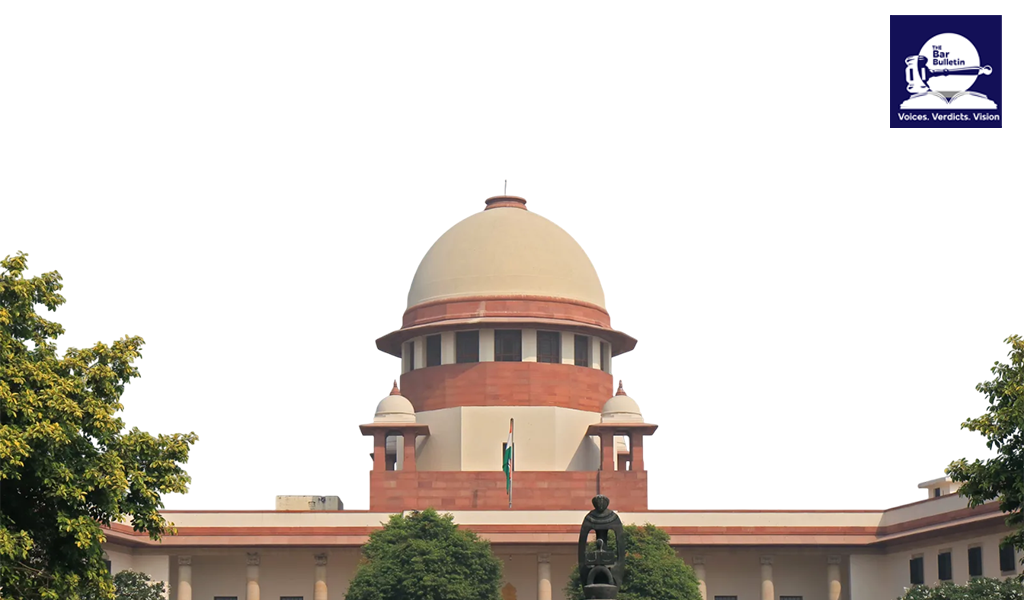

The Supreme Court accepted the MoEF&CC Committee’s operational definition of the Aravali Hills and Ranges, while directing that no new mining leases be issued until a scientifically backed Management Plan for Sustainable Mining (MPSM) is prepared on the lines of the Saranda model. The Bench of CJI B.R. Gavai, Justice K. Vinod Chandran & Justice N.V. Anjaria held that sustainable mining can proceed only after a detailed ecological assessment identifies permitted areas and demarcates inviolate zones.
The Supreme Court was dealing with issues concerning the Aravali Hills and Ranges in Delhi, Haryana, Gujarat and Rajasthan, in two long-running environmental proceedings, namely, M.C. Mehta v. Union of India, WP(C) No.4677 of 1985 and T.N. Godavarman Thirumalpad v. Union of India, WP(C) No.202 of 1995.
The Court directed the Central Empowered Committee (CEC) to inspect mining sites in Haryana and Rajasthan and report whether the operations were occurring inside the Aravali Hills or beyond them, amid conflicting claims by State authorities. After the CEC submitted its report on mining activities in the region, the Court noted that there was still no uniform, scientific definition of the Aravalis, leading to recurring disputes over whether mining sites fell inside or outside the range. This concern resurfaced during the Godavarman hearing on 10 January 2024, when the Bench again questioned the exact location of certain mining operations. To address this persistent ambiguity, the Court, by its order dated May 9, 2024, directed the constitution of a committee to frame a clear and authoritative definition of the Aravali Hills and Ranges.
The Court reviewed the Committee’s recommendations. The Supreme Court noted that although the Committee, assisted by a technical sub-committee, had done ‘commendable work’ in defining the Aravali Hills and identifying conservation and mining zones, the ecological sensitivity of the region required a deeper, geo-referenced examination before permitting any further extraction activities. The Court stated that while it proposed to accept the MoEF&CC Committee’s definition of the Aravali Hills, ecological prudence demanded a more rigorous assessment before expanding mining access. The Court also approved the Committee’s recommendation prohibiting mining in core/inviolate zones, subject to the limited exceptions.
The Bench recalled its recent consideration of mining issues in the Saranda Wildlife Sanctuary, where the Ministry of Environment, Forest & Climate Change (MoEF&CC) had commissioned a scientific study from the Indian Council of Forestry Research and Education (ICFRE). That study had enabled the preparation of a Management Plan for Sustainable Mining (MPSM) in Saranda and Chaibasa, based on detailed ecological mapping.
Drawing a parallel to the Aravalis, the Court observed that the region exhibits “similar ecological fragility” and functions as a crucial “green barrier preventing desertification in the Indo-Gangetic plains, Haryana and western Uttar Pradesh.” The Bench also noted deforestation, illegal and excessive mining, urban encroachment, aquifer depletion, and the eastward drift of desert sands in the range, which collectively ‘undermine not only biodiversity but also water security and climate resilience.’
Taking these concerns into account, the Court directed MoEF&CC to prepare a Management Plan for Sustainable Mining (MPSM) for the entire Aravali range, through ICFRE, modelled on the Saranda plan. No new mining leases are to be granted until the MPSM is finalised. The MPSM must:
- identify areas where mining is permissible or ecologically prohibited,
- assess cumulative environmental impacts and carrying capacity, and
- include detailed post-mining restoration measures.
“We find that it would be appropriate that such a study as was conducted for Saranda… is also conducted for the Aravali Hills and Ranges,” the Bench said, noting that an MPSM would provide geo-referenced ecological data and identify core/inviolate areas as well as zones where sustainable mining could be permitted.
Given the Aravalis’ vast expanse, the ASG submitted that carrying out an MPSM would take a much longer time and would be a herculean task. Still, the Court held that ecological integrity could not be compromised and that before allowing new mining, the same must be preceded by preparation of an MPSM. Existing legal mining, however, would continue to be subject to statutory compliance.
Appearances
Amicus Curiae: Shri K. Parameshwar
For MoEF&CC: ASG Aishwarya Bhati
For Haryana: Sr. Adv. Balbir Singh
For Rajasthan: ASG K.M. Nataraj